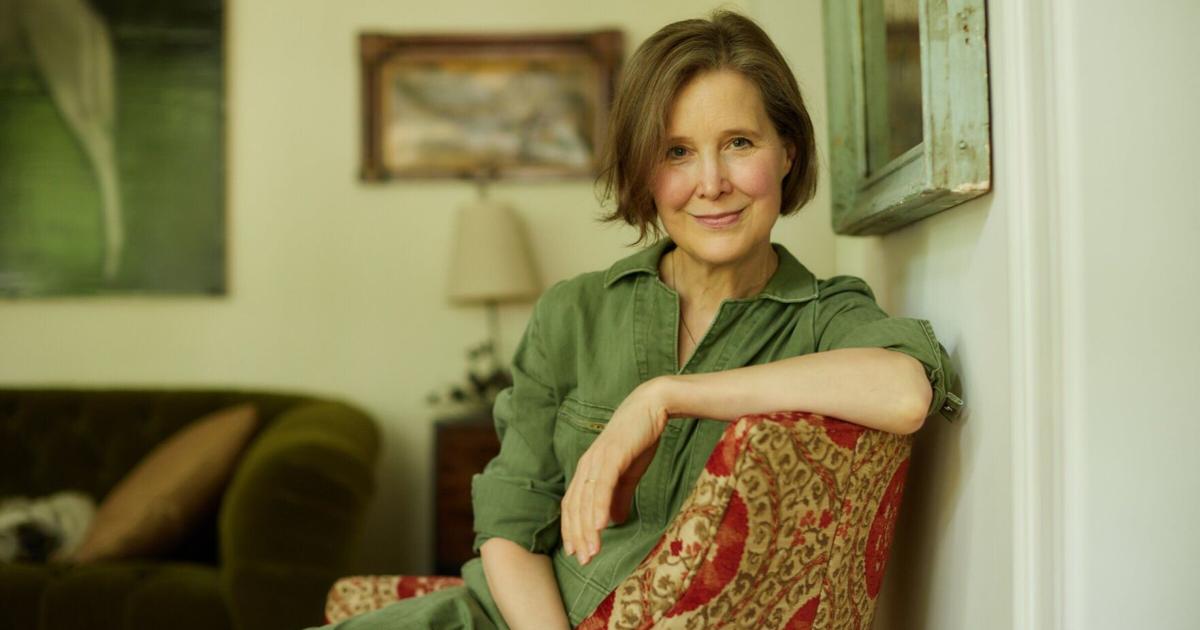
In her latest novel, “Whistler,” Ann Patchett explores the reconnection of a relationship between a middle-aged woman and the stepfather she adored in childhood.
The book (out now from Harper) is the 10th novel by the acclaimed and award-winning author who has written works of fiction, nonfiction and children’s literature, and owns Parnassus Books in Nashville, Tenn.
As “Whistler” begins, Daphne Fuller and her husband Jonathan are touring the Metropolitan Museum of Art in New York when they realize they are being followed by an elderly gentleman. He is Eddie Triplett, to whom Daphne’s mother was briefly married. Their abrupt divorce came shortly after a car accident, which involved both Eddie and then 9-year-old Daphne.
“Whistler” explores the layers of their rekindling friendship, connecting past to present and spanning memory, surprise, grief and joy. With trademark wry humor and utmost tenderness, Patchett explores the choices, secrets and bonds that over a lifetime may bring us together or keep us apart.
“Whistler” came to Patchett like both a gift and an escape hatch. For some time, she had been working on another book that fell apart. Then she wrote about a glowworm cave for The New Yorker, and “there was a little piece in that essay about my friend, Jim Fox, who had died on his 85th birthday. And I suddenly thought, I want to take all the love I had for Jim and all the love Jim had for me and put it in a book.” While “Whistler” is dedicated to Fox, Patchett points out that the book is not about him — “Jim is not Eddie” — but simply inspired by their relationship.
As “Whistler” introduces and develops new characters, the novel navigates the complexities of both biological and chosen family. Daphne has a close relationship with her sister, Leda, a successful therapist with an enviable family life and luxury condo, and a fraught one with her mother, Abigail. Eddie wrestles with his ties to friends Stan and Polly, which prove both anchor and tether. Meanwhile, the murky line that Eddie toes between family and friend allowed him to disappear from Daphne’s life in the past but also to pick up right where they left off in the present.
Readers keep telling Patchett that “Whistler” seems like such a personal book, it must be autobiographical, but she says, “It’s actually not. It’s just emotionally very true to a real person in my life.” Daphne’s character, like Patchett, has three fathers (biological and step) and one sister, but these coincidences were dictated by the needs of the story. While Patchett says she used to alter her novels’ circumstances to differentiate them from her real life, her perspective has changed. “It’s impossible to preemptively control what people are going to think, and it’s also not my job,” she explains. “At this point in my life … all that matters is that I write the best novel that I can write.”
Patchett notes that the ways in which her novels are autobiographical might surprise readers. For example, Eddie, like the author, doesn’t have children of his own, and he demonstrates his ineptitude when he opts to distract young Daphne from a terrible situation by telling her a story that turns horrific. “He bombs,” Patchett says. “He tells her the wrong story for their circumstance and for her age, and … this is exactly the kind of thing I would do. I would tell a story that was too adult or too scary, because I didn’t know what the correct milestones were.”
In the era of #MeToo and the Epstein files, a novel about a woman reconnecting with the stepfather she knew in childhood might evoke dark preconceptions, but the novel eschews nefarious tropes. “I’m aware of the creepy factor, and I didn’t want to exploit that,” Patchett says. Daphne’s husband does express discomfort over her spending time with Eddie at first, “so there’s definitely an acknowledgment,” but while those cultural expectations might always be there, Patchett explains, “I am writing a story about two good people who love each other. I am not trying to trick you into a false sense of security.”
Because of the unfettered affection between its protagonists, “Whistler” feels like both a breath of fresh air and a quietly subversive rewriting of our standards for fictional relationships between a man and a woman. Patchett gets mail from people who thank her for writing nice men. “I think that there are a lot of nice men throughout my work. I know nice men.” Thinking back on her youth, she muses, “I really wasn’t trod on, nor did I allow that to happen, and it put me in a good place. I was very fortunate.”
Eddie is not unlike a fairy-tale prince of a father, especially for readers who may have less positive relationships with their own patriarchal figures. Although his May-December relationship with Daphne is purely platonic, Patchett says, “This is the most romantic novel I’ve ever written.” A long scene at the heart of the novel sees the two enjoying a magical evening together in Manhattan. Patchett says she loves the scene and its “Audrey Hepburn quality”: “I love that they exist in this place (where) they’re so swept up with each other, they adore each other. What a revolutionary, strange place to go.”
“Whistler” forgoes grandiose twists and the darkness so common around the corners of literary plots, focusing instead on the repercussions of secrets and choices and on the frustration and fulfillment of real relationships. Paring the story down to these human basics makes it all the more poignant, particularly when combined with Patchett’s exquisite character development and snappy dialogue. Where lesser authors might have delivered a saccharine tale, she expertly grabs the reader by the lapels and takes them for a whirl that dizzies long after the last page.
Whistler, the horse featured on the cover and central to the story’s overarching metaphor, came from the manuscript that Patchett shelved before diving into this one. “The book that I had been working on for a year that failed was about a woman who fell off a horse, and I had done a ton of research about what a horse would and would not do.” After that book fell apart, she says she thought, “I gotta make this horse work” in the new novel.
“Whistler,” meanwhile, came from the heart. “This book was just a real pleasure,” Patchett says, “and I have such a sense that I could be here … still trying to write that other book. It was just such an incredible piece of luck that I bailed out, and that I found this story.”
‘ The preceding article may include information circulated by third parties ’
‘ Some details of this article were extracted from the following source www.yakimaherald.com ’