By Jonathan Blumhofer
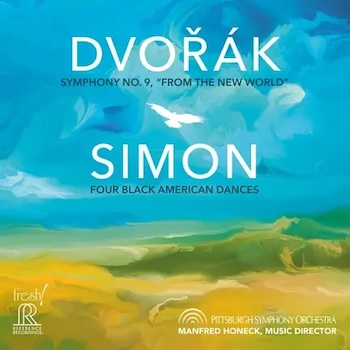
With Carlos Simon’s Four Black American Dances, the Pittsburgh Symphony offers a thoughtful and resonant recontextualization of Dvořák’s Ninth.
During his residency in the United States in the 1890s, Antonin Dvorak famously found much to admire in the music of Black Americans. “I am now convinced,” he told the New York Herald in 1892, “that the future music of this country must be founded on what are called Negro melodies.”
Dvorak was correct, as jazz, the blues, rock, hip-hop, and countless varieties of pop music have demonstrated. Regrettably, not many of his classical contemporaries, American or otherwise, took the Czech master at his word—at least not so thoroughly as they might have. Perhaps unsurprisingly then, precious few recordings (let alone orchestral programs) have since seen fit to pair anything of his with the music of Black American composers. That makes the Pittsburgh Symphony Orchestra’s new album featuring the “New World” Symphony and Carlos Simon’s Four Black American Dances commendable for the originality of its concept alone.
But there’s much more to it than just that.
Premiered by Andris Nelsons and the Boston Symphony in 2023, Simon’s curtain-raiser is at once a lot of fun to listen to and very well written. Its four movements offer what the composer calls a “representation of the wide range of cultural and social differences within…Black American communities,” and touch on some deeply personal ties: the finale, in particular, nods to his experience in the Black Pentecostal church.
That section, “Holy Dance,” is the work’s most Ivesian, with swirling, amorphous textures coalescing into a striding, exuberant main body. Simon’s writing in this part is riff-heavy—but there are enough contrasts of color and rhythm to hold the attention and, besides, his sense of pacing is unerring. The same is true of the opening “Ring Shout,” with its swaggering, earthy syncopations and inviting plays of color. In between comes an elegant, silky “Waltz” and an energetic homage to tap dancing.
The PSO has a thoroughgoing grasp of all of it, with their performance, led by music director Manfred Honeck, demonstrating a deep familiarity with Simon’s idiom and syntax. The “Waltz,” in particular, becomes something quite alluring, while “Ring Shout’s” vigorous rhythms possess all the bite and flash one might desire.
Indeed, the orchestra’s reading underlines one of the composer’s most impressive accomplishments in these Dances: it is no easy trick to spin out fifteen minutes of music that are at once so agreeable, inviting, and yet substantive. Or, for that matter, to write something that stands toe-to-toe with Dvorak’s Symphony No. 9 and emerges holding its own. Simon, though, has done just that.
And that says something, given Honeck’s refreshingly revisionist approach to the warhorse. The Austrian conductor has made a habit of rethinking canonical totems during his tenure in Pittsburgh and his thoughtful reconsideration of this score (spelled out in typically informative liner notes) has the benefit of underlining the music’s tragic aura.
Part of that atmosphere is likely the result of the symphony’s debt to Longfellow’s Hiawatha (Dvorak evidently contemplated a dramatic work based on the poem, parts of which found their way into the score), as well as his homesickness for Bohemia. Either way, here Honeck and the PSO mine an impressive lode from the work’s reservoirs of excitement, sweep, beauty, pain, and wistfulness.
Everything is well-blended—the framing sections of the Largo are particularly luminous—and big contrasts are the rule. The first movement’s introduction is conspicuously explosive, its coda feisty. There’s a brawny rusticity to parts of the finale and the big climaxes near the end sound almost like screams.
Throughout, too, there’s a becoming sense of space, both in fast tempos and slow. The Largo is enchantingly unhurried but never drags, while the Scherzo’s lilting Trio comes across like a vision from afar: its nuanced dynamics and taut rhythms craft an atmosphere of beguiling nostalgia.
Taken together, Honeck’s is an interpretation that allows one to hear—or at least think of—this music afresh. There are myriad ways to approach it, of course, but, given the context of the symphony’s proximity to Simon’s Dances, the larger album suggests a vision of shared humanity across eras, styles, ethnicities, and genres that our times, so fraught with division and strife, might do well to learn from.
Jonathan Blumhofer is a composer and violist who has been active in the greater Boston area since 2004. His music has received numerous awards and been performed by various ensembles, including the American Composers Orchestra, Kiev Philharmonic, Camerata Chicago, Xanthos Ensemble, and Juventas New Music Group. Since receiving his doctorate from Boston University in 2010, Jon has taught at Clark University, Worcester Polytechnic Institute, and online for the University of Phoenix, in addition to writing music criticism for the Worcester Telegram & Gazette.
‘ The preceding article may include information circulated by third parties ’
‘ Some details of this article were extracted from the following source artsfuse.org ’