In 2024, artist and activist Jackie Sumell established the nonprofit Freedom to Grow, an abolitionist-driven initiative of art, land-based healing justice, community empowerment and archival practices. The abolitionist movement works to end incarceration and create alternatives to punishment. Sumell serves as the creative director.
Freedom to Grow’s current projects include Herman’s House, Solitary Gardens, the Abolitionist’s Apothecary, the Abolitionist’s Sanctuary and an artists-in-residence program.
Originally from New York, Sumell moved to New Orleans in 2005 and says she’s lived there longer than she’s lived anywhere.
Jackie Sumell, artist, founder and creative director of Freedom to Grow in New Orleans.
Sumell’s creative practice has been supported by residencies and fellowships, including the 2024 Guggenheim Fellowship, 2023 Christian A. Johnson Fellowship, 2022 Marguerite Casey Foundation Fellowship and Rockefeller Foundation. Her collaboration with Herman Wallace, one of the Angola 3 (Wallace, Albert Woodfox and Robert King — former Angola prison inmates who lived in solitary confinement for several decades), was featured in the Emmy Award-Winning documentary “Herman’s House.”
This interview has been edited for length and clarity.
For those who may be unfamiliar with the term “abolitionist work,” how would you describe that?
It’s really important that we think about abolition as a practice that isn’t precisely defined. … I personally think of abolition as a practice where we respond to inevitable harm with the intention of not creating more.
There are many people who speak much more eloquently to this, but I think of abolition as something that not only exists as the desire to live outside of a punitive system, but as something that we do relationally every day with every thought, word and action.
How did you get involved in abolitionist work in Louisiana?
I started off as a pen pal with Herman Wallace and Albert Woodfox of the Angola 3. That evolved into moving here to be closer to them, and I began work on a project called “The House That Herman Built.”

Herman Wallace, one of the inspirations behind Freedom to Grow, and Jackie Sumell, play arm wrestle during a visit at Angola. Wallace died in 2013.
It really reorganized my life and value system. The next 20 years of this work has been a way to say thank you to Herman and Albert and John Thompson.
As a practice of gratitude to be closer to them, I have created family relationships with other folks who are still incarcerated. What’s been so beautiful is that it no longer is just Angola. It’s prisons across the country.
I feel very deeply committed to this land and this place. I’m here for the long haul.
How did Freedom to Grow evolve into the organization it is now?
It’s an outgrowth of this work and the legacy of the Angola Three.
Starting a nonprofit was not something that I, as an artist, ever imagined, but it became necessary in a world in which it has become increasingly difficult to fundraise.
Doing abolitionist-centered work and visiting folks in prison has been a labor of love for most of this journey, but the larger the projects get, the more they require sustenance.
Freedom to Grow will continue long beyond my own life, and it allows us to create a means of fundraising and sharing. The hope is that we inspire a world where we don’t rely on punishment to respond to harm.

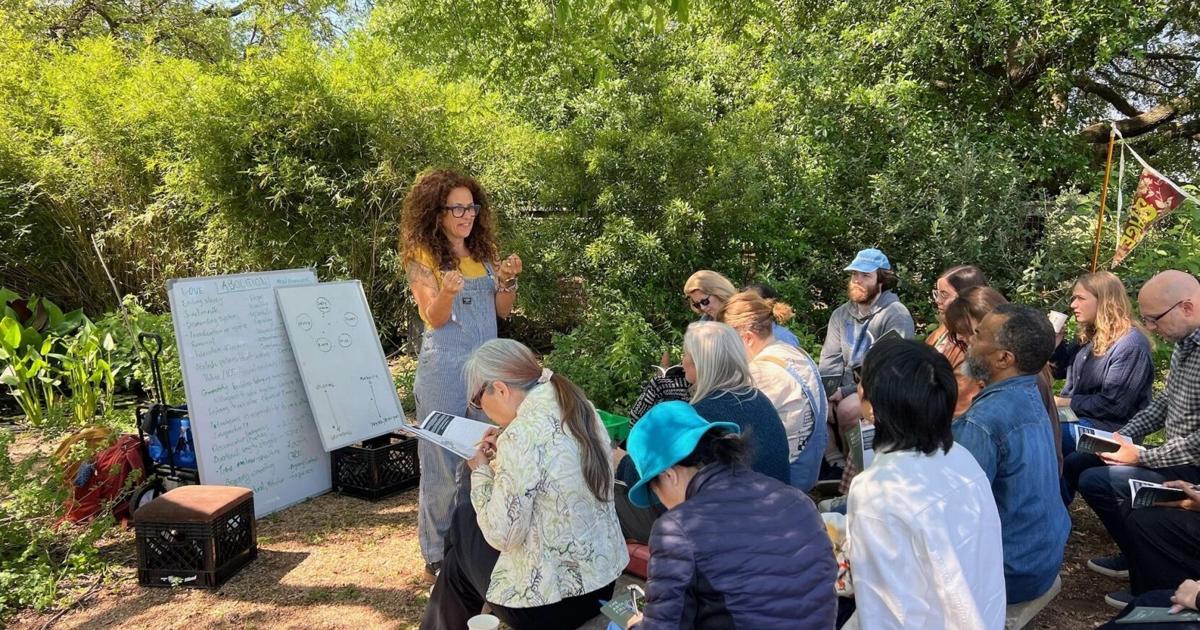
Freedom to Grow staff and volunteers in New Orleans.
We just started a capital campaign to be able to retrofit the John Thompson Legacy Center to be this museum.
How do the Freedom to Grow Solitary Gardens spread that abolitionist practice?
Solitary Gardens, in particular, is birthed out of Herman’s House — creating garden beds that are the same size and blueprint that solitary cells are. Then they’re grown in collaboration with folks who are currently incarcerated and tended to by folks on the outside who are formerly incarcerated.

An example of a Freedom to Grow Solitary Garden in New Orleans.
My elders often say those of us who are closest to the problem are also closest to the solution.
What is the Freedom to Grow Artist-in-Residency program and who are the artists?
Artists are the vanguards of complicated and sometimes impossible conversations. Art is a critical vehicle, and so, how do we engage artists in abolitionist and revolutionary thinking?

Freedom to Grow Artists-in-Residence Chandra McCormick and Keith Calhoun, New Orleans photographers.
New Orleans icons Chandra McCormick and Keith Calhoun are our inaugural artists in residence. This was a relationship that was like literally born out of deep admiration for their work and for their legacy, both inside Angola and inside New Orleans.
We’re asking Keith and Chandra, who are very established photographers, to work outside of their medium and comfort zone — as an abolitionist practice. It’s challenging them to be an example of growth within the realm of productive discomfort.
An abolitionist future is not reform, but it requires us to really live and exist outside the world that we know. That’s terrifying.
We’re asking them to look at the legacy, not only of the horrors that have happened on the land now occupied by the Louisiana State Penitentiary, but to imagine, to feel and to think about the magic or the resistance or ways that people not only survived the impossible, but transmuted it. Ultimately, to look at the ways that people can take the impossible and alchemize it into a different outcome.
How can Freedom to Grow impact Louisiana?
I want people to know that the entire world is born from the tip of intention. If our intention is to be kinder, faster, we can build that world. If our intention is to be bigger and meaner, then we will build that world. So, what Freedom to Grow is hopefully doing is creating an alternative universe that is rooted not only in possibility but in lived experience.
Herman used to say to me, “Slow down, baby, this is a marathon.” What I’ve come to realize is that it’s actually a relay race, and Freedom to Grow is the baton.
I want people to know, to trust, and to believe that another world is possible. The first step is an act of faith. Our relationship to faith and to spirituality is actually a superpower, and we can think of abolition as a practice of faith. In some ways, I want Freedom to Grow to be a container for folks to feel safe in abolitionist thought and practice.
‘ The preceding article may include information circulated by third parties ’
‘ Some details of this article were extracted from the following source www.nola.com ’