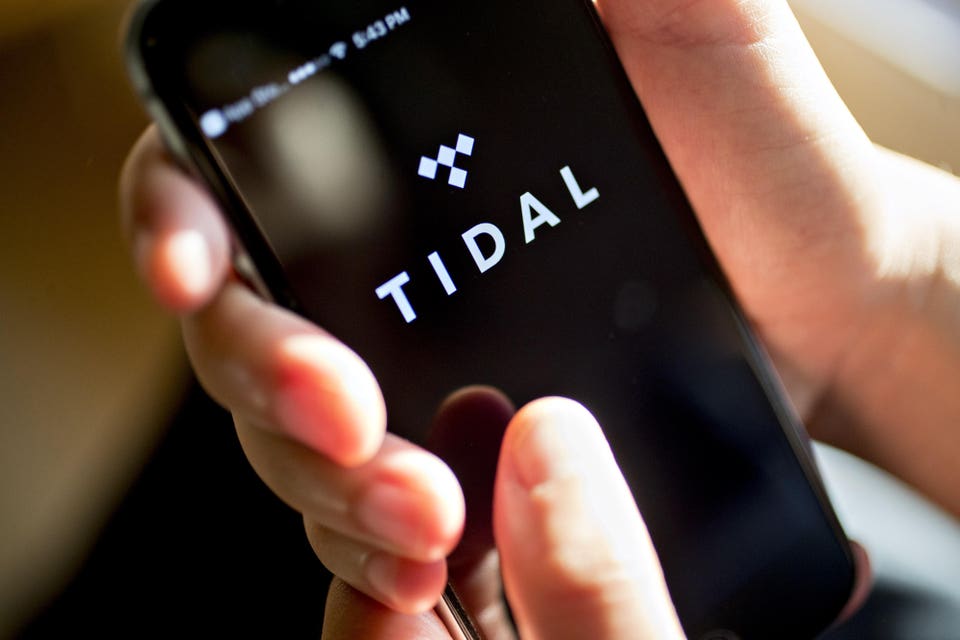
The Tidal application is seen on an Apple Inc. iPhone arranged for a photograph in Washington, D.C., U.S., on Tuesday, June 27, 2017. Photographer: Andrew Harrer/Bloomberg
© 2017 Bloomberg Finance LP
Last week the music service Tidal posted a new policy on AI-generated music. Starting in mid-July, the service will tag music that it detects as 100% AI-generated with an icon in its user interface, and it will no longer pay royalties on that music. In the future, it will require that labels and distributors identify AI-generated music when uploading it to the service. With this, Tidal’s AI policy becomes one of the most stringent of any music service.
Tidal’s new AI policy is just the latest in a rapidly evolving series of changes that music services are making to cope with the fast-increasing volume of music resulting from generative AI platforms. Deezer reported that, as of the end of March, it was taking in an average of 170,000 tracks per day, 75,000 (44%) of which it detected as AI; and it detects as much as 85% of AI track streams as fraudulent (e.g., generated by bot farms to siphon off royalties).
The deluge of AI music creates various complexities for music services. The essential problem is that while it’s possible to determine whether a track was AI-generated with reasonable confidence, as we’ll see, it’s not possible to tell whether it’s one of the huge number of AI tracks intended for streaming fraud or one that was generated by a (human) team looking to build an audience for an “AI artist.” An increasing number of the latter have generated tracks that have gotten enough listenership to garner chart placements.
Digital Music Services’ AI Policies
This dichotomy is leading music services to make a range of policy decisions on AI music. Though these are changing regularly, here is a current summary:
Digital music services’ varied policies on AI-generated music.
Bill Rosenblatt
First, will they accept AI music submissions at all? So far, the answer is generally yes – with the exception of Bandcamp. Bandcamp, home to lots of music by indie artists, relies on its user base to implement a no-AI policy: when a user complains about an AI track on the service, Bandcamp will investigate and potentially take it down.
The question is whose responsibility it is to determine whether a track is AI-generated or not. Music services generally would prefer it if the record labels and indie digital distributors that upload music to them would provide that information themselves – which in turn relies on musical artists to make these disclosures.
A few services, including Spotify and Apple Music, have developed AI disclosure tag sets that – for now, at least – they are asking uploaders to use voluntarily. The music industry standards body DDEX has also published a simple set of AI tags as part of its ERN (Electronic Release Notification) standard. Unfortunately, these tag sets are all different from one another.
AI Detection Technology
So most music services are identifying AI tracks themselves using AI detection technology, which examines music files and determines whether they were purely generated by some of the known AI music platforms. This technology is fast becoming part of the “plumbing” layer of digital music, along with other technologies such as ACR (automated content recognition) and the DDEX standards for communicating music release and consumption data.
Some of the larger music services, such as Spotify and Apple Music, have developed this kind of technology in house, mainly for use in detecting spam and fraud.
There’s also a growing number of vendors of AI detection technology. Deezer developed the technology for its own service and decided to make it available to third parties. Another is Ircam Amplify, the commercial division of Paris’s IRCAM music and audio technology research institute, which has developed various audio technology products over the past several years. A number of startups such as HumanStandard, SoundSafe.ai, Detect.Music, and various others are offering this type of technology too. And other “plumbing” vendors such as Pex (ACR) and Beatdapp (streaming fraud detection) have added AI detection as part of their technology stacks.
AI detection technologies typically report a level of confidence that a music track was purely generated by AI, and they are tuned to prioritize minimizing false negatives (misidentifying a human-created track as AI) over false positives (misidentifying a pure AI track as human-created). They aren’t able to detect the increasingly common use of AI to assist in tasks such as production and mastering, or if only some of the instruments on a track were AI-generated.
In addition to music services, independent digital distributors – which feed music from indie artists to the music services – are also adopting AI detection to enforce submission policies. Two of the biggest, TuneCore and CD Baby, recently announced restrictions on pure AI music on their services. TuneCore only allows 100% AI-generated music made with AI platforms that are “trained on fully licensed datasets.” CD Baby goes further: it bans all fully AI-generated music and will terminate accounts of users who attempt to upload it repeatedly.
Tagging and Promoting AI Music for Users
Tidal will be the second music service that shows the results of its AI detection to users. Deezer was the first one to display “AI-generated content” tags in its user interface, starting in June of last year. Spotify has announced plans to display uploader-submitted AI disclosures – though not the results of its own AI detection technology – in the future.
The next variable in music services’ AI policies is whether a service will promote tracks it detects as AI to users, such as on algorithmic playlists or in search results. Services that have opted not to do this include Deezer and the audiophile-oriented music service Qobuz.
And then there’s the question of whether to pay royalties to uploaders for plays of pure AI tracks, given that (in US law, at least) they aren’t eligible for copyright protection. Most music services take steps to detect fraud – which has become a huge business – and don’t pay royalties on those streams. Qobuz and Tidal have adopted the more stringent – and much simpler – policy of not paying royalties on detected AI music at all.
In general, services with smaller user bases like Bandcamp, Deezer, Qobuz and Tidal have adopted the most stringent AI music policies. This makes sense given that they have more limited resources to deal with the growing volume of AI-generated tracks and streaming fraud, and they want to position themselves as the more human-artist-friendly services. (Deezer’s series of press releases on AI and streaming fraud over the past year have done wonders for its reputation in this regard, particularly in the US market where the service has had a limited presence.)
AI Policies Will Evolve
These policies will surely change as the music industry comes to understand more about AI music and its listenership, as fraudsters’ techniques evolve to evade detection, and as the AI tools themselves increase in sophistication. The question is what steps larger services like Spotify, Apple Music, YouTube Music, and Amazon Music will take, and when.
But one thing is for sure: technologies such as AI detection and AI labeling are becoming part of the music industry’s digital infrastructure, much in the same way that digital rights management and ACR have done in the previous decades. Each of those technologies went through initial periods when many startups (as well as established companies) introduced the technologies, and real-world experience winnowed the markets down to the handful of solutions that may not have been “perfect” but that industry stakeholders judged to be good enough for certain tasks.
And these technologies have also endured arms races with bad actors who developed hacks and workarounds. For example, a well-known hack to ACR technology in its early days (e.g., to get your copyright-infringing track up on a file-sharing service that used ACR for takedowns) was to introduce a few seconds of silence at the beginning or shift the track’s pitch a bit. And DRM technology – which is used by all major music and video streaming services today – has evolved to withstand many different types of hacks.
It will be the same with AI detection technologies. Already services have appeared that purport to tweak your AI-generated tracks to evade detection, though there’s no evidence so far that the AI music platforms themselves are attempting to make their outputs detection-proof.
Analogously, the industry will likely coalesce around standards for AI music labeling and implement them based on the use cases for labeling that actually make sense. For example, streaming fraudsters, artist impersonators, and other bad actors will never be expected to follow such standards.
And even if AI labeling standards take hold, downstream entities such as distributors and music services could still use AI detection technology, if only to help enforce AI labeling requirements by testing for noncompliance. (The music industry is also working on labeling standards for human-generated content, which raises yet another set of issues.)
Just as in the past, these technologies will take shape to meet the practical needs of the digital music supply chain as AI music generation technology continues to improve and the music industry continues to mature its understanding of AI’s place in the music generation and creation processes. And digital music services’ AI policies will continue to evolve accordingly.
‘ The preceding article may include information circulated by third parties ’
‘ Some details of this article were extracted from the following source www.forbes.com ’