I have a love-hate relationship with “Damn Yankees.”
When I was a child, my grandparents took me to the original Broadway production of the 1955 musical with a score by Richard Adler and Jerry Ross and a book by George Abbott and Douglass Wallop, based on Wallop’s novel “The Year the Yankees Lost the Pennant.” It was a birthday present. My grandfather, who was a Bronx politico, picked up my younger sister and me at our modest Long Island house in a big black Cadillac, the kind with fins. I don’t remember much about the show except for Gwen Verdon’s stellar performance as Lola, but the experience was one of the most exciting in my young life and nurtured my lifelong love of live theater.
Watching Theo’s production of “Damn Yankees,” however, I was acutely aware of the script’s limitations. Yes, it is based on the timeless Faust legend, but the sensibility is firmly rooted in 1950s family values. Traditional gender roles are the rule, with men as the breadwinners whose penchant for neglecting their wives for baseball “Six Months Out of Every Year” is easily tolerated. Women are classified as devoted wives, vamps or busybodies. Of course, the true love of a middle-aged married couple wins out in the end, defeating the clever Devil’s machinations.
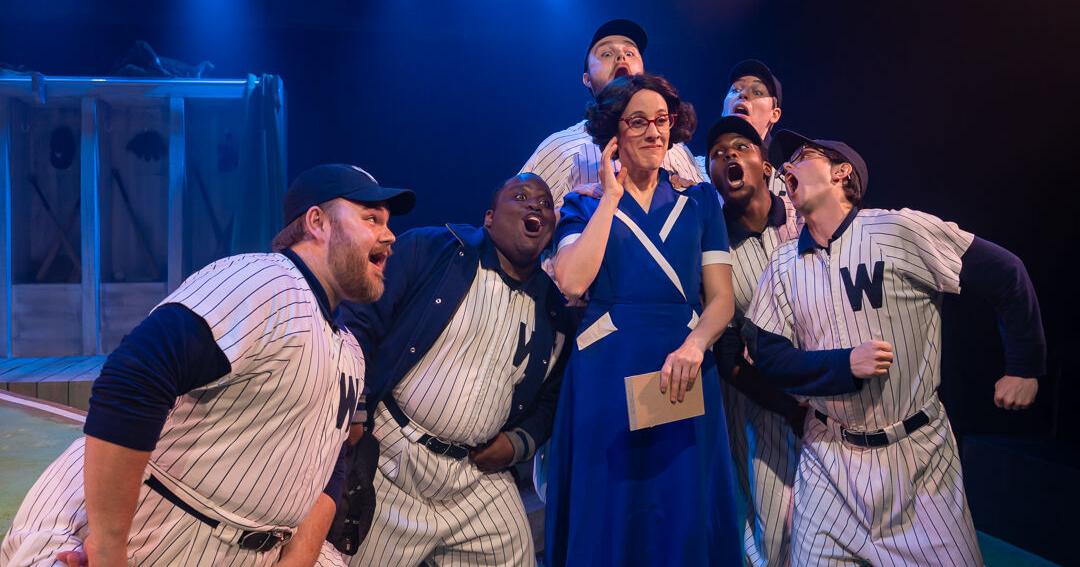
“Damn Yankees” also is devilishly hard to stage, especially in a space as intimate as the Fred Anzevino Theatre (named for the late founder-artistic director). The basic problem is how to handle the scenes of men playing baseball, and director Daryl D. Brooks, choreographer Christopher Chase Carter and the ensemble don’t quite hit a home run. Set designer Manuel Ortiz crams a miniature ball field center stage, but no one knows how best to use it, and I’m told sight lines are limited from the dugout.
Theo’s version of the musical seems to draw on the movie, particularly in the second act, and that makes the sequence of events and their import rather muddled at times. Compared to the greats of the era, such as “West Side Story,” it’s arguably mediocre — with a couple of memorable character parts and half-a-dozen great songs, among them “Heart,” “Whatever Lola Wants, Lola Gets,” “Who’s Got the Pain,” “Those Were the Good Old Days” and “Two Lost Souls.”
What Theo brings to the game is an ensemble of talented singers who handle every number with aplomb. They also tackle Carter’s choreography reasonably well, even if he’s no Bob Fosse and they’re no Broadway hoofers. A highlight is “Who’s Got the Pain” for Lola (Jenny Couch) and Eddie (Quinn Rigg), which incorporates lots of Fosse tropes.
Brooks’ direction and blocking are for the most part workmanlike or better, though he does let some of the minor characters lapse into caricature. The all-around winner is Luke Nowakowski’s Joe Hardy. Handsome and admirably square-jawed, he brings a lovely sincerity and vulnerability to the part of the hero who holds the Washington Senators and the whole show together by selling his soul to the devil as Joe Boyd and living out his fantasy of being a slugger.
The savviest detail is that Boyd, having been a real estate salesman, insists on an escape clause in his contract with the devil, aka Mr. Applegate, here a suave yet sleazy Tommy Thurston. And when the young Hardy remains so homesick for his old life with wife, Meg Boyd (Megan Hoyt), that he rents a room in her house, Applegate loads the bases to trick him into keeping his bargain.
Chief among his ploys is Lola, portrayed by the long-legged Couch with convincing charm and seductiveness summed up in her first solo, “A Little Brains, A Little Talent.” She’s not the consummate coquette Verdon was, but when she’s seduced by his goodness rather than him fully falling for her wiles, it’s a welcome turn of events.
For the rest, kudos go to music director and conductor Ryan Brewster and his small band tucked in one corner of the room, and to the other designers, who make the most of limited resources.
I’ve read that a totally new revival of “Damn Yankees” that takes on racism in baseball is in the works for 2027. In the meantime, Theo’s traditional take has enough heart to be worth seeing.
‘ The preceding article may include information circulated by third parties ’
‘ Some details of this article were extracted from the following source www.hpherald.com ’