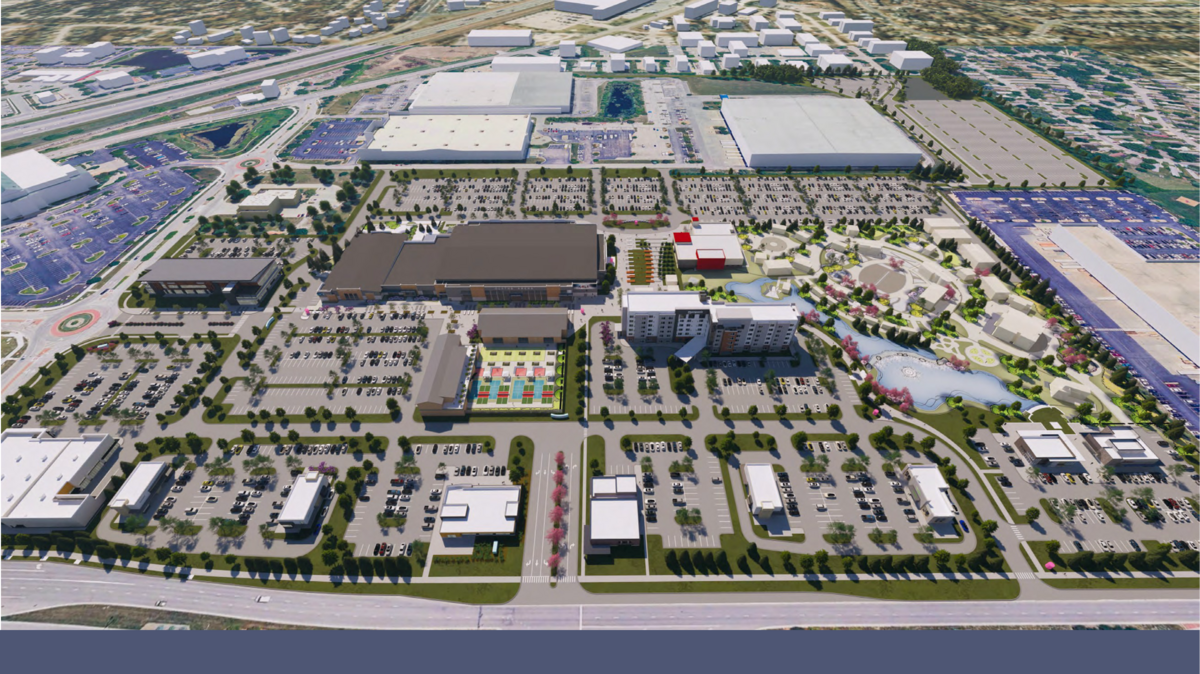
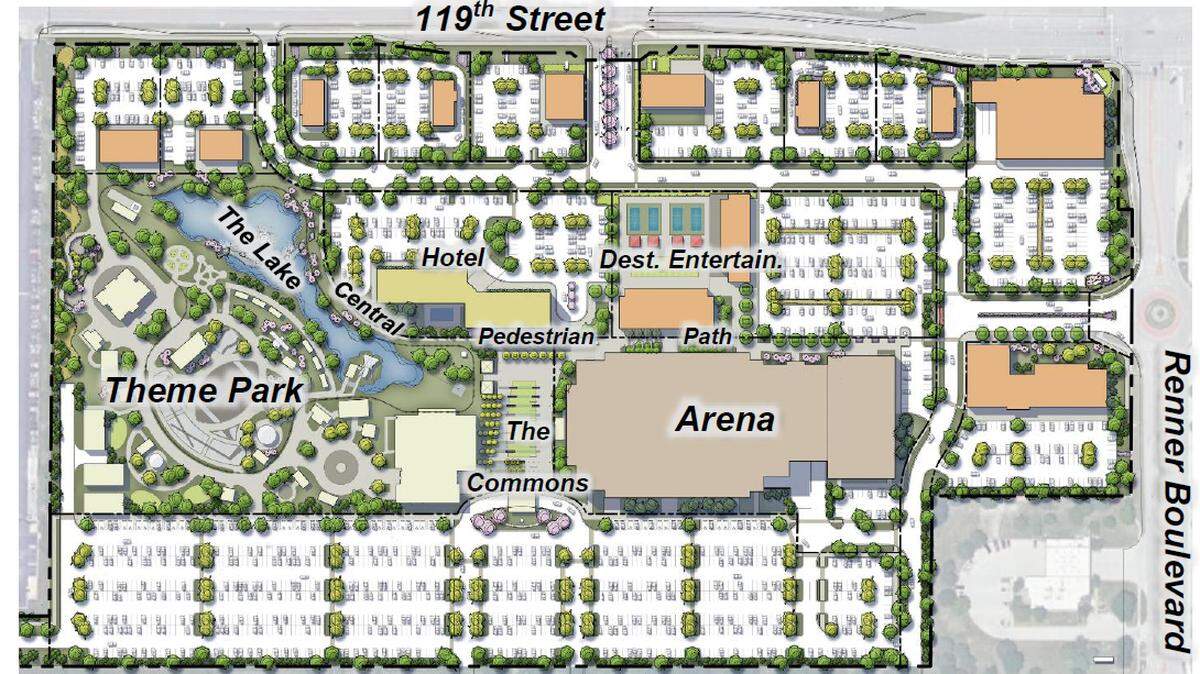
Loretto Properties plans to develop 50 acres of land on the southwest corner of West 119th Street and Renner Boulevard in Olathe.
Renderings by Slaggie Architects
After an 18-month pause on starting construction because of issues with the land’s sale, Olathe’s multimillion-dollar, ultra accessible theme park has a new construction timeline, with parts of the project aiming to open as early as January, and the full entertainment district planning to be operational around summer 2028.
Lamar Hunt Jr’s company, Loretto Properties, and VanTrust Real Estate celebrated the $320 million entertainment district’s groundbreaking in February, kicking off construction for what will eventually become a theme park, a hockey arena, and a six-story hotel on the southwest corner of West 119th Street and Renner Boulevard.
“We’re shooting for 24 months to be up and running because we want it out of the ground,” said James Arkell, the chief operating officer of Loretto Companies and Hunt Jr.’s son-in-law.
The theme park, Michael’s World, is in honor of Hunt Jr.’s grandson and Arkell’s son, Michael, who has a rare medical condition that requires him to be in a wheelchair. Loretto Properties wanted to design a place where families with children who have disabilities could be together without limitation — similarly to Morgan’s Wonderland in San Antonio.
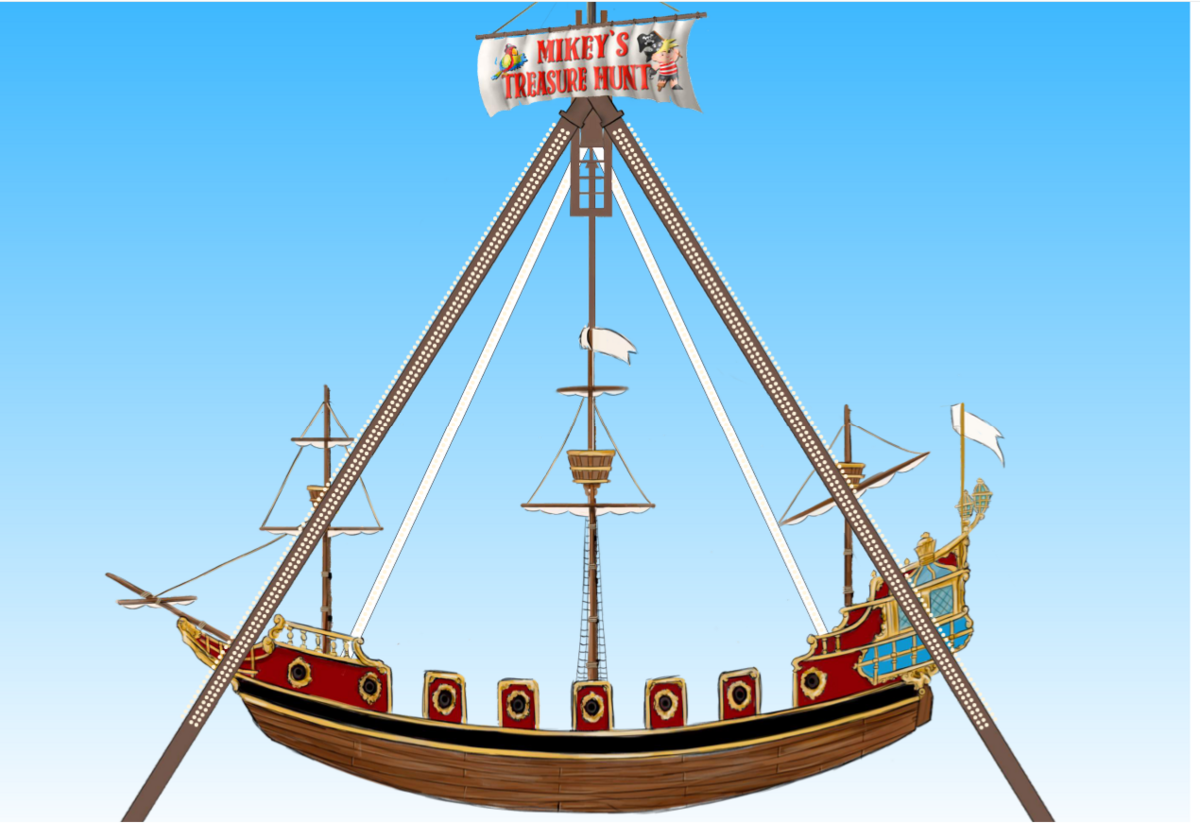
“We want it open, and we want people to start really having a good time and coming out and seeing all the really cool pieces that are coming to this that are going to make it so unique and special for the community and the surrounding area,” Arkell said.
Construction timeline
The Olathe City Council approved the project last January, and developers initially planned for construction to begin last summer, but a titling issue with the property stopped the land’s sale and hindered the construction start date until it was resolved.
The development will be supported by about $104 million in incentives, including a sales tax revenue (STAR) bond district to support the development of entertainment and tourism attractions. Tax collection won’t start until the developments are in place and generating revenue.
With the titling issues sorted, Arkell said the developers will start with building out roads, sewers and utility lines, and clear the 50-acre property over the next eight to 10 months in order to make way for building construction.
Once the supporting infrastructure is in place, it will be about 12 to 18 months of “vertical construction,” or developing the amenities, the theme park and the arena that will eventually make up the entertainment district.
“You’ll see quite a bit of work happening here in the next month that’ll make it start to take shape and really look like a project coming off the ground,” Arkell said.
Medical clinic opening in January
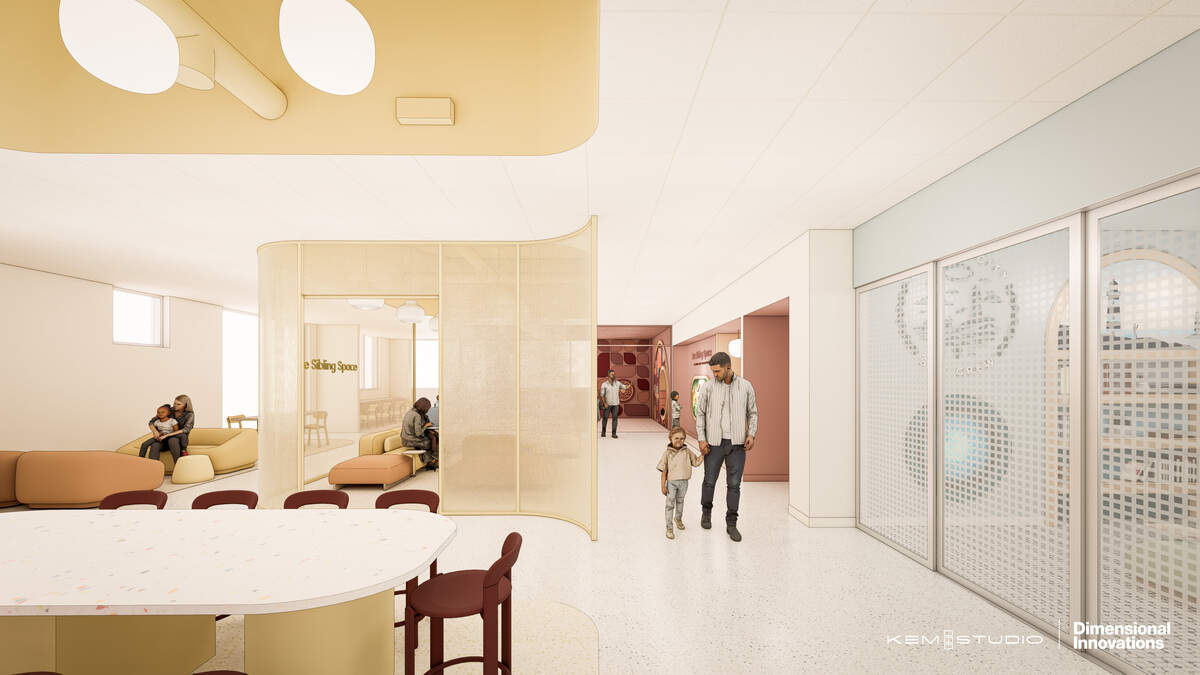
While the entertainment district is under construction, the project’s accompanying medical clinic, dubbed the Halo Care Collective, is expected to open in January in an existing building across the street from the future theme park.
The Halo Care Collective is moving faster than the theme park in part because the building already exists.
“They’ve delivered us the building in just phenomenal shape… it looks brand new,” he said. “It makes it easier to get that going faster.”
From physical and occupational therapies to helping families gain access to healthy food and financial planning, the clinic will host 18 medical care providers and roughly 60 community organizations to help families in one place rather than making them travel around the metro for different services.
“Everyone’s really kind of gathered in a way that I don’t think they’ve ever done before,” he said.
The Kansas City Star
Taylor is The Star’s Johnson County watchdog reporter. Before coming to Kansas City, she reported on north Santa Barbara County, California, covering local governments, school districts and issues ranging from the housing crisis to water conservation. She grew up in Minneapolis and graduated from the Walter Cronkite School of Journalism and Mass Communication at Arizona State University.
‘ The preceding article may include information circulated by third parties ’
‘ Some details of this article were extracted from the following source www.kansascity.com ’