A retrospective of the 50-plus-year career of Sandwich artist David Phillips is on view at the Cape Cod Museum of Art in Dennis through August 16.
Primarily a sculptor, Phillips has been prolific in creating art for public spaces, especially in Boston and Cambridge, but also further afield, such as at Garden in the Woods in Framingham, Osher Map Library in Portland, Maine; Willimantic, Connecticut; Washington, DC; Salt Lake City, Utah and as far away as Shiroishi City, Japan.
In Boston, his work can be found at the New England Conservatory of Music, the Frog Pond in Boston Common, the Animal Rescue League, the Boston Esplanade Playground, the Yawkey Center Rooftop Garden at Massachusetts General Hospital, outside the Seaport Hotel and other locations.
In 2024, Phillips was recognized by the Cape Cod Museum of Art with a Lifetime Achievement Award, “not as a capstone,” writes museum director Benton Jones in the introduction to the book “David Phillips: A 57-Year Retrospective,” “but as an acknowledgement of an artist who remains relentlessly moving between materials and ideas with a curiosity that feels undiminished.”
Jones said he was first introduced to Phillips through experiencing his public art firsthand.
“I think David has more public sculpture in Boston and Cambridge than any other singular person,” he said.
The exhibit is filled with work so diverse that one would assume it was made by a conglomerate of artists, not just one person.
“As a sculptor myself, it’s been a real inspiration to see somebody work in so many different ways,” said Jones. “There are no boundaries for David. From using metal shavings and magnets to make drawings to recently, piano roll paper and braille. There are no limits. It’s so inspirational.”
Between having the artistic talent, being able to draft a proposal, present an idea and work with a committee that might have no background in art, “public sculpture is probably the hardest thing anybody could do,” said Jones.
Jones first met Phillips when the artist participated in several juried exhibitions at the museum, including an open sculpture invitational. After spending the day at Phillips’s studio, Jones said he was compelled to organize the exhibition. “It was overdue and I was honored that David took the leap of faith,” said Jones.
For Phillips, being a working artist has been all-consuming, so the opportunity to show his work at the museum has been appreciated.
“I was always focused on the next job,” said Phillips. “I had a good run with commissions and one thing led to another. I was always busy making stuff instead of promoting.”
Phillips was humble in surmising that one of the advantages he had with submitting proposals was that he had his own foundry. “I could offer more bronze per proposal than just about anybody else.”
A graduate of Cranbrook Academy of Art in Michigan, Phillips initially studied painting with a minor in sculpture.
“I spent more time in the foundry watching the pours and eventually my instructor told me to—go ahead and make something.” Phillips began bronze casting and eventually went on to a BFA in sculpture.
Phillips’ sculptures range from early work that includes life-size bronze and steel figures of torsos to whimsical figures of anthropomorphized animals such as frogs with fishing poles in Boston Common and dancing dogs and cats at the Animal Rescue League.
These public sculptures, of course, could not be uprooted and brought to the museum, but photos and wall text describe them. The exhibit does contain many large sculptures, as well as smaller pieces, three-dimensional works made with cut stone that hang on the walls, experimental works with iron and magnets, stone pieces that include poems translated into braille and more.
A series of photographs in the exhibit shows the process involved in creating a large sculpture of a conch shell.
The process used to source the materials and create a poured sculpture in various metals is a complicated one. For every type of material used by Phillips, there’s a learning curve of trial and error and seeing about how the material reacts, how much heat is needed to melt it, et cetera.
“Similar to glass blowing, it’s a bit of a dance when you’re doing these castings,” said Jones. “You have to have a whole team of people who know what they’re doing.”
Commenting on how hands-on Phillips is with his work, Jones said, “I worked at a foundry for a number of years. Most of the artists would make a maquette and send it to our foundry. We would spend six months enlarging it on a pantograph to monumental size. The artist would come in for maybe three hours, close the door behind them and then they would leave and say—okay, it’s ready. David never worked that way. He’s always involved in the process and he’s relentless about learning new ways of working.”
Photographs show Phillip’s assisting with the installation of stone and bronze sculptures outside of the Porter Square MBTA subway station in Cambridge. “David is installing the piece on site, lowering the rock down,” said Jones.
Jones’s appreciation for Phillips’ public artwork is palpable. “There are no boundaries to these sculptures for the whole world. It’s really a gift,” he said.
“Another thing that’s fascinating about David’s work is his love of nature and incorporating that into his work,” said Jones.
Before moving to Sandwich, Phillips and his wife Peggy spent over 20 years summering in Truro, with Phillips sometimes commuting back and forth to Boston on the ferry.
Phillips said he’s inspired by small natural objects that will make a statement at large scale, likening his series to works by Claes Oldenberg, who is best known for taking small everyday objects, a clothespin or a safety pin, and recreating them in enormous scale.
“Instead of a big spoon or a fork, it’s a natural object,” said Phillips.
After finding a stone with an interesting shape, Phillips has created sculptures that scale the tiny objects up to monumental size. The exhibit is set up so as to pay homage to the original objects by placing them in the center of the gallery with the larger sculptures radiating out from the center pieces.
“Taking something so small and making it monumental shows that the artist wants people to recognize the object’s beauty,” said Jones.
While they appear solid, most people don’t realize the large sculptures are hollow. “It would be so impractical to have them solid,” said Jones.
Photographs in the exhibit and in the catalogue also chronicle pieces Phillips has created that are hidden in the woods. “I was impressed that David did these monumental pieces that not many people will see,” said Jones.
Two such pieces are at the Andres Institute in New Hampshire. The institute has a sculpture symposium every year. Phillips attended in 2003 and 2005.
The institute is on 100 acres, including a large hill with boulders and partly quarried stone, which the artists can choose to work with.
Rather than carve away at the rock, Phillips decided to simply work with the stone, in one instance hammering lead triangles along a ridgeline to give the impression of an animal’s spine and in another adding rectangular stainless steel and copper “posts and beams” to an existing quarry wall.
Phillips created a similar piece at Garden in the Woods in Framingham, adding a row of bronze “spikes” along the top of a large rock to create “Stegosaurus.”
Some of Phillip’s city sculptures also incorporate natural elements, while others are representational.
“It’s a huge scope,” said Jones. “David’s work repeatedly reveals something that’s either innate or underlying in the material and shows it to others. With the small rocks, he’s revealing their beauty by scaling them up and with the natural objects in the woods, it’s by interacting with the inherent shapes.”
Phillip’s interest in naturally occurring patterns can be scene is some of his most unique pieces: magnetic art.
With these pieces, Phillips has taken sheets of anodized aluminum and arranged hundreds of neodymium magnets underneath the aluminum.
“I sprinkled iron powder on the plate and it locks into place and reveals the pattern of the magnetic fields,” said Phillips.
Some of the magnetic plates are abstract, designs created by the magnetics themselves, and in others, Phillips uses stencils to create certain shapes and forms. “You can vibrate or tilt the plate and get interesting effects,” said Phillips.
“In these pieces, David is also revealing something,” said Jones. “You can’t see the magnetic fields, but David is revealing them and how they create patterns and then preserving the patterns so he can share with the viewer something that was completely invisible.”
“To be able to do any of these works, you have to have faith in yourself and in the process,” said Jones. “You start something, not knowing where it’s going to end. That’s what a lifetime of sculpting successfully can lead to—the ability to start something challenging and to know that you’re going to be able to resolve it,” said Jones.
Another stone piece, completely different from his others, looks to represent Phillips’ surrealist period. In “Memory of Stone,” two slabs of stone are joined together with a bronze slab in such a way that the stone appears to “drip” off the edge of a narrow table, referencing the melting clocks in Salvador Dali’s painting, “The Persistence of Memory.”
“Cocoon,” an early piece by Phillips, grew from the artist experimenting with balloons. In it, a large bulbous bronze larva sits snug inside a fiberglass resin cocoon.
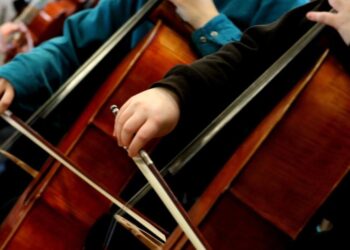
Another series includes commissioned pieces for the New England Conservatory, where Phillips created large pieces for outside on the school’s campus and wall pieces and mobiles for inside the buildings.
In “Scrolls,” an 18-foot-high sculpture representing the spiral necks of two violins sits atop a pedestal outside the school. The stainless steel sculpture is created using metal that’s been laser cut throughout with holes and is lit from the inside. Another piece is in the shape of an enormous violin bridge.
Jones said it was uniquely appropriate for Phillips to have created works for the conservatory.
“Music has this underlying, hidden mathematics and patterns to it. It’s a great match.”
The exhibit continues in a smaller gallery where a video playing continuously shows some of Phillips’ process. Sculpture in that room includes a whimsical series of bronze pieces based on partly spouted potatoes. “Potato Head Family” features five animated-looking potatoes; while in another grouping, two spouted potatoes seem to reach toward one another in an effort to embrace.
“You’ve got to have a little fun,” said the artist.
In a newer series, the artist has taken braille pages sourced from poems by Emily Dickinson and Robert Frost and fastened them onto stone, creating stone “books” in the process.
The resulting tactile pieces have a Rosetta Stone-quality to them. “That’s what I was thinking of,” said Phillips, “the Rosetta Stone and hidden languages.”
Phillips also experiments with charring and burning the pages, which gives them an antique shroud-like appearance.
In another new series, Phillips works with rolls of player piano paper, layering the thin papers on top of each other, which results in pieces that look like white birch trees.
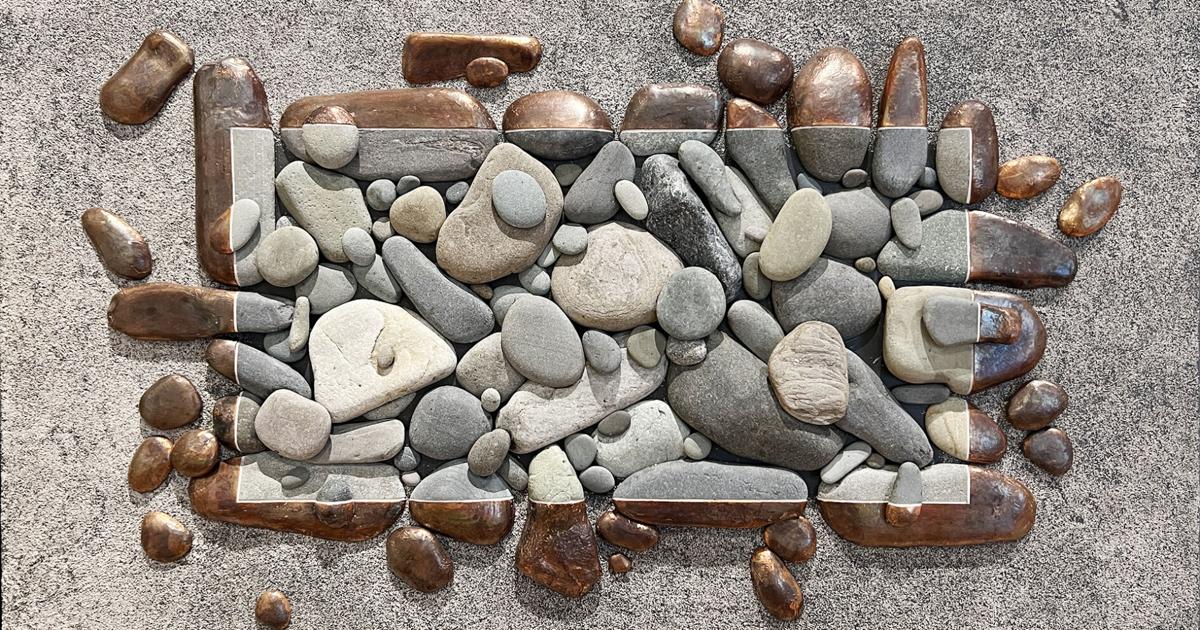
Another series, less monumental in size, but still using rocks and stones, features rocks collected by the artist on Sandy Neck Beach.
In the hung pieces, Phillip’s experiments with grid patterns, cutting the rocks and piecing them back together in different ways.
After having spent over 50 years doing the physical work of lifting, pulling, pushing and grinding that it takes to create sculptures, Phillips said, “Moving forward in my career, I’m interested in smaller, more personal stuff. I’m compelled to work with lighter, more manageable materials.
“I think I’m going to have a lot of fun. It’s just the beginning of this exploration using these methods and materials.”
“David Phillips: A 57-Year Retrospective” is on view through August 16.
The Cape Cod Museum of Art is at 60 Hope Road in Dennis.
‘ The preceding article may include information circulated by third parties ’
‘ Some details of this article were extracted from the following source www.capenews.net ’