When you hear the name Dan Quisenberry, what’s the first thing that comes to your mind?
Is it his fabulous pitching record? Is it his unusual submarine delivery? Could it be his wicked sense of humor? Maybe it’s his red hair and ‘70s police officer/porn star mustache?
It might be all or a combination of those things.
One thing is certain: Dan Quisenberry was an outstanding pitcher and a one-of-a-kind human being. There’s never been another one quite like him with the Royals or Major League Baseball, for that matter.
Quisenberry’s path to the major leagues was as unusual as the man himself. Quiz and his older brother Marty, also a pitcher, played at smallish Orange Coast College before Dan matriculated to La Verne College, where he became an NAIA All-American.
He was ready to move on with his post-baseball life when Ben Hines, the coach at La Verne, talked to Royals legendary scout Rosey Gilhousen, the man who scouted George Brett.
Gilhousen mentioned that they needed an additional pitcher at Class A Waterloo, and Hines replied, “I’ve got a guy for you.”
Dan drove his battered Gremlin (remember those?) ten minutes to Rosey’s house in Santa Ana and signed for $500 a month plus a Royals bat, pen, and lapel button.
Dan made his way to Waterloo, which must have been a culture shock coming from Los Angeles. On Sunday, June 22, 1975, Dan attended services at the Church of Christ, a large brick church located on the 4th Street church row, and was baptized. That afternoon, he made his professional debut, throwing a seven-inning complete-game win over Wausau in the first game of a doubleheader. This was Quiz’s first and last start as a professional pitcher. Manager John Sullivan informed him after the game that he was being moved to the bullpen because he needed a relief pitcher who could throw strikes.
That 1975 Waterloo team was something else. Older locals still talk about them. They finished with a 93-35 record. Their .726 winning percentage still ranks among the best in the history of the minor leagues. Despite that, the team was not loaded with future stars. Quisenberry and 19-year-old outfielder Willie Wilson were the only two who had a major impact. German Barranca, Charlie Beamon, Roy Branch, Joe Gates, Luis Silverio, and Mark Souza all appeared briefly but never attained stardom.
Even Quiz wasn’t a sure thing. Said Wilson, “I didn’t see him going to the big leagues.”
Quiz split 1976 between Waterloo and AA Jacksonville. He spent all of 1977 and 1978 in Jacksonville and, at the age of 25, seemed more like organizational filler. The Royals finally moved him to Omaha for the 1979 season, where he was adequate but far from spectacular.
Kansas City, short of bullpen arms, reluctantly gave him a shot in July 1979. He made his major league debut on July 8 with 2⅔ innings of shutout ball against the White Sox. He made 32 appearances through the end of the summer, pitching 40 innings with a respectable 3.15 ERA. His longtime teammate George Brett said, “I’d never heard of him. He looked funny, he threw funny. He was funny, and I wanted to know why we didn’t trade for someone.”
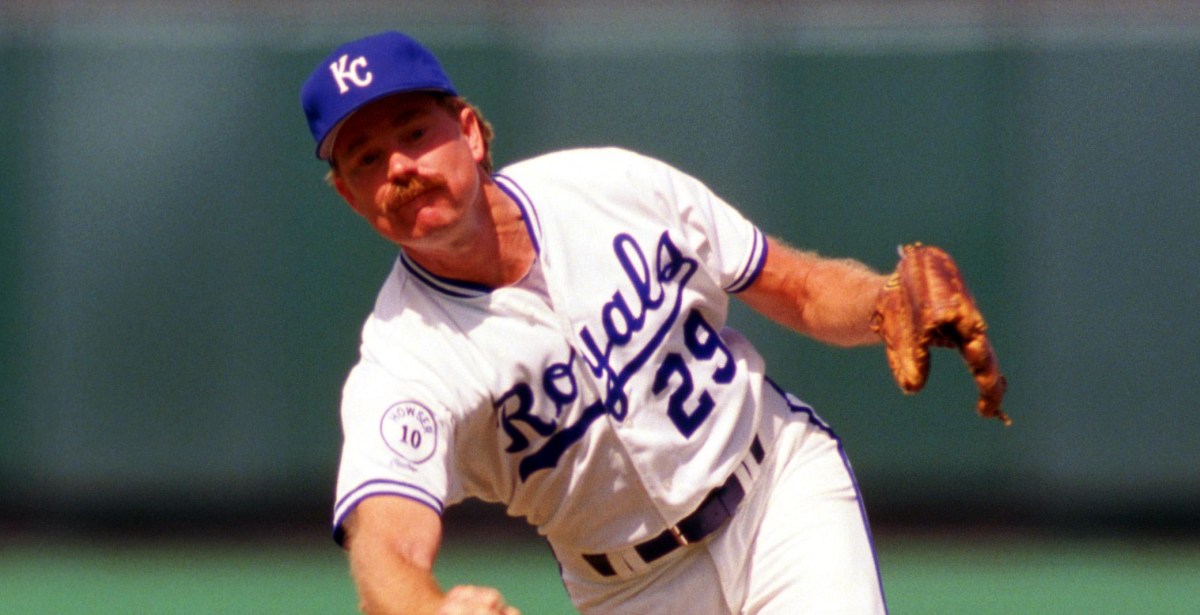
Over the winter, the Royals brought in a new manager, Jim Frey. Frey looked at Quisenberry’s delivery, which at the time was between three-quarters and sidearm. In spring training, he hooked Quiz up with Kent Tekulve, who had enjoyed serious success in 1979 as a submariner. Tekulve taught Quiz the submarine style, and the rest is baseball lore.
Quiz led the majors with 75 appearances in 1980 while racking up a league-leading 33 saves in helping the Royals reach their first World Series.
In the six seasons from 1980 to 1985, you’d be hard-pressed to find a better relief pitcher than Dan Quisenberry. He led the league in saves five times and in games finished another four. And he wasn’t just a one-inning pitcher, either. During that six-year span, he averaged 120 innings per year, with a high of 139 in 1983. No entrance music. No theatrics. Just a humble and funny man walking to the mound and inducing ground balls.
His ERA during that six-year span was an impressive 2.45. Quiz rarely walked anyone and generally kept the ball in the park. He was never a big strikeout guy, but his submarine delivery induced hitters to pound the ball into the ground, where it often was turned into an inning-killing double play. Quiz made three All-Star teams during that span while also receiving Cy Young votes in five seasons.
He finished second in the Cy Young voting on two occasions (1983-84) and third in two other seasons. He picked up MVP votes in five seasons, with a highest finish of third in 1984, when he saved 44 games.
His 45 saves in 1983 were a single-season record at the time. Along with the gaudy save numbers, Quiz appeared in most of the Royals’ biggest wins of the era. He got the save in Game 3 of the 1980 ALCS, which put the Royals into their first World Series. He got the final outs of Games 6 and 7 of the 1985 ALCS against the Blue Jays and got the win in Game 6 of the World Series, the infamous Denkinger Game. On April 30, 1980, Quiz and catcher Jamie Quirk became the first all-Q battery in major league history.
Quiz’s time as a Royal came to an end during the 1988 season. At the age of 35, he was getting by on smoke, mirrors, and guile but wasn’t yet ready to hang it up. After being released by the Royals, he reunited with former manager Whitey Herzog for two seasons in St. Louis. He closed his career with a five-game stint with the Giants in 1990 before arm troubles ended his illustrious career.
Quiz’s name still sits atop the Royals’ career lists in categories such as ERA, walks per nine innings, and adjusted ERA+. He was the team’s career leader in saves when he retired before being overtaken by Jeff Montgomery. His name still dots the top 10 in multiple career and single-season categories.
In addition to being an outstanding pitcher, Quiz was also the resident funny man and a noted poet. When the Royals took a congratulatory call from President Reagan after the 1985 Series, Ron inadvertently called Dan “Jim Quisenberry.”
When the team visited the White House, Reagan apologized for the faux pas, to which Quiz replied, “That’s okay, Don.”
He published a book of poetry in 1998 called On Days Like This. It’s very good.
I was lookin’ up when Janie and I had a girl and a boy
A fifty-day strike, Marvin Miller said
Let’s show them our muscle
I learned to hang wallpaper
In retirement, Dan and his beloved wife, Janie, were actively involved in the Kansas City community. They did yeoman’s work for Harvesters Food Bank.
In January 1998, while on a skiing vacation in Colorado, Quiz experienced headaches, dizzy spells, and blurred vision. Upon returning to KC, he immediately went to the doctor and was diagnosed with stage IV astrocytoma, a highly malignant form of brain cancer. Surgery and treatment couldn’t save the man who saved so many games. We lost him on September 30, 1998, at the young age of 45.
In recent years, there’s been a push, and rightfully so, to get the Hall of Fame to take another look at Dan’s body of work.
Here we are in 2026, and most voters still don’t know how to properly evaluate relief pitchers. The pitcher most frequently compared to Quiz was his contemporary Bruce Sutter, who was elected to the Hall in 2006.
I’m not taking anything away from Sutter, who was a fantastic pitcher, but you can’t look at them side by side and not make a strong case for Quiz. They pitched nearly an identical number of innings and games. Sutter has a few more saves (300 to 244); Quiz has a better ERA (2.76 to 2.83). Sutter made it into the Hall with 24 WAR; Quiz sits at 24.6.
Quiz won the Rolaids Relief Award five times. Sutter won it four times. Sutter does have one Cy Young, though through no fault of Quiz, who should have won in 1983.
Having watched both Sutter and Quiz pitch throughout their entire careers, I believe they are both legitimate Hall of Famers.
The Royals at least got it right, inducting Quiz into the team’s Hall of Fame on May 30, 1998. He and Janie circled the ballpark in a convertible Corvette while 30,341 Royals fans poured their love on him with a prolonged standing ovation.
Mostly I had my head down
But sometimes I looked up
‘ The preceding article may include information circulated by third parties ’
‘ Some details of this article were extracted from the following source www.royalsreview.com ’