On the morning of the summer solstice last month, Karol G tells me she’s been learning to untame herself. “When people say a woman is wild, it doesn’t mean she’s an animal,” Karol says. “She’s wild because she goes against the grain of how things are ‘supposed’ to be, you know?”
Inside the Hotel Bel-Air, a lush pocket of paradise tucked away in Beverly Hills, I find Karol and her publicist posted up in a private cabana awaiting my arrival. The Grammy-winning Colombian pop star rises from behind her laptop, which is decked with multiple Selena Quintanilla stickers, to greet me in a rhinestone-studded denim jacket and matching bootcut jeans. Once we sit down, the 35-year-old superstar thumbs through her long, sandy blonde tresses, and excitedly tells me over tea that she’s been undergoing a revolution of sorts, both personally and artistically. “The next version of me will be new to people,” she says, “but it’s always been there, dormant.”
In the weeks leading up to our interview, following her historic show at Coachella in April—where she was the first Latina to headline the annual music festival—Karol has been rehearsing daily for her upcoming international stadium tour: the Viajando por el Mundo Tropitour, which begins in Chicago on July 24 and runs through July 2027. Spanning 39 shows (with more to be announced soon), it follows her previous Mañana Será Bonito tour, the fifth-highest-grossing of all time by a Latin artist. Karol says her new show will not only be a show of gratitude to the Latin community, but also an expansion of her sound and performance.
“Women are constantly transforming, trying to find where we fit in. People try to pigeonhole me, but I’m so many things. Sure, I’m a bichota”—she says, referencing her popular 2020 song of the same name, which is the feminine counterpart to the Puerto Rican term bichote, or “big shot”—“but I’m also vulnerable. I love that my image and what I represent are deeply Latin, yet I also want to be a global artist. Sometimes I’m all about colors; other times, I’m not. There’s a part of me that vibrates in darkness, that vibrates in solitude.”

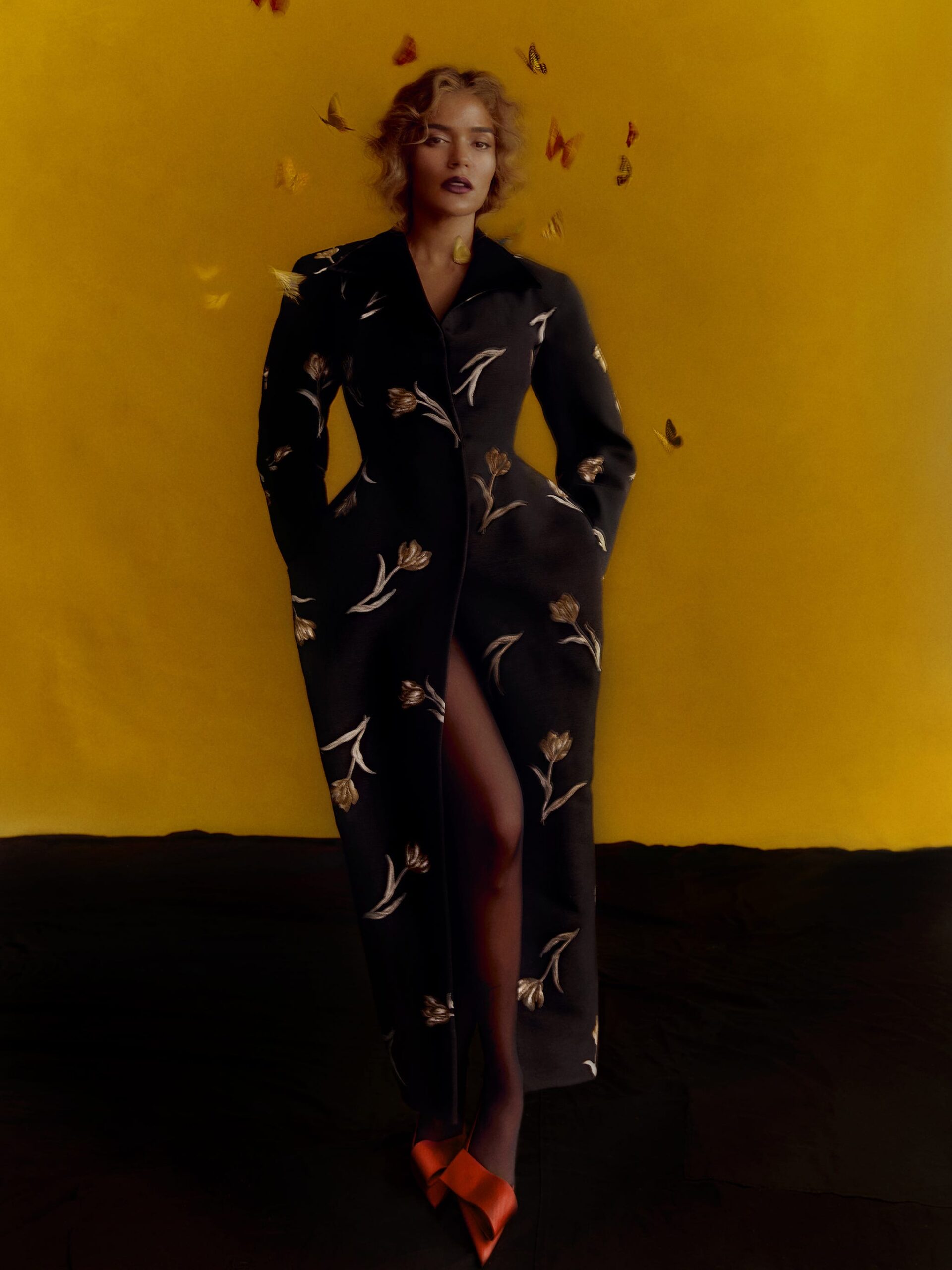
Coat, Jacquemus. Tights, Wolford. Shoes, Givenchy by Sarah Burton.

Dress, Diotima.
Long before she set out to unlock the great mystery of the primal, feminine energy inside herself, Carolina Giraldo Navarro was, she says, a “young tomboy” growing up in Medellín, Colombia. It’s hard to imagine what that was like in a place where “women are always put together—like a dessert,” she says. But, as she tells it, her parents originally expected her to be a boy, “so for a large part of my life, I dressed like one,” she explains. “I think it comes from them calling me Tomás all the time [what they would have named a son]. But I admired [Mexican pop stars] Thalía and Selena Quintanilla. I was so far from seeing myself like that then. It wasn’t that I wanted to re-create what they did, but I wanted to understand why it connected with me.”
Moved by las divas Latinas, as well as Alicia Keys and Lauryn Hill, Karol cultivated a passion for singing, and even competed in Colombia’s answer to The X Factor. In 2014, at the age of 23, she signed a deal with Universal and emerged with a rising tide of reggaeton stars, like hitmaker J Balvin, with whom she once performed at a quinceañera in Colombia.

Jacket, skirt, pumps, Dior.
In “Ahora Me Llama,” her 2017 breakout single with fellow newcomer Bad Bunny—followed by her 2018 morning-after anthem, “Mi Cama”—Karol introduced herself as the shrugging feminist foil to the macho manosphere that had long been reggaeton. Her warm, silken voice and unabashedly sex-positive ethos offered a reprieve in a field crowded with male MCs who didn’t identify women by their names, but instead by exaggerated recollections of their body parts.
Karol continued her ascent with the tough-girl stance of “Bichota,” and earned further international cred via collabs with Nicki Minaj and her Colombian pop foremother, Shakira. With the 2023 release of her most pop-facing album yet, Mañana Será Bonito, Karol wrested herself free from the trappings of the aforementioned boys’ club; “I was healing my inner child,” she says of the album now. The record would earn her the Latin Grammy for Album of the Year in 2023, as well as her first Grammy for Best Música Urbana Album the following year.
Once Karol began to share more red carpets and stages with people outside Latin America, it became increasingly clear to her how urgent her representation would become. “I wondered how I could be someone worthy of standing on those stages,” Karol admits. “I was always asking myself, ‘Who should I be? What kind of music should I make?’ I thought I had to be something else. But when I first played Coachella [in 2022], not on the main stage, [I realized that] what I wanted to do in my life was to represent who we are…as Latinos.”
Once she was confirmed as one of three headliners at this year’s Coachella, along with Sabrina Carpenter and Justin Bieber, Karol began designing the show with Parris Goebel, creative director and choreographer to stars such as Rihanna, Lady Gaga, and Jennifer Lopez. “I’d wanted to work with Parris on a huge project for years, but I wanted our two universes to coexist,” Karol explains. “I didn’t want her to just come in and make my show visually stunning but soulless. So it became a process of me introducing her to my culture.”

Top, Schiaparelli. Earrings, ring, bracelet, Cartier.

Dress, Diotima. Ring, Bernard James. Heels, Giuseppe Zanotti.
To test the viability of her Latin American cultural references, Karol had a perfect subject in Goebel, who is from New Zealand. Her method? Bingeing music videos on YouTube. “When I showed Parris videos of Juan Gabriel, she would cry,” Karol recalls of introducing Goebel to the top-selling Mexican recording artist of all time. “I thought, ‘Wow, I hope people feel that when they see my show, even if they aren’t Latino.’ I want them to understand that there is so much magic and triumph in who we are as artists.”
Karol did plenty of research of her own as well. At the famed Parisian strip club Crazy Horse, she studied the seductive art of burlesque; she also visited the ABBA museum in Stockholm to better understand the Swedish pop machine of her parents’ era. (“We listened to a lot of ABBA growing up,” she notes.) Karol pored through books like The Monk Who Sold His Ferrari by Canadian author (and eventually her life coach) Robin Sharma.
Yet she says her greatest inspiration for the Coachella show was the essential 1992 feminist text, Women Who Run With the Wolves: Myths and Stories of the Wild Woman Archetype by Mexican-American psychoanalyst Clarissa Pinkola Estés. (Which explains why the set was constructed to look like a complex of caves, with Karol and her dancers undulating ferally against one another between the rock walls.) In the book, Estés used folk tales as parables to encourage modern women to be less civilized. She argued for women to recover their natural-born intuition, which she said was largely suppressed by men under the guise of rational thought. Karol first discovered the book five years ago in a season of unbounded singledom, and dusted it off while plotting this year’s live show.

Gown, Meruert Tolegen.
“Many things I’ve done since were inspired by that book, often without me even realizing it,” she says. “That ‘wild woman’ persona is a state we should all strive to reach. Reconnecting with ourselves, our intuition, our sensuality, and our sexuality—I wanted to bring that to the stage. And I wanted to capture our Latino essence: our history, our music, that fiery spirit we have. We come from a long history of resilience and rising up from adversity.”
In the months after Bad Bunny showed support for immigrant communities at this year’s Grammy Awards and at the Super Bowl halftime show, Karol says she considered her own role as a Latin pop star with a large audience in the U.S., where Latin people have been disproportionately targeted by Immigration and Customs Enforcement under the Trump administration. In an April interview with Playboy, she shared the anxieties of others in the Latin corner of the industry, non-U.S. citizens worried about being made examples of by authorities in the States. And at the first of her two Sunday night shows at Coachella, after dancing and singing for nearly two hours—including while perched atop a majestic giant macaw—Karol delivered an ardent speech to her Latin fans, packed with poise and power. “Don’t feel fear,” she said. “Feel pride!”
“That felt like the first time in my life I really made a strong statement,” she tells me now. “I wanted to [show] people at every single concert that our [community] deserves those big stages. It wasn’t about transforming ourselves to fit into that space. It’s not really about me; I’m just a bridge, helping them feel proud of where they come from.”

Dress, Balenciaga. Necklace, Van Cleef & Arpels.
The premise of her 2025 album, Tropicoqueta, was born of cultural pride—not just for her own country, but for all of Latin America. She says that during her Mañana Será Bonito world tour, she felt heartened by the array of flags being waved at her shows. Each song on the album became a love letter to the countries her fans represented: She fashioned a bachata number for her Dominican fans, shared a honeyed pop track with Mexican balladeer Marco Antonio Solís, and recorded a funk song in Portuguese with Brazilian producer duo Tropkillaz.
“Tropicoqueta was about bringing a little piece of home for every place,” Karol says. “At the Coachella show, it was so beautiful to see people bringing their flags, especially considering how lately in the U.S., being Latino has been suppressed—how they try to make people afraid, or try to push us away, or actually strip Latinos of their role in this country’s evolution.
“Being Latino isn’t just a trend—people are just waking up to who we are,” she continues. “We aren’t Latina just for the moment; it’s forever. And everyone is invited to the party. Latinos are an open community. We love for people to understand who we are, to know our roots, even to try our foods, to go to our country. We can use music to extend that message, to open doors.”

Dress, Maison Margiela.
After she wrapped the first of her two Coachella shows, a power player opened the door to her trailer: Paul Tollett, CEO of Goldenvoice, the company behind Coachella. “I mentioned how crazy it was that it took 27 years [since] the festival [began] to finally bring a Latina to the stage as a headliner,” Karol tells me. “So he came up to me. He was very kind. He said, ‘I should apologize.’ I didn’t want to make him feel bad, but he acknowledged that it was the reality.…Before me, there were so many who could have undoubtedly filled that spot. What if Daddy Yankee had headlined Coachella? Or Ricky Martin, Enrique Iglesias, Gloria Estefan, Shakira? The fact that I was the first one just feels wrong—it feels incorrect.”
Whereas her expressions of dissent were previously reserved for the lyrics of her songs, Karol has embodied more of a warrior stance in the past year than ever before. In July, she made a rare political move by posting an open letter on social media, urging incoming right-wing Colombian President Abelardo de la Espriella, “May you not govern for a party…govern for Colombia.” And in her revealing 2025 documentary, Karol G: Tomorrow Was Beautiful, she spoke out against sexual harassment in the music industry, recounting how at age 16, she was propositioned by a music manager in his 40s, who made inappropriate advances while offering assistance with her career.
The documentary also delved into her love life, including her tumultuous engagement to rapper Anuel AA, and her more recent, and more private, three-year romance with Colombian singer-songwriter Feid. In January, headlines began appearing that they split, and while fans dug desperately for clues behind their breakup, Karol has maintained that it was not due to a catastrophic series of events, but a simple matter of misalignment. A couple of months before the breakup went public, Karol disappeared in Hawaii for four weeks to grieve and unwind.
“Before, I was trying to be a super powerful version of myself all the time,” she reflects. “It was like I put on a shell, like an armor—‘I can handle it, nothing touches me, nothing gets to me.’ But you have to exist in all your versions in order to have that power. People say, ‘Why me? Why did I love him?’ No…I don’t want my fans to feel that they always have to be a bichota. I also want to teach them to live through sadness. When time passes and you see things more clearly, you say: ‘It had to happen to learn this, to understand this, to value this more.’”

Dress, Diotima.

Gown, Meruert Tolegen. Earrings, Bernard James.
In her solo time, she stayed mostly offline. “I felt like I lost a bit of my freedom of expression; everything I say somehow gets twisted,” she adds. She listened to French pop avant-gardist Oklou (“her music stimulates my brain,” Karol says) and binged on the lovelorn shoegaze of indie-pop band Cigarettes After Sex, whose profile she followed on Instagram. She received a black heart emoji promptly after following the account; so began her friendship with frontman Greg Gonzalez, with whom she wrote the 2026 dream-pop ballad, “Después de Ti.”
“[‘Después de Ti’] came from a love that was lost, without me even knowing it was lost yet—after that, I kept pursuing that love,” she explains. “Then I had a little cousin who died. And when I spoke to his mother, she said things that were exact phrases from my song. I feel it can be for someone who went to heaven, or for people who are no longer together. It resonated with Greg, because of a personal loss he had also experienced. We clicked immediately.”
“Her lyrics are often deeply romantic, but also a bit dangerous at times,” Gonzalez tells me. “When she first showed it to me, I knew it was coming from a very honest place. I responded to the hurt that was being expressed by her voice.”
After swapping snippets of songs in DMs, Karol flew to L.A. to record in Gonzalez’s home studio. Joined by a keyboardist, guitarist, and bassist, they downed shots of tequila, chain-smoked cigarettes, and landed the best take of the track that night—“the same way I work with my band,” Gonzalez says. They debuted the song live at this year’s Coachella, to the delight of her fans. (“Crying was not on my agenda,” commented a fan on YouTube. “We need an entire EP or album by you two,” said another.) “It was like nothing I’ve done before. It felt like being at a bonfire,” Karol says of recording with the band. In fact, the experience inspired Karol so much that she’s returned to the studio—hoping to stoke that same creative flame she sparked that night in L.A.

Jacket, skirt, pumps, Dior. Earrings, Bernard James.
In the process of rewilding herself, as Estés might say, Karol is revisiting a time in her life when her inner fire was less hampered by external expectations: things like chart placements, awards, or tour revenue. “I was the ultimate romantic,” she recalls of her teen years. “Back then, it was still cool to dedicate songs [to your crush] over the phone. I used to leave letters—I went a bit overboard, I was a little cheesy. But how incredible it was to be dramatic and romantic. How incredible it was to cry over a song, even when you didn’t really know what heartbreak was yet!”
As we make our way outside the Hotel Bel-Air, we immediately spot a skywriting plane in the distance, leaving a trail of clouds in the shape of a heart and an infinity symbol. “Wow, look at that! Love forever! It was meant to be,” Karol says with a big smile. After 90 minutes in her company, talking about recovering our whimsy and wildness as women, I can’t help but feel like the message was divinely timed for us. “It’s a bit like going back to that—to that sense of wonder,” she adds. “Let’s see what it awakens.”
Lead Image: Top, Schiaparelli. Earrings, ring, bracelet, Cartier.
Hair by Dindi Hojah at Forward Artists; makeup by Bo for Dior Beauty; manicure by Stephanie Stone at Forward Artists; set design by Natalie Fält at Lalaland; produced by Nathalie Akiya and Raz Segal at GTS Productions.
‘ The preceding article may include information circulated by third parties ’
‘ Some details of this article were extracted from the following source www.elle.com ’