The Royal Commission on Antisemitism and Social Cohesion will today hear evidence from the community of a Melbourne synagogue gutted in a firebombing that Australia’s spy agency alleges was orchestrated by the Iranian government.
Early-morning worshippers fled the Adass Israel Synagogue in Melbourne’s inner-south-east when the deliberately lit fire tore through the building in December 2024.
Three people have since been charged over the fire, which the Australian Security Intelligence Organisation (ASIO) alleges was ordered by Iran’s Islamic Revolutionary Guard Corps.
This week, the royal commission hearings in Melbourne have primarily focused on security arrangements for the Jewish community.
Today, the Adass Israel Synagogue community is expected to give evidence to the commission on the impact of the firebombing on the community.
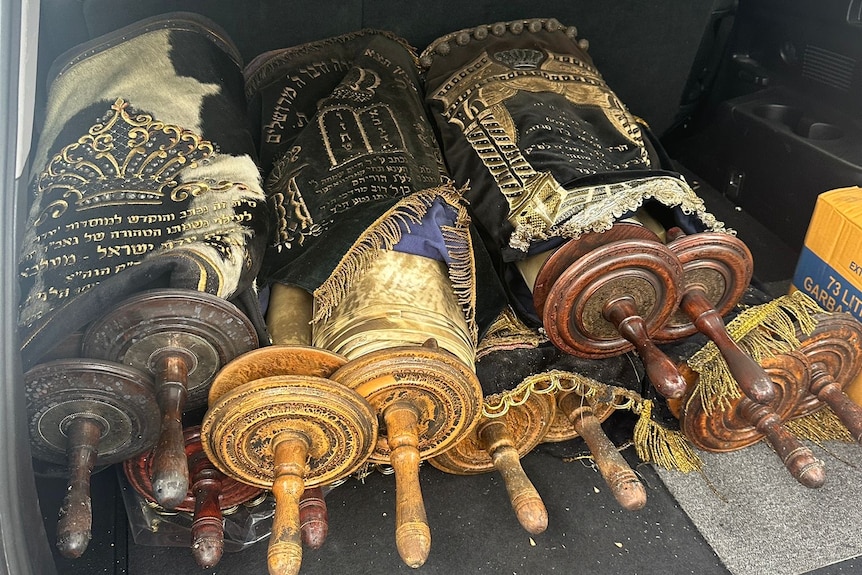
The synagogue is not expected to reopen for years as a result of the significant damage done to the building by the fire, which also damaged priceless Torah scrolls.
Torah scrolls were damaged in the arson attack on the Adass Israel Synagogue in Melbourne’s south-east in December 2024. (Supplied)
The scrolls were contained in a fireproof safe, which was installed after an arson attack on the same synagogue in 1995.
While the safe offered some protection during the 2024 blaze, radiant heat and water from dousing the fire caused damage to the delicate parchment.
Prime Minister Anthony Albanese announced the royal commission in January following Australia’s worst terror attack in which 15 people were killed at a Hanukkah event on Bondi Beach in December 2025.
Security arrangements in the spotlight
This week, the royal commission is focusing on security arrangements for the Jewish community, the role of law enforcement agencies and emergency preparedness.
Much of yesterday’s hearing focused on Jewish security organisation Community Security Group, which told the commission the cost of its operations had tripled amid a rise in antisemitic incidents after October 2023.
A representative of the group said he had major concerns about the sustainability of the operation, which works closely with police but was funded mainly through philanthropic and community support.
“The pressure has been immense on all our staff and our volunteers,”
he said.
“We ask more of them now than we ever have.”
Jason Steinberg from the Queensland Jewish Board of Deputies told the inquiry that identifying what did and did not count as antisemitism had been a challenge for police in his state before recent changes around hate speech laws.
“It’s easy to understand right-wing extremism: it’s a Nazi salute, it’s a swastika,” he said.
Jason Steinberg is on the Jewish Board of Deputies and established the Queensland Holocaust Museum. (ABC News: Mark Leonardi)
“But without that, the other levels of antisemitism of attacking Queenslanders as being genocidal terrorists, for example, in public, is not so easy to identify for police.
“Our community has felt vulnerable because the police haven’t been acting on that.”
The inquiry is expected to hear from police agencies in several states, a counterterrorism expert and a senior bureaucrat from the Department of Home Affairs as hearings continue this week.
‘ The preceding article may include information circulated by third parties ’
‘ Some details of this article were extracted from the following source www.abc.net.au ’