Seattle’s music legacy is often known to be grunge, flannels, Soundgarden and Nirvana. But years before grunge blew up in summer 1991, the Seattle rap scene had been bubbling beneath the surface to produce stars that would put the city on the map.
“I have a friend who owns a record store in Capitol Hill — I remember chatting with him, and he was like, ‘Yeah, I sell 10 copies of (“Nevermind” by Nirvana) a day,’ ” said Gary Campbell, a music researcher. “It’s one of those things like, why isn’t it the same enthusiasm, love, discussion, excitement around Seattle hip-hop?”
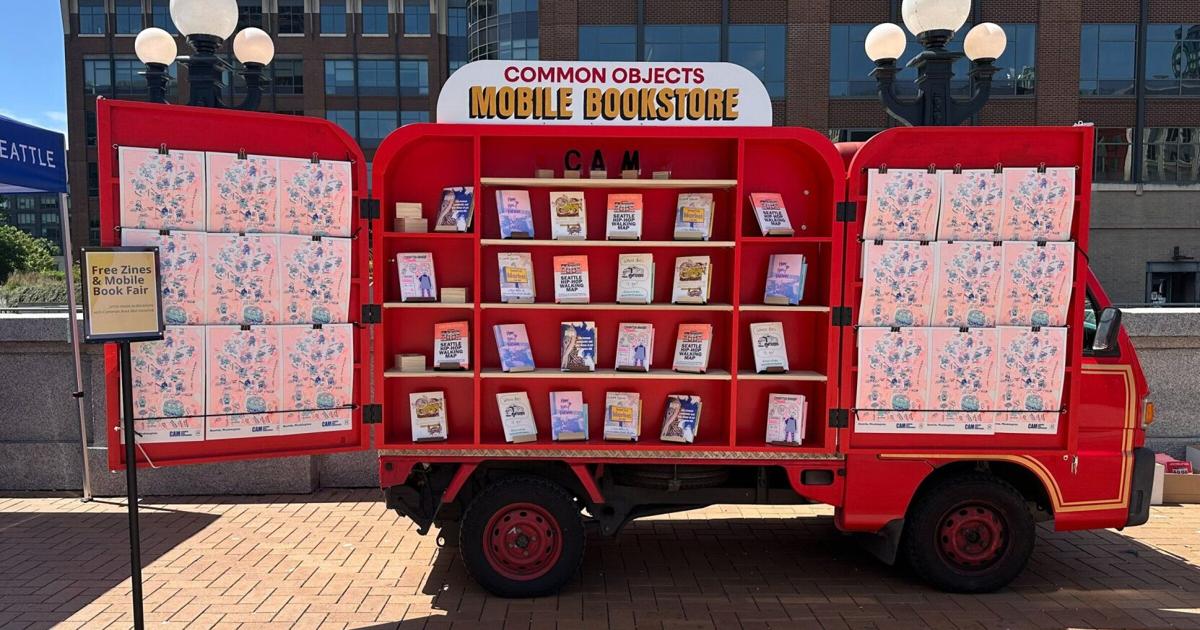
The question drove Campbell to create “The Seattle Hip-Hop Walking Map.” Spanning over 7 miles across the Central District, downtown Seattle and Capitol Hill, the guide, which is available at pop-up events hosted by artist nonprofit Common Area Maintenance throughout the summer, highlights 23 “landmarks” integral to the city’s first rap decade — from record shops to concert venues and clubs.
Originally from Toronto, Campbell moved to Seattle in 2013, where he became involved in the local hip-hop scene and eventually opened his own rap record label, Crane City Music.
“When I first moved to the United States, (someone was) like, ‘If you want to know about America, you should listen to hip-hop music,’ ” Campbell recalled. “So I sort of got really interested in it: ‘I live in Seattle, let’s start listening to Seattle hip-hop music and kind of understand more about the city.’ ”
During the pandemic, he began archiving lost Seattle rap records. Eventually, Campbell joined CAM as a space to begin researching and writing a new book on Seattle rap. Derived from research for this future book, his hip-hop walking map was born, covering the genre’s rise in the city from the early 1980s to 1993. Accompanying the map is a brief summary for each landmark explaining its significance during that time.
The guide is part of a project known as “Pocket Neighborhoods,” put on by CAM. The nonprofit put together a collection of 10 zines made by local independent artists exploring Seattle’s “hidden histories,” with Campbell’s walking map being one of them. Granted by the city’s office of arts & culture, nearly 500 prints were distributed for free via a “mobile bookstore” at the June Pioneer Square Art Walk, where all printed zines ultimately sold out. (The hip-hop walking map and other Pocket Neighborhoods zines are still being printed, CAM executive director Timothy Firth said, and will be available at community events like Pioneer Square Art Walk for the rest of the summer.)
“Seattle, in particular, has a lot of really interesting stories to tell — small neighborhoods, corners, an individual, a family,” Firth said. “This is an attempt to support artists in capturing some of those stories and adding to the broader kind of cultural and historic texture of the city.”
Split into two routes (Central District to Capitol Hill, and Seattle Center to downtown), the guide starts off in Judkins Park to honor hip-hop group Emerald Street Boys, who released the first local rap record in 1983. The park was the site of the 1982 Black Community Festival, where the trio competed at a “rap off” competition. Known for their emcee and break dancing skills, their win earned them a slot to perform at that year’s Seafair Torchlight Parade.
This was just one of many prominent shows the trio performed through the ’80s. A few stops northeast on the walking map, catch sight of the Central District’s Washington Hall, where Emerald Street Boys performed with other pioneering local hip-hop groups like Emerald Street Girls and Silver Chain Gang in 1982. And on the second route, hit the former Flag Pavilion (now the Fisher Pavilion) to see where the trio became the first rap group to perform at Bumbershoot in 1983.
Also in the Central District, pass by Rotary Boys & Girls Club, where Grammy Award-winning rapper Sir Mix-A-Lot got his start playing turntables for neighborhood kids and teens. (Four blocks east is another landmark highlighted on the map, Garfield High School, which is the alma mater of notable music figures like Macklemore, Derrick “Vitamin D” Brown, Quincy Jones and Jimi Hendrix.)
Two other guide locations also serve as highlights for Sir Mix-A-Lot: Dick’s Drive-In on Capitol Hill and the Olympic Hotel on University Street.
In his 1988 song “Posse’ on Broadway,” the rapper tells the story of him and his friends “cruisin’” through the Central District, eventually stopping at the local burger joint: “Dick’s is the place where the cool hang out, the Swass like to play, and the rich flaunt clout.”
As for the Olympic Hotel, that’s where Sir Mix-A-Lot’s label, Nastymix Records (co-founded by the late “Nasty” Nes Rodriguez), held a black-tie gala to celebrate his debut album, “Swass,” in 1989. At the time, the record became the bestselling independent album from an artist in the Northwest, at 500,000 copies.
Although some of these sites and others on the map still exist, many are either demolished or shut down, Campbell said. For example, on First Avenue, a vintage clothing store sits in the site of former grunge club The Vogue. Vitamin D and Bill “B-Self” Rider, a duo known as Ghetto Chilldren, performed there with Seattle rock band IMIJ in 1993. A cousin of Emerald Street Boys’ Eddie “Sugar Bear” Wells, Vitamin D went on to have an influential career in music, working with well-known hip-hop artists like 50 Cent, Macklemore and Kendrick Lamar.
Campbell’s walking map serves as a continuation of recent works highlighting the city’s hip-hop history, something that scholars say has largely gone undocumented. In 2020, historian and professor Daudi Abe attempted to correct the lack of preservation with the release of his book “Emerald Street: A History of Hip Hop in Seattle.” Another book, “The Birth of Seattle Rap” by music journalist Benjamin “Novocaine132” Camp, was released last year.
“Every place has its own story — (hip-hop) might have hit these places at the same time in 1979, but all these places have different energies, different people, different styles coming out of them,” Abe said. “I’m happy and excited to see all of these different region-specific texts coming out, and I think that’s going to expand as we move forward.”
For Campbell, his walking map is just another way to celebrate and amplify the region’s rap scene.
“I look at a project like this walking map as a fun and interesting way to provide an introduction to the city,” Campbell said. “My hope is that someone who gets these two self-guided walks … you get a chance to kind of see the city through (a) new lens.”
‘ The preceding article may include information circulated by third parties ’
‘ Some details of this article were extracted from the following source www.yakimaherald.com ’