Christopher Nolan omitted several elements from The Odyssey in his own film adaptation, from Odysseus’ (Matt Damon) “nobody” trick to the appearance of gods like Hermes. However, he also added something to the film: references to the mysterious “people from the sea.”
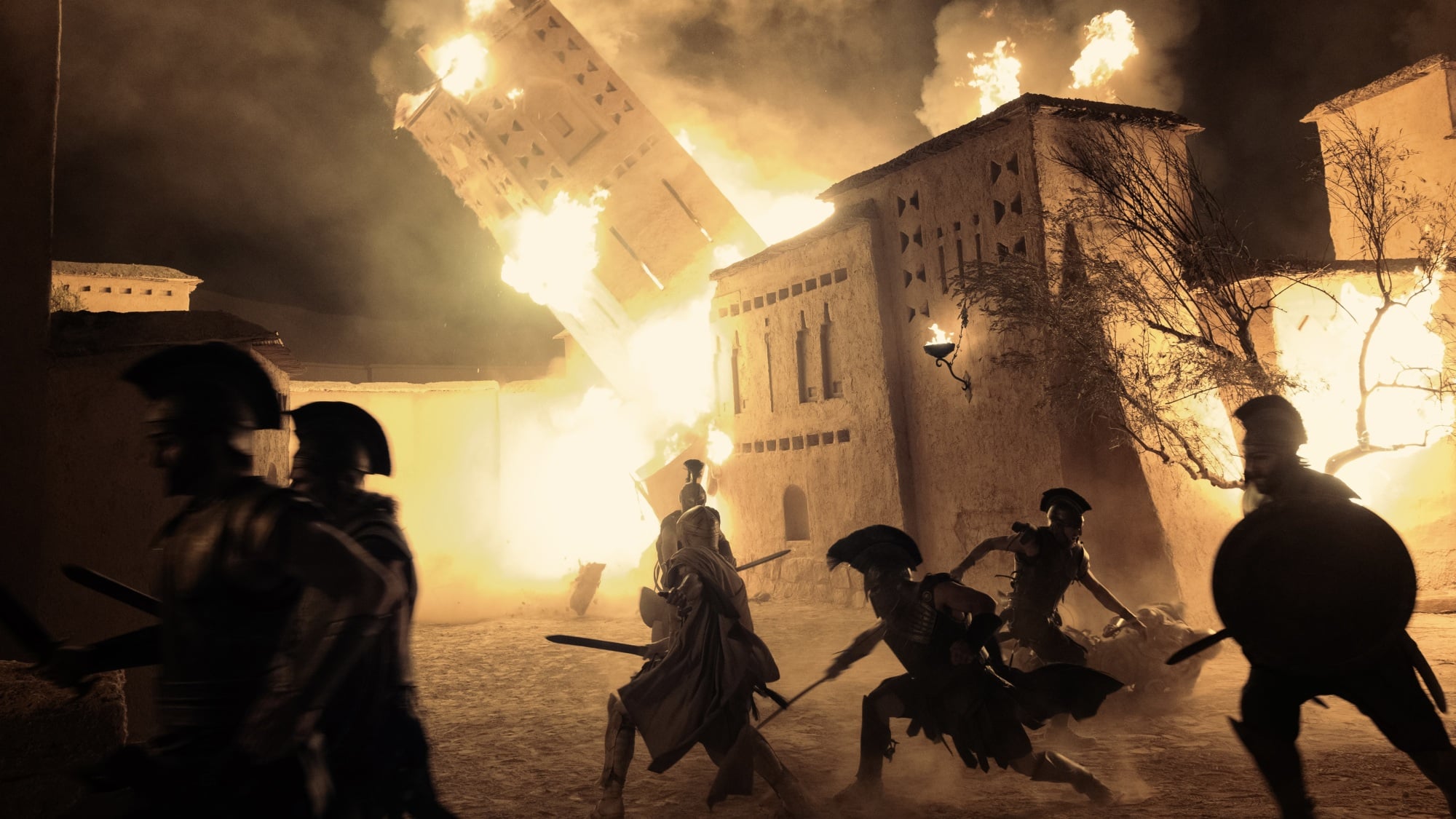
Penelope (Anne Hathaway) and the rest of Ithaca fear these marauders, who have been raiding nearby shores following the end of the Trojan War. By the end of The Odyssey, Nolan reveals that these unknown attacks come from a lot closer to home than Penelope would have guessed. They’re the Greeks, returning to their homeland after storming Troy and desecrating Zeus’ law.
The people from the sea storyline isn’t in Homer’s Odyssey. However, it is rooted in the real history of the Late Bronze Age. Who were the real Sea Peoples, and could they have inspired portions of Homer’s epic poem? Let’s dig in.
Who were the Sea Peoples?
Credit: Melinda Sue Gordon / Universal Pictures
“Sea Peoples” is a blanket term coined by 19th-century French Egyptologist Emmanuel de Rougé, used to describe a number of seafaring factions theorized to have attacked and settled in Egypt and other parts of the eastern Mediterranean, including Eastern Anatolia, Cyprus, Palestine, and Syria.
Previously, historians attributed the Bronze Age collapse to the Sea Peoples’ invasions throughout the 13th and 12th centuries BCE. This is essentially the route Nolan chooses in The Odyssey, as Odysseus believes the Sack of Troy and the Greeks’ ensuing return home are bringing about the end of “our age of bronze.”
However, that line of thinking has since changed, especially when considering environmental impacts around the region. In his book 1177 B.C.: The Year Civilization Collapsed, Eric Cline, professor of Classics and Anthropology at George Washington University, posits that the collapse of the Bronze Age comes down to a “perfect storm” of disastrous events, ranging from droughts and earthquake storms to rebellions and systems collapse. The blame, then, does not lay squarely at the feet of the Sea Peoples.
“It’s a mixture of both a symptom and a cause,” said Megan Daniels, assistant professor of Ancient Greek Material Culture at the University of British Columbia, in a phone interview with Mashable. “When you have mass instability, people leave. People migrate. People band together with one another to try to survive. Yes, that might involve getting in ships and raiding to stay alive, but they’re often leaving because of other instabilities in their own societies.”
Mashable Top Stories
The actual Sea Peoples are varied. Sources from the reigns of two pharaohs, Merneptah (1213-1203 BCE) and Ramses III (1187-1157 BCE), detail interactions with several groups. Daniels highlighted three in particular: the Peleset, the Denyen, and the Sherden. The Peleset are related to the Philistines, and based on aspects of their material culture like cookware and decorations, they likely originated from the Greek world. The Denyen carry a name that could be related to a term Homer used to describe the Greeks: the Danaans, after their ancestor Danaus. Finally, the Sherden’s name could suggest ties to Sardinia. While they do show up in sources as attacking Egypt, they also appear as mercenaries for the pharaoh. In later records, they even settle in Egypt, buying land and paying taxes.
“It’s not one people, and they’re not simply invaders,” Daniels said of the Sea Peoples. “They, in many ways, seem to also be mercenaries, traders, maybe pirates. With Merneptah, some of the language that he used talks about a Libyan king allying with these people, but he also talks about his wife and children with them. Once again, you get this question of, are they all simply just piratical invaders? Or are they people just migrating, families who are trying to leave and find a better life somewhere? It just goes to show the depth and the complication of this scenario that we call the Sea Peoples.”
Did the Sea Peoples influence Homer’s Odyssey?

Jimmy Gonzalez, Matt Damon, and Himesh Patel in “The Odyssey.”
Credit: Melinda Sue Gordon / Universal Pictures
The Sea Peoples were active from the 13th to 12th century BCE, while traditional dates for Homer range around the 8th century BCE. Could knowledge of the Sea Peoples’ past exploits have wound up in The Odyssey in some way?
Potentially! In his book Black Ships and Sea Raiders: The Late Bronze and Early Iron Age Context of Odysseus’ Second Cretan Lie, archaeologist Jeffrey P. Emanuel singles out an episode from The Odyssey and draws parallels between it and the activity of the Sherden. The episode in question is known as “the Cretan Lie” and appears in Book 14 of The Odyssey. Here, a disguised Odysseus tells loyal Eumaeus (John Leguizamo) a falsehood about his past. He claims to be the son of a rich Cretan and says that he carried out an unsuccessful raid on Egypt. After the pharaoh showed him mercy, he claimed he settled there for seven years.
Emanuel highlights the similarities between this tall tale and the activity of the Sherden in Egypt, suggesting that this falsehood may ironically bear a kernel of truth based in history. This isn’t to say that the Cretan Lie actually happened, but rather, that it may draw from records of the Sea Peoples, emphasizing the interplay between history and epic poetry.
This is a theme Nolan highlights in his adaptation of The Odyssey. Towards the end of the film, as Odysseus and Penelope sail west, they talk, fairly heavy-handedly, about how the collapse of civilization will bring with it the loss of writing. Instead, oral storytelling will be how people will recall the Trojan War.
“It was definitely betraying Nolan’s awareness that this odyssey that he’s adapting was this preservation of these memories of this time,” Daniels explained. “The later Greeks called it an Age of Bronze and an Age of Heroes, and it was looked back on as this golden age, a mythical time, even though it was actually real. Of course, things get embellished in different ways.”
Nolan’s inclusion of the Sea Peoples in his take on The Odyssey is one such embellishment. It may not be in keeping with the historical record, but it does serve the film’s broader messaging about the devastation of war, one that leads to an Oppenheimer-esque reckoning for its hero. So, in bringing the Sea Peoples into The Odyssey, Nolan is also drawing a common thread through his own work that will be familiar to those who have seen his films.
As Daniels said, “Nolan is probably doing what Homer would have done too, which is repackage an age-old tale that has some basis in deeper history for his own audience.”
‘ The preceding article may include information circulated by third parties ’
‘ Some details of this article were extracted from the following source mashable.com ’






![[ URDU ] ROYAL ELITE SERIES S1 | GRAND FINAL DAY 3 | FT – #dsg #kong #t2k #asl #lf #ns #karo](https://celebrity.land/en/wp-content/uploads/2026/07/1784886102_maxresdefault-75x75.jpg)