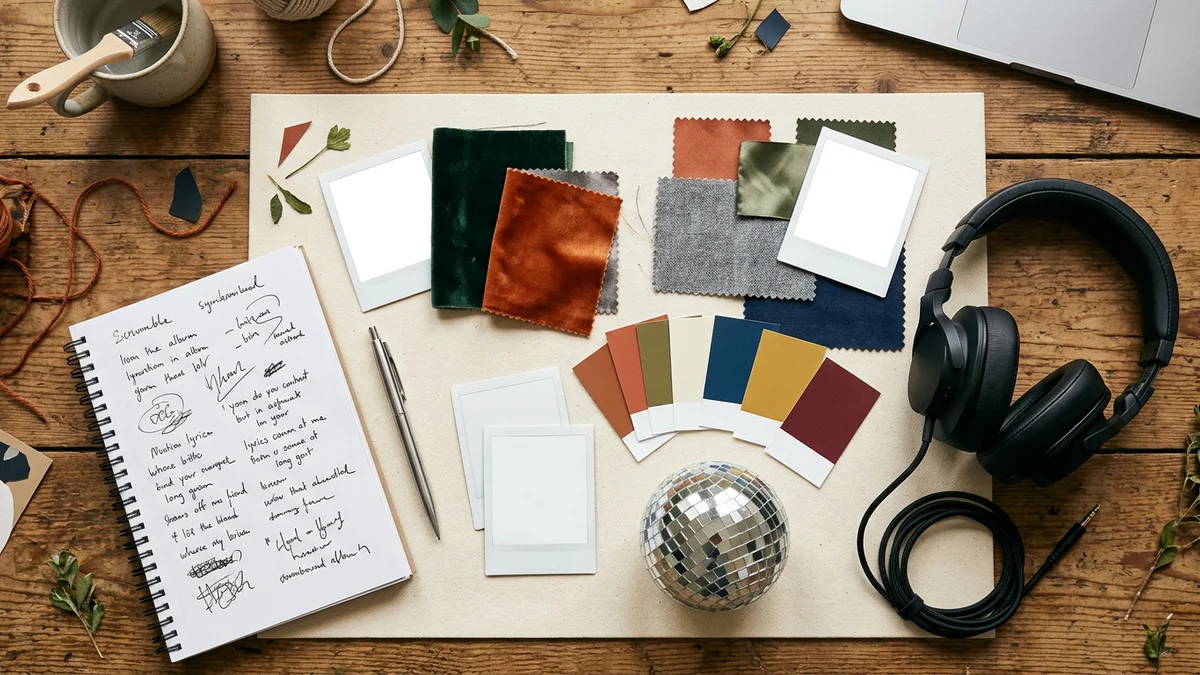
Remember when an album announcement was just an announcement? At Young Hollywood, we’ve watched as artists now build entire visual universes for fans before a single note is released.
There was a time, not so long ago, when an album rollout was a straightforward affair. An artist announced a title, revealed the cover art, and dropped a lead single. It was an event, sure, but a contained one. Young Hollywood has been on the front lines watching that paradigm get completely dismantled. Today, an album era doesn’t begin with a song; it begins with a color. A font. A feeling.
Welcome to the age of the album-rollout-as-moodboard. It’s a full-fledged aesthetic experience that kicks off weeks, sometimes months, before we hear a single track. This isn’t just about building hype. It’s about building a world, inviting fans to step inside, get comfortable, and start redecorating their own digital lives to match.
The Anatomy of an Era
So what does this new school of marketing actually look like? It starts with the fundamentals of graphic design. A specific shade of lavender, a stark crimson, or a hazy, sun-bleached yellow can become the immediate signifier for an entire musical project. Artists will wipe their Instagram feeds clean, leaving only this new, dominant color, signaling to millions of followers that a new chapter has begun. It’s a digital reset button that’s impossible to ignore.
Then comes the typography. Every era has its font. Is it a classic, literary serif suggesting introspection and nostalgia? Or a clean, futuristic sans-serif hinting at electronic beats and a forward-facing sound? These choices are deliberate, an unspoken promise of the sonic and lyrical themes to come. Fans immediately adopt these elements for their own bios and fan edits, becoming extensions of the campaign itself.
This visual language is further developed through cryptic micro-clips. A three-second, glitchy video of a flower blooming, a distorted shot of a cityscape, a hand reaching for a telephone—these are the new trailers. They aren’t meant to be fully understood. They’re meant to be screenshotted, debated, and dissected frame-by-frame by a legion of fan-detectives trying to piece together the puzzle.
Fan Service or World-Building?
Cynics might call this overwrought marketing, but that misses the point. This is participatory art. In the screenshot era, giving your audience a rich visual tapestry is the most valuable currency you have. An album cover is a static image; a moodboard is a living, breathing ecosystem of content. It provides the raw materials for fans to create their own content, turning passive listeners into active co-conspirators in the rollout.
Fan theories blossom in this environment. Does the number of rings on a finger in a photo hint at the track number for the lead single? Does the specific type of flower in a clip connect to a historical art movement? The artist provides the dots, and the fanbase furiously works to connect them. This collaborative decoding creates an intense sense of community and shared purpose long before the music festival wristbands are even ordered.
Dressing the Part
Perhaps the most fascinating evolution is the establishment of ‘outfit codes.’ The moodboard extends beyond the screen and into the closet. An artist’s new aesthetic comes with an unspoken dress code, a palette and silhouette that fans are encouraged to adopt. Think flowing white dresses for a folk-inspired era or shimmering sequins for a disco-pop revival. This is more than just merch; it’s a costume for the role you play as a fan.
The concert or listening party then becomes a real-life manifestation of the digital moodboard. The arena is filled not just with fans, but with thousands of people all dialed into the same exact frequency, all speaking the same visual language. It’s a powerful sight, and one that is tailor-made for TikTok transitions and Instagram photo dumps, creating an endless, self-perpetuating loop of promotion that feels entirely organic.
A Richer Listening Experience
Ultimately, this deep-seated pre-load of visual information changes how we experience the music itself. When the album finally drops, you aren’t just pressing play. You’re stepping into a universe where you already know the rules, the colors, and the textures. That melancholic synth line hits harder because you’ve been immersed in its corresponding shade of midnight blue for weeks. The defiant lyrics resonate more because they are typed out in that bold, uncompromising font you’ve seen everywhere.
The music becomes the final piece of the puzzle, not the first. It’s the soundtrack to a world that has already been lovingly and meticulously constructed in the public imagination. It gives the songs an immediate sense of place and history.
Forget the simple album drop. The modern musical era is a multi-sensory, multimedia art installation. And we, the fans, are its curators, its inhabitants, and its most passionate evangelists. The show starts the moment the feed goes dark.
‘ The preceding article may include information circulated by third parties ’
‘ Some details of this article were extracted from the following source younghollywood.com ’