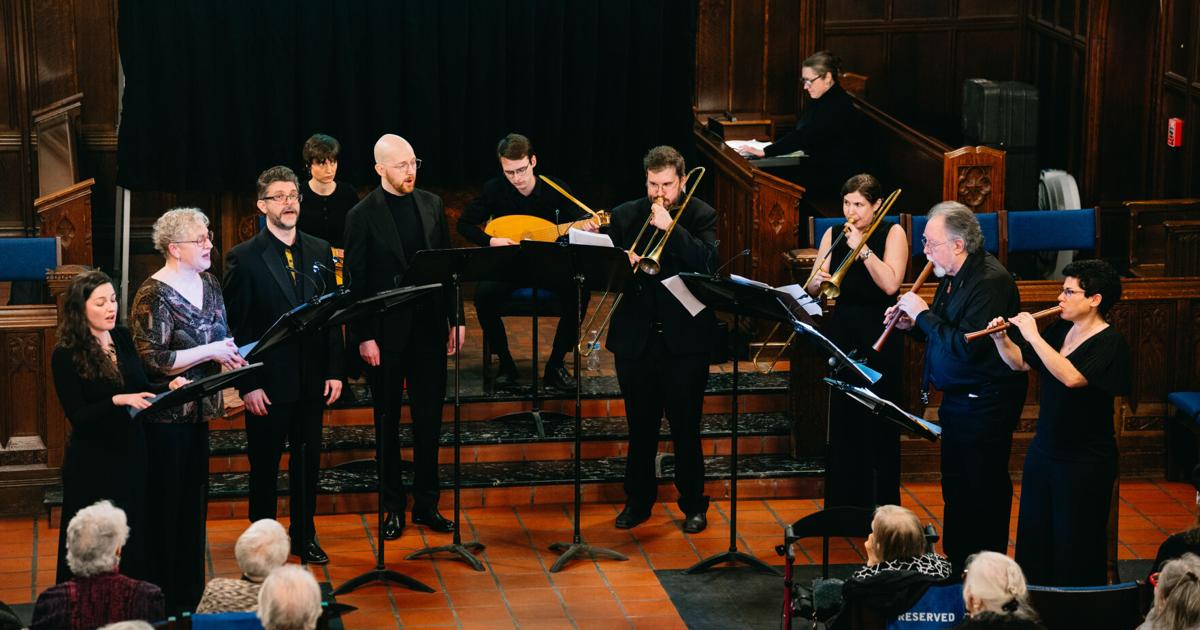
The Newberry Consort’s latest concert at Bond Chapel on the University of Chicago campus featured music from the 15th and 16th centuries and was designed as a celebration of the Renaissance.
Artistic director Liza Malamut assembled a fine group of musicians, including a vocal quartet made up of Camila Parias, soprano; Laura Pudwell, mezzo-soprano; Matthew Dean, tenor; and Ian R. Prichard, bass. They offered a stunning performance of Jean de Ockeghem’s motet “Alma redemptoris mater,” creating a beautifully balanced a cappella performance.
Particularly striking were Mary Vanhoozer on hurdy-gurdy and Rotem Gilbert on bagpipes. They created a tantalizing sound in such works as “La dance de Cleves” from Marguerite of Austria’s “bassedanse” manuscript. Daniel Zanuttini-Frank’s lute was sweet and delicate and for Ockeghem’s “Departes vous male bouche” his sound was hushed and pretty.
Throughout the evening Malamut and Ben David Aronson (executive director of the Newberry Consort) offered bracing music for sackbut and trombones. They added an invigorating element that created a sparkle in the music. The recorders, including one played by Daniel Stillman, provided a lovely airiness. The music, 23 pieces in all, was a splendid collection that held your interest and showed how effective these early instruments could be in making memorable music.
One thing which the Newberry Consort does really well is to place their music in historical context. Spoken commentary as well as the program notes transport you to another place and time, often with specificity. This time around, they wanted to highlight the interconnection between the new Renaissance technologies and the changes that were taking place in the world of music. This is a huge subject and it would be unfair to say that they managed this in more than the most superficial way. Most of the texts performed had little to do with developments in tech and science and instead were about religion or love, thus limiting their ability to make their point. The projected images — while often scientific — mostly had no connection to music.
Leonardo da Vinci was mentioned multiple times in the program notes as well as in the spoken commentary, yet there was no mention that he was a skilled musician, inventor of musical instruments, or a composer. For some, da Vinci himself might be seen as the embodiment of the night’s thesis, yet even that is unclear. When Michelangelo sneered that da Vinci was “that lyre-player from Milan,” he was not being complimentary. Not everyone, even heroes of the Renaissance, believed that music was as elevated a practice as was painting or science.
So in the end, the idea was really left as a tantalizing suggestion, one that many people may keep in the back of their minds as something interesting to contemplate. That itself is a fine experience to add to an evening of music.
‘ The preceding article may include information circulated by third parties ’
‘ Some details of this article were extracted from the following source www.hpherald.com ’