The legendary A PLACE IN THE SUN HOTEL in Palm Springs, originated as Compound of the Oscar winning movie with the same name and a celebrated landmark by Walter White and Albert Frey, shares the secrets of the Film Festival: “It is An Oscar Oracle!”
The Hollywood A List goes in and out of the legendary midcentury modern landmark hotel A Place In The Sun on 754 E San Lorenzo Road in Palm Springs that is named in one breath with the Parker Hotel, The Ritz Carlton, La Quinta Club Hotel, Hermann Bungalows and the Le Horizon and Ingleside Inn.
The real big stories happen at the pool that was favored by Elizabeth Taylor, Marilyn Monroe, Walt Disney and Margaret O’Brien: “We hear from our current and past Oscar Winning guests since 1951 when our gates opened, that the Infernation Film Festival Winners of Palm Springs always score big at the Oscars! And when we research this story it becomes a fact! If the Palm Trees could talk at the elegant estate…
Palm Springs International Film Festival and the Oscar Oracle Effect.
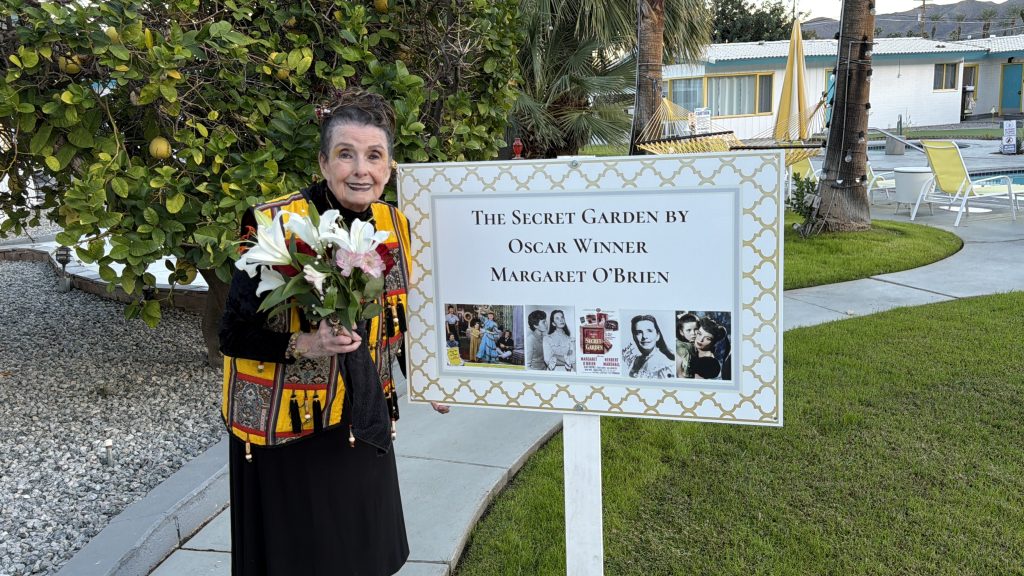
Oscar Winner Margaret O’Brien came to A PLACE IN THE SUN HOTEL Palm Springs for Christmas 2025 and Her Plaza Theatre Show about Judy Garland
A desert gathering that quietly shapes awards season narratives long before the ballots are cast.
The Palm Springs International Film Festival has developed a reputation that extends far beyond its official screenings and awards ceremonies. Within the industry, it occupies a particular place in the calendar where momentum becomes visible and consensus begins to take shape. Its timing, atmosphere, and carefully curated audience have turned it into a reliable indicator of which performances and films are likely to resonate throughout the remainder of awards season.
Set in Palm Springs, the festival benefits from a location that encourages focus without isolation. The city offers comfort, clarity, and space, qualities that allow industry conversations to unfold naturally. Unlike festivals driven by premieres or market urgency, this gathering is about assessment, recognition, and reflection. Films arrive having already been seen elsewhere, yet the response here often carries greater consequence.
The festival’s awards are shaped by a jury and an audience that includes Academy members, publicists, studio executives, and seasoned observers of awards campaigns. Their reactions tend to align closely with later outcomes at the Academy Awards. Over time, this alignment has become consistent enough that Palm Springs is widely regarded as a proving ground rather than a celebration alone.
The atmosphere surrounding the festival reinforces its role as an oracle. Events are polished but restrained. Screenings are followed by thoughtful discussions rather than spectacle. Conversations move easily from craft to career trajectory, and from individual performances to broader industry patterns. There is an emphasis on substance that rewards films with emotional clarity and disciplined storytelling.
Actors often arrive at Palm Springs at a pivotal moment in their campaigns. By this point, early critics’ prizes have been announced and guild screenings are underway. The response they receive here helps confirm whether a performance has staying power. Applause, standing ovations, and the tenor of post screening conversations are noted carefully by those shaping awards strategies.
Directors and producers find Palm Springs equally valuable. The festival provides a chance to present work to an audience that understands the mechanics of awards voting. Technical achievements are recognized with seriousness, and ensemble work tends to receive particular appreciation. This focus often mirrors later nominations, reinforcing the festival’s predictive reputation.
Studios treat Palm Springs as a calibration point. Campaign messaging is refined based on reactions here. Performers who connect strongly with the audience often see increased visibility in subsequent weeks. Films that underperform may be repositioned or quietly scaled back in awards ambitions.
The festival’s awards ceremony reflects its measured tone. Honors are presented in an environment that feels formal yet accessible. Recipients are acknowledged for specific contributions, and the emphasis remains on the work rather than personal narrative. This approach aligns closely with how Academy voters often describe their own priorities.
Palm Springs audiences are known for their attentiveness. Screenings are marked by sustained focus and considered responses. Laughter, silence, and applause are registered in a way that feels collective rather than performative. This attentiveness contributes to the sense that reactions here are meaningful indicators rather than fleeting impressions.
Industry professionals often remark on the clarity that emerges during the festival. Films that seemed uncertain elsewhere can find renewed strength here. Performances that felt understated gain recognition when viewed alongside peers in a concentrated setting. The desert backdrop, while understated, seems to encourage this kind of reassessment.
The city itself supports the festival’s rhythm. Venues are close, schedules are manageable, and informal encounters are common. These conditions allow conversations to continue beyond official events, reinforcing impressions formed in screening rooms. Over several days, a consensus often develops quietly.
Palm Springs has also become a place where emerging talent gains credibility. Young actors and first time directors benefit from being presented alongside established figures. Recognition here signals industry confidence and can accelerate future opportunities.
The festival’s history reinforces its standing. Many films and performances honored in Palm Springs have gone on to receive major nominations and wins. This pattern has been observed repeatedly, lending weight to the idea that the festival reflects broader industry sentiment rather than shaping it artificially.
Publicists and strategists pay close attention to press coverage generated here. While the festival is not driven by breaking news, the tone of reporting often emphasizes inevitability or momentum. These narratives can influence how films are perceived in the crowded awards landscape.
The absence of premieres allows Palm Springs to focus on evaluation. Films are seen without the pressure of discovery, enabling audiences to engage with them on their merits. This context mirrors the way Academy members encounter nominated films later in the season.
As awards season progresses, references to Palm Springs often surface in conversations about frontrunners. Its role is rarely overstated, yet it remains consistently present. The festival functions as a mirror held up to the industry, reflecting its collective instincts.
For filmmakers, inclusion in Palm Springs represents acknowledgment from peers who understand both artistry and industry realities. This dual recognition contributes to the festival’s authority. It is respected not for spectacle, but for discernment.
The Oscar oracle reputation is not the result of deliberate positioning. It has emerged organically through years of alignment with final outcomes. The festival’s structure, audience, and timing have combined to create an environment where consensus can be observed rather than manufactured.
Palm Springs International Film Festival continues to occupy this unique space with quiet confidence. Its influence is subtle but enduring. In a season defined by noise and urgency, it offers a moment of clarity that often proves decisive.
‘ The preceding article may include information circulated by third parties ’
‘ Some details of this article were extracted from the following source t2conline.com ’