It’s been a miserable build-up to this year’s Strictly Come Dancing, from arguments over the casting of divisive Apprentice star Thomas Skinner to lingering scandals around inappropriate behaviour and alleged drug-taking. So it must be a relief to Strictly’s producers that, following the start of the competition, the biggest talking point is a very familiar one: whether celebrities with previous dance training should be allowed to compete.
Some viewers are even crying “fix” given that two accomplished contestants, musical theatre actors Lewis Cope and Amber Davies, were rushed in as last-minute replacements after Kristian Nairn and Dani Dyer withdrew with injuries. It’s even been reported that Love Island winner Davies was rejected from the show previously by BBC bosses because she had too much dance experience.
Davies trained at London performing arts college the Urdang Academy, and has starred in West End shows like 9 to 5: The Musical and The Great Gatsby. She produced an impressive waltz in her Strictly debut – despite only having three days’ rehearsal.
Emmerdale actor Cope also bounded up the leaderboard with his energetic jive, though some viewers grumbled that he’d previously appeared in Billy Elliot the Musical and competed on Sky One’s Got to Dance.
Both super-subs were pipped to the top spot by former Lioness Karen Carney, although any jubilation at this total beginner triumphing was short-lived: we’ve since learnt that Carney competed in dance contests as a child before switching to football.
To which I say: so what? I have absolutely no patience with this hand-wringing over perceived unfairness, which seems to plague Strictly every year. Yes, some celebrities begin with more dance ability than others, but that doesn’t guarantee they’ll win – quite the opposite, in fact.
Strictly’s history is teeming with contestants who powered into the competition as though shot out of a cannon, already able to do multiple spins and pop into the splits, only to discover that such overconfidence turns off viewers. The judges might reward them with 10 paddles galore, but they also need those crucial votes.
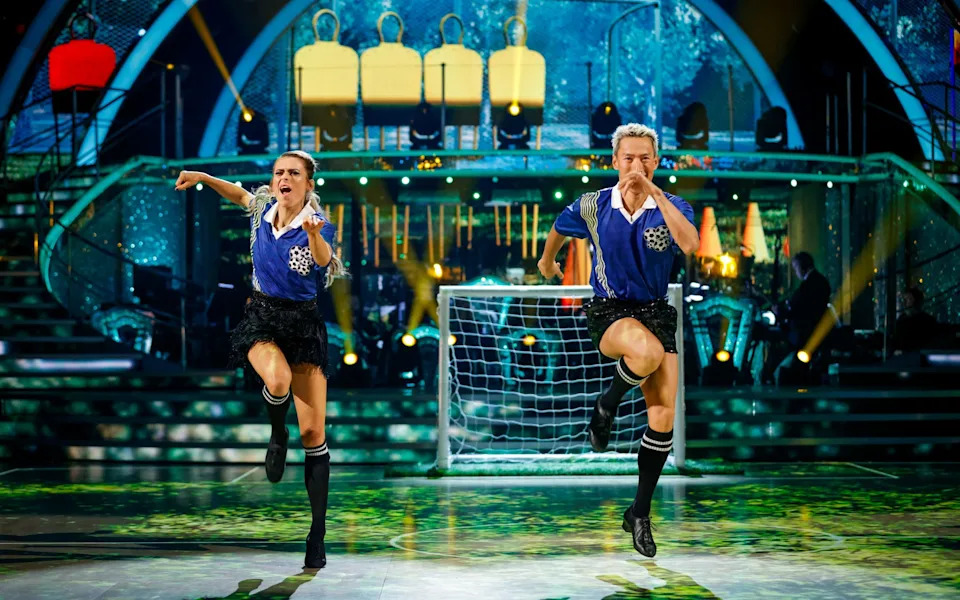
Karen Carney topped the leaderboard last week, but we’ve since learnt that she competed in dance contests as a child – BBC/Guy Levy
However, once a contestant gets the dreaded “ringer” tag, it becomes next to impossible to actually lift the glitterball trophy. West End actor Layton Williams, who had appeared in Billy Elliot and Everybody’s Talking About Jamie before taking part in Strictly, learnt that to his cost in 2023.
Although he protested that his jazz, tap and ballet training wouldn’t necessarily help with ballroom, his flashy performances suggested otherwise. He had the highest scoring average of his series, including four perfect 40s, yet finished runner-up to Coronation Street’s Ellie Leach.
Similar issues plagued model Tasha Ghouri, whose prior experience competing in commercial dance was much discussed last year. Yes, she was ultimately beaten by blind comedian Chris McCausland. Meanwhile, Steps star Faye Tozer argued in 2018 that celebrities having certain advantages is what makes Strictly “an interesting competition”. However, she lost out to broadcaster Stacey Dooley, a contestant whose ballroom prowess surprised viewers.
But it was JLS’s Aston Merrygold in 2017 and former Pussycat Doll Ashley Roberts in 2018 who experienced the biggest backlash. Merrygold made a shock exit just halfway through his series, despite topping the leaderboard twice and initially looking like a hot favourite. Perhaps that was his downfall, though: when he had an off week, viewers weren’t remotely interested in giving him their sympathy votes. Roberts produced some of the best numbers we’ve seen on Strictly, but her distinctly American swagger meant she could never be the people’s champion.
Roberts would likely have fared better over on the US version, Dancing with the Stars. Her fellow Pussycat Doll Nicole Scherzinger won the competition in 2010, as have other accomplished celebrities such as Dirty Dancing’s Jennifer Grey and TikTok dance star Charli D’Amelio.
On this side of the pond, we Britons aren’t interested in rewarding such professionally polished, gung-ho contestants. We want to see the patented Strictly “journey”: relatable, self-deprecating amateurs cautiously improving week by week in heart-warming fashion. If everyone is brilliant to start with, it’s boring telly.
But then so is a version of Strictly where every contestant dances like Ed Balls, and anyone with stage school training or performance experience is automatically banned. So, instead of fretting, let’s trust the show to run its course. The likes of Cope and Davies might seem unbeatable now, but history has taught us that, come December, it’s highly unlikely they’ll actually waltz off with the glitterball trophy.
Strictly Come Dancing continues on BBC One on Saturday 4 October at 6.20pm
‘ The preceding article may include information circulated by third parties ’
‘ Some details of this article were extracted from the following source www.yahoo.com ’