The origins of Madison Opera’s new world premiere sound like a Hinge love story.
“We met in a Facebook group that was like, ‘composer/writer connections,’” said Scott Gendel, the Madison-based composer of “Everlasting Faint,” opening Friday, Feb. 13 in the Capitol Theater.
In groups like this, writers of music and words send out their work and see what comes back, testing the waters for a new collaboration. And just like on Hinge and other dating apps, Gendel had tried this tactic before. It had not, he said, “been super successful for me in the past.”
Scott Gendel composed “Everlasting Faint.”
But a few years ago, something caught. Sandra Flores-Strand, an Arizona-based librettist, had a story in mind — a ghost story, about a murder and a mother’s determination to get justice for her daughter. (An opera’s text, or story, is called a libretto.)
“I’ve been a singer for a long time, and my husband’s also a singer,” Flores-Strand said. “We were living up in Calgary when the pandemic started, and I was working on another project.
“I found this timeline of the Spanish American War … and there was this tidbit about the first case to be won based on the testimony of a ghost. I lost my mind a little bit. I had to figure out what’s going on here.”
At the same time, Gendel was resolving to his wife that he would “write an opera with all the bells and whistles and an orchestra and chorus and everything.”

Sandra Flores-Strand wrote the libretto for “Everlasting Faint.”
“I was asking librettists, do you have librettos you really want to do?” he said. “Sandra shared this one with me and immediately, I was like, ‘that’s an opera I have to write.’”
True crime in West Virginia
Flores-Strand took some liberties with the story behind “Everlasting Faint,” but the core concept comes from the Greenbrier ghost story of 1897. As the story goes, young Elva Zona Heaster marries Edward Trout Shue, a blacksmith who’d been married twice before, in West Virginia.
Three months later, a neighbor finds Zona dead in their home. Her husband rushes the doctor and coroner through their examinations, buries her in a high-neck dress, and that’s that — until Zona’s mother, Mary Heaster, says her daughter appeared to her as a ghost.

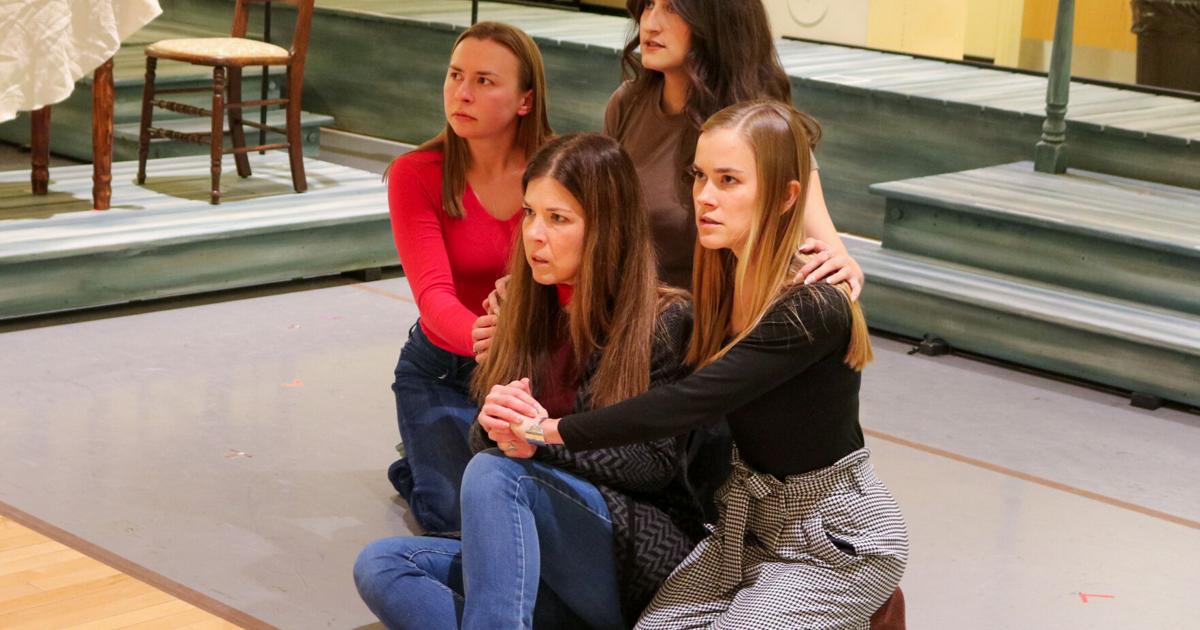
Emily Birsan, at left, plays Martha Jones and Katherine Pracht plays Mary Heaster in “Everlasting Faint,” shown in rehearsal at the Madison Opera Center.
Zona’s ghost tells her mother she was murdered. Mary persuades the local prosecutor to reopen her daughter’s case and exhume the body, where it is revealed that Zona was choked to death. A judge sentences Shue to life in prison.
“The fact that it’s a ghost story perks a lot of interest, because we like true crime,” Flores-Strand said. “We like things that seem like they couldn’t possibly happen. It’s a very engaging story.”
“It’s a story that feels sadly, perpetually relevant,” Gendel added, referencing the domestic violence at the story’s beginning. “It took place 130 years ago but there is a piece that is obviously commenting about today. … All my favorite movies are taking on some really serious issue while doing something entertaining.”
Gendel and Flores-Strand staged a reading of “Everlasting Faint” at the Hamel Music Center at the University of Wisconsin-Madison in December 2023. Gendel is the principal pianist and vocal coach for Madison Opera. So Kathryn Smith, the opera’s general director, came to see it (“as a favor to me,” Gendel said).
Smith saw the work’s potential. And though opera premieres are difficult for a variety of reasons — they’re expensive, they’re risky, there can be resistance among opera audiences to new things — she put it on the current season. A Friends of Everlasting Faint donor group helped bring it to life.

Katherine Pracht, left, plays Mary Heaster and Tori Tedeschi Adams plays Elva Heaster Shue, shown in rehearsal for “Everlasting Faint” at the Madison Opera Center.
‘The pace of 21st century life’
“Everlasting Faint” runs two acts and roughly two and a half hours. It will be sung in English with supertitles — a key tool for new operagoers, Gendel says — and the story “moves at the pace of 21st century life,” he said.
With a scene structure modeled after Verdi, “Everlasting Faint” includes a trio of ghosts singing about vengeance. There’s a classic opera drinking song, as Shue pours one out with his buddies to “mourn” his dead wife. Flores-Strand’s story closely follows the mother, Mary, as she tries to get justice for her daughter — her rage aria is called “That Devil Killed Her.”
The story arc, Flores-Strand said, is about “power and control … who’s falling apart, who’s winning. Scott also does that musically.

From left, Alan Dunbar plays Dr. George Knapp, Tori Tedeschi Adams plays Elva Heaster Shue and Andrew Bidlack plays her husband, Trout Shue, in rehearsal for Madison Opera’s “Everlasting Faint.”
“In opera and in theater, it’s easy to focus on the big event. I wanted to make it more about the people, because that relates to today and how we’re experiencing things.”
The music of “Everlasting Faint” draws from folk traditions, among other sources. Gendel and Flores-Strand wrote a duet for two mothers singing their goodnight prayers, and a gossipy crowd scene. There is a “Sweeney Todd” moment, a reference to Stephen Sondheim’s demon barber.
“It feels really immediate in a way that I don’t always expect opera to feel,” Gendel said. “I love that about doing new work. Everybody we’ve shared this with has been enthusiastic, but there’s always that hurdle of going to the unknown.”
Those curious about “Everlasting Faint” can come to a free pre-show talk an hour before each performance, held in the Wisconsin Studio on the third floor of Overture Center. There are clips online of some of the music, including “That Devil Killed Her,” performed by Madison Opera studio artist Madison Barrett. (Katherine Pracht plays Mary in the premiere.)
“My friends who don’t ‘do’ opera, I think there’s often an assumption that you should go to a classic, that’s how you get started,” Gendel said. “But most of my friends who aren’t into opera are actually much more interested in things like this. Modern opera has a faster pace. It’s more unpredictable.”
‘ The preceding article may include information circulated by third parties ’
‘ Some details of this article were extracted from the following source captimes.com ’