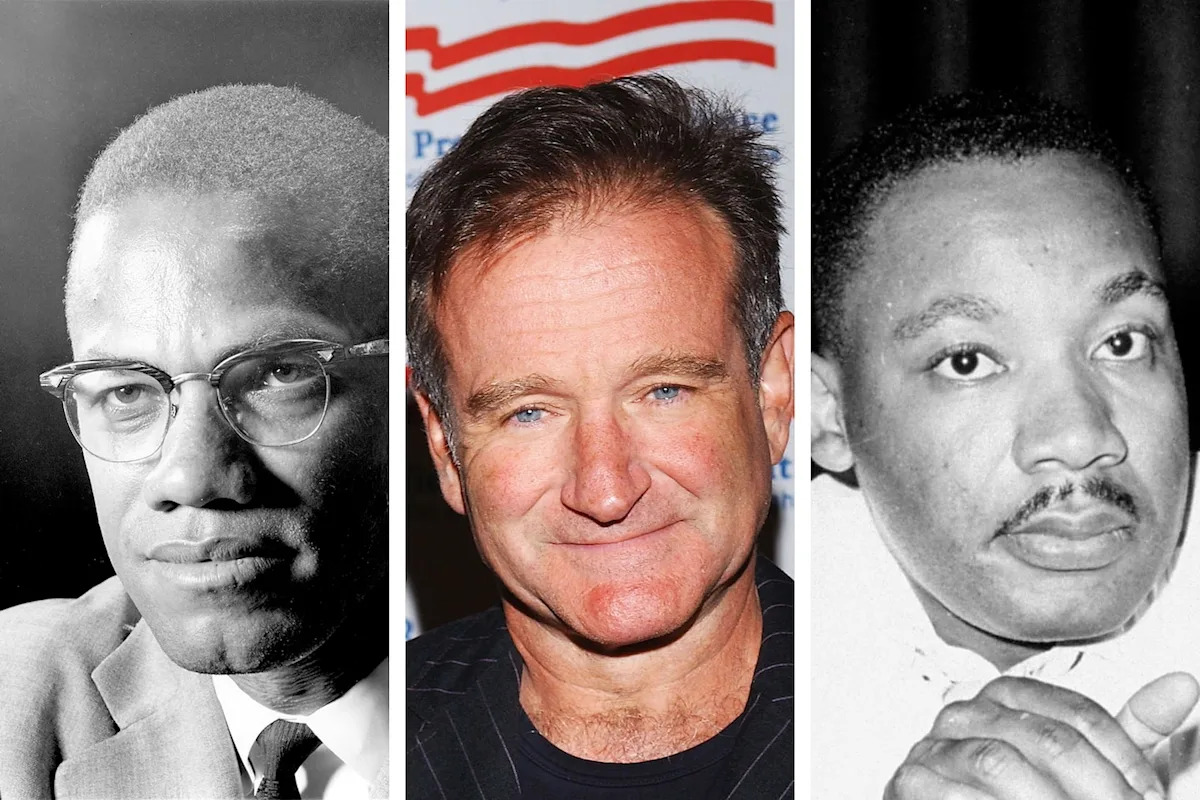
Ilyasah Shabazz didn’t want to look at the AI-generated videos of her father, Malcolm X. The seemingly realistic clips – made by OpenAI’s new video-maker Sora 2 – show the legendary civil rights activist making crude jokes, wrestling with the Rev. Martin Luther King Jr. and talking about defecating on himself.
Sora’s speed and uncanny realism has helped rocket the app to the top of the download charts, and videos reanimating the dead have been among its most viral clips. Sora-produced videos of Michael Jackson, Elvis Presley and Amy Winehouse have flooded social media platforms, with many viewers saying they struggle to tell whether the videos are real or fake.
Some clips played for laughs, such a video of “Mr. Rogers’ Neighborhood” host Fred Rogers writing a rap song with hip-hop artist Tupac Shakur. Others have leaned into darker themes. One video showed police body-camera footage of Whitney Houston looking intoxicated. In some clips, King makes monkey noises during his “I Have a Dream” speech, basketball player Kobe Bryant flies aboard a helicopter mirroring the crash that killed him and his daughter in 2020, and John F. Kennedy makes a joke about the recent killing of right-wing influencer Charlie Kirk.
OpenAI said the text-to-video tool would depict real people only with their consent. But it exempted “historical figures” from these limits during its launch last week, allowing anyone to make fake videos resurrecting public figures, including activists, celebrities and political leaders – and leaving some of their relatives horrified.
“It is deeply disrespectful and hurtful to see my father’s image used in such a cavalier and insensitive manner when he dedicated his life to truth,” Shabazz, whose father was assassinated in front of her in 1965 when she was 2, told The Washington Post. She questioned why the developers were not acting “with the same morality, conscience, and care … that they’d want for their own families.”
Sora’s videos have sparked agitation and disgust from many of the depicted celebrities’ loved ones, including actor Robin Williams’s daughter, Zelda Williams, who pleaded in an Instagram post recently for people to “stop sending me AI videos of dad.”
“To watch the legacies of real people be condensed down to … horrible, TikTok slop puppeteering them is maddening,” she said.
As AI’s rapid development gives everyday people the power to create realistic-feeling images and chatbots, it also challenges age-old notions about who controls a person’s memories, identity and legacy after they die. Most companies can’t use Robin Williams’s likeness for commercial gain without permission from his family. But on Sora, strangers have rendered Williams, who died in 2014, as they choose.
“Commercially, if you create meme-able content of famous people who are recognizable, that’s going to get more clicks,” said Henry Ajder, an AI expert who studies deepfakes and coined the term “synthetic resurrection” to describe creating digital copies of the dead. “With deceased individuals, this opens up such a huge question about ownership of likeness, and really fundamentally changes the social contract around what it means to be you online.”
As technology advances, Ajder’s vision is becoming a more common reality. The prospect of digitally cloning the dead is already sparking uncomfortable questions about families’ inability to control how their loved ones are portrayed.
“The amount and the volume of this kind of synthetic resurrection content is just huge now,” he said. “And it’s not being done by creative agencies in partnership with the estate … or by a Hollywood studio as a tribute to a much-loved actor or actress, with consent from their family. It’s being done by s—posters, memesters, racists and all the rest.”
OpenAI said its policy was based on “strong free speech interests in depicting historical figures.” But after backlash, the company said Wednesday it would begin allowing the representatives of “recently deceased” public figures to request that their likeness be blocked from Sora videos.
“We believe that public figures and their families should ultimately have control over how their likeness is used,” an OpenAI spokeswoman said. She declined to define “recently deceased.”
OpenAI has described its video tool as a wellspring of creativity – fueled in part by its depictions of real people. One executive, Varun Shetty, told the tech blog Newcomer that company officials had been permissive with video creation to avoid a “competitive disadvantage” from laissez-faire rivals. And chief executive Sam Altman said on a podcast that some copyright holders – instead of being furious that their intellectual property was being swiped – had told the company they worried “you won’t put my character in enough.”
In public statements, however, some of Hollywood’s biggest firms have been far less charitable. The chief of the Motion Picture Association said OpenAI needed to “take immediate and decisive action” to protect creators’ rights. And the talent firm Creative Artists Agency said Sora 2 had exposed its “clients and their intellectual property to significant risk.”
Online, the tool has sparked considerable criticism. Bernice King, the daughter of Martin Luther King Jr., re-shared Zelda Williams’s comments and asked people to “please stop.” Hank Green, a popular YouTuber and creator, shared a Sora video of King and said, “That’s got to be illegal somehow. … OpenAI launched a lawsuit magnet into the world.”
Joan Kowalski, president of the company that owns painter Bob Ross’s work and likeness, said dealing with unauthorized reproductions of the artist has long been an issue. But Sora brought a new challenge, she said, as videos of the soft-spoken Ross, who died in 1995, grabbed millions of views by depicting the artist having a screaming meltdown in his studio or painting the World Trade Center in flames.
Fans of Ross can no longer tell what’s real and what’s fake, Kowalski said, and some wrote to the company in alarm. Ross’s reputation for kindness and encouragement, he said, seemed to make the artist a magnet for irreverent renderings.
“People want to take the most pure, wholesome person and mess it up,” Kowalski said. “There’s some sort of weird human condition where they want to take the most lovely, innocent thing and bash it.”
Ajder, who has advised companies and governments on synthetic-media policies, said deepfakes have already made waves in recent years as advertisers look to use clones of dead celebrities in promotions. These include a 2021 video in which a body double and face-mapping software was used to make Ross paint a scenic portrait of Mountain Dew with Bob Ross Inc.’s permission.
But the debate has been supercharged by AI, which can create more realistic images quicker and with fewer considerations of style or taste. The law offers little recourse.
Reid Kress Weisbord, a professor at Rutgers Law School who studies wills and estates, said defamation law relates to injuries of reputation for the living, and the claim generally “dies with the person who’s being defamed.”
Families might pursue a legal claim for the person’s postmortem right of publicity, which prevents commercial exploitation of someone’s name or likeness without their consent. Many states now allow for those rights to descend to the dead person’s estate, including in California, where the statute of limitations lasts 70 years after a death.
OpenAI could argue that the videos represent a “transformative use,” a legal concept for protecting parodies, reviews and other forms of expression that build on the value of another person’s work. And some tech boosters have long argued that AI-generated works should be protected by the First Amendment.
But the legal questions strike at a corner of the law that AI has made more unsettled every year, Weisbord said. Focusing on the financial question might miss the real issue: Who can shape a person’s likeness or memory after they die?
Regarding the emotional impact of a child seeing a likeness of their parent doing things they never did, Weisbord said, “I’m not sure the commercial exploitation angle really captures the nature of that harm.”
For political figures, there’s the added risk of people using their likeness to spread wrong information or stoke outrage. Sora videos of Winston Churchill, for example, showed the late British prime minister promoting the airline JetBlue or referencing crass internet memes.
As a new generation learns about major historical figures, its first encounters should be grounded in reality and not fake AI portrayals, said Adam Howard, executive director of the International Churchill Society.
Churchill’s “name, likeness, and words are not free stock for synthetic manipulation,” added Randolph Churchill, president of the Society and Winston Churchill’s great–grandson. “Winston Churchill belongs to history, and his legacy deserves accuracy, dignity and lawful stewardship.”
By allowing for controversial yet eye-catching content like AI celebrities, OpenAI is borrowing from a playbook perfected by social media companies such as Meta: Do whatever it takes to get users on the app and ask forgiveness later, said Thales Teixeira, a business professor at the University of California at San Diego. “First you grow, and then you try to solve the problems,” he said.
Family members like Shabazz, meanwhile, are left to deal with the emotional fallout. For days, Shabazz let the fakes sit on her phone unwatched. Only after she returned home from a work trip did she open them, ready to process whatever they contained.
“I have people relying on my support,” she said. “I don’t want to be weighed down by … someone else’s irresponsible act.”
– – –
Razzan Nakhlawi and Monika Mathur contributed to this report.
Related Content
Melania Trump says she has ‘open channel’ to Putin on family reunification
She left the medical mainstream and rose to be RFK Jr.’s surgeon general pick
A combative Bondi clashes with senators on Epstein, cases against Trump foes
‘ The preceding article may include information circulated by third parties ’
‘ Some details of this article were extracted from the following source www.yahoo.com ’