At Louisiana weddings, when Ronnie Milsap’s 1980 song “If You Don’t Want Me To” comes on, something happens. People flood the floor, line up and at a precise moment — they freeze.
Nobody knows why.
The song has no reference to anything cold or frozen. The songwriters and producers didn’t even know about the line dance sensation until the early 2000s. And yet, somewhere in Louisiana, a tradition was born that is now so embedded in the culture that at least one family believes if the Freeze isn’t played at a wedding, the marriage will fail.
Ronnie Milsap
Allison Bohl DeHart and Peter DeHart want to find out why.
That question — why — is the premise of the DeHarts’ latest documentary.
As spouses, parents, designers, musicians and creatives, the two founded makemade in Lafayette, a design studio that works on film production, photography, graphic design, exhibition design, branding, animation, illustration and web design. They are rooted in widening the lens of what people believe Louisiana culture is, including the stories that make up the state.
Their focus is to elevate voices that might otherwise go unheard.
“We’re usually interested in people that are more or less not bound by the classic genre boundaries that Louisiana culture gets put in,” Bohl DeHart said. “We like the people and the music and the art that blurs those boundaries.”

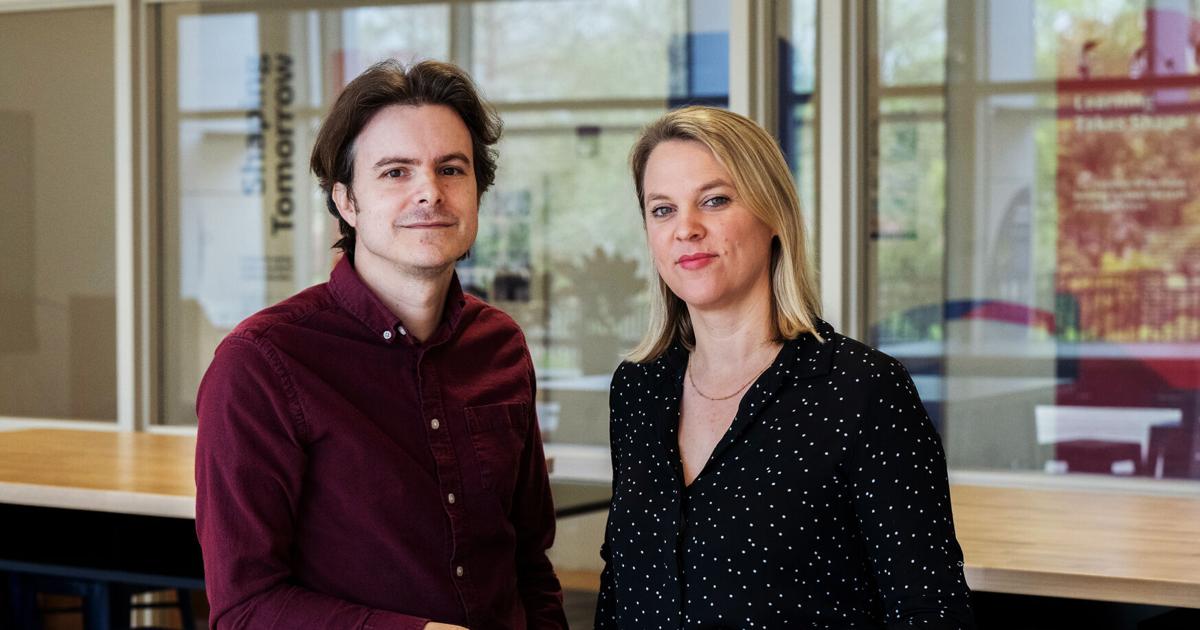
Husband and wife Peter DeHart and Allison Bohl DeHart are pictured Wednesday, March 18, 2026, at The Learning Lab in Lafayette, La.
Both creatives are quick to point out that they aren’t Cajuns — and in a state where cultural identity runs deep and complicated, that distinction matters.
“The big question in documentary is, ‘Why are you the one to tell this story?’ You have to really ask yourself that on a deep level and have an answer that’s valid, because these things take a long time,” Bohl DeHart said.
The DeHarts’ graphic design work with Route Lafayette, in collaboration with Council for the Development of French in Louisiana, focused on incorporating more Louisiana French around the city.

John Schiro with 3D International puts the finishing touches on the installation an aluminum map sign installed in downtown Lafayette as part of the Route Lafayette project Wednesday, November 3, 2021. The signs, which give walking directions to landmarks in French and English, were designed as a collaboration between Lafayette agencies SO Studio Architecture and Allison and Peter DeHart’s Makemade.
“Neither of us speaks Louisiana French fluently, but I always say that you don’t have to be fluent in a language to champion it,” DeHart said.
That sentiment resonates beyond Cajun French. The DeHarts may not have extreme roots in south Louisiana, but that doesn’t mean they can’t highlight the culture.
A common theme in their work is legacy. Their film projects usually center around people who are trying to find deep understanding.
DeHart said he and his wife don’t make it a goal to purposely highlight the older generation, but it’s something that comes up often. They don’t create many films that center around coming-of-age stories.
They said their work comes from a place of curiosity — and a shared understanding that a project could take up to 10 years to complete.

John “Pudd” Sharp serves as the assistant director for research at the UL Center for Louisiana Studies.
“We help each other through that unknown in a good way,” Bohl DeHart said. “A lot of people that we bring on, or come work with us, have that same kind of shared understanding that stories about this area take a long time to understand, because it’s kind of a misunderstood area.”
For their research on the Freeze line dance, the DeHarts consulted John “Pudd” Sharp, the assistant director for research at the University of Louisiana at Lafayette Center for Louisiana Studies. Sharp is a folklorist who writes grants, works with film and video restoration and digitization. He said the DeHarts are “special storytellers” who can showcase stories that otherwise may be taken for granted — like the Freeze.
“There are all these things that you wonder about with that dance and the song,” Sharp said. “They are trying to get to the bottom of it, and it’s a nice exploration of something that’s been hidden in plain sight that no one really has a good answer to.”

Oubre decedents step together in a line dance during the Oubre family reunion at the Lemann Memorial Center in Donaldsonville on Saturday, October 11, 2025.
He, too, is enamored with the origin story of the line dance, especially considering that the song has no “instruction” for dance — such as with “Cupid Shuffle.”
“I’ve been at multiple weddings where there’s a live band — of very accomplished and highly sought-after musicians — and people are sitting and watching them play music,” Sharp said. “As soon as they take a break, the DJ puts on the Freeze, and the whole crowd jumps up and runs to the dance floor. It is such a strange phenomenon in a place known for live music and the love of live music.”
Past projects from the DeHarts include “Sallie’s Ashes,” a film focused on three grandmas from Alabama who fight for the removal of a toxic coal ash pit in their city, and “Ancestral Artistry,” a documentary about the influence of Africans and Creoles of color on Louisiana architecture — made with the Louisiana Architecture Foundation, Conni Castille and C.E. Richard.
For the short-fiction film “17 Year Locust,” Bohl DeHart received the #CreateLouisiana French Culture Film Grant. The story follows a Haitian immigrant and Cajun woman who find connection in south Louisiana. Becca Begnaud, of Lafayette, is in the film.

Becca Begnaud, of Lafayette, worked with Allison and Peter Dehart on the film “17 Year Locust.”
When several creatives are working on a project, Begnaud says a group sometimes needs a person who reigns everyone in. Bohl DeHart was the ring leader and troubleshooter for “17 Year Locust,” Begnaud said.
“She kept things in order. She would oversee what was going on, and she could pull the pieces together,” she said of working with Bohl DeHart on “17 Year Locust.” “In all the films that I’ve worked on in all these years, I felt very calm that nothing was going to be forgotten on a professional level, because I walked into that as a nonprofessional.”
The DeHarts also released “Bending Lines,” a film about sculptor Robert Wiggs in Lafayette. Wiggs, who died in 2015, wasn’t from Lafayette, but he spent most of his life here.
“He’s still part of Louisiana landscape. Almost all the sculptures we have in Lafayette are his, so he’s part of Lafayette,” DeHart said.

Husband and wife Peter DeHart and Allison Bohl DeHart are pictured Wednesday, March 18, 2026, at The Learning Lab in Lafayette, La.
Because the DeHarts didn’t grow up in south Louisiana, much like some of their characters, they noted that they relate to those stories because they can see themselves in the subject matter. Their professional goal is always to make a film that connects to national and international audiences and motivates people to learn more about the state.
The duo says Lafayette is a special place to make these films, because the city is full of people who are multidisciplinary creatives. There may be a CEO who is also a fiddler or a filmmaker who is also a musician.
Bohl DeHart said the collaborative nature of the creatives in Lafayette makes it a strong place for connections.
“I didn’t know that staying in one place would be so fruitful,” she said. “If you think about the connections you make to the community and the people, what can develop and flourish long term is so much more fruitful than shallow connections everywhere else.”
‘ The preceding article may include information circulated by third parties ’
‘ Some details of this article were extracted from the following source www.nola.com ’