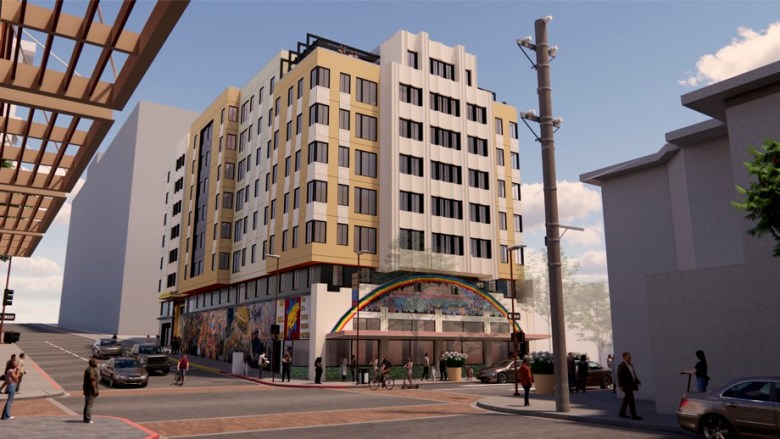
Amoeba Music’s Telegraph Avenue record shop has stayed afloat through many sea changes in how people get their music, from the rise of CDs to the era of streaming apps. Now its owners have a plan they say will help secure the future of the 35-year-old store — and the iconic mural on its exterior depicting pivotal moments from Berkeley’s 1960s history.
A team that includes Amoeba co-owners Dave Prinz and Marc Weinstein is developing a proposal for a new apartment building at the site, representatives for the project told Berkeleyside this week.
The plan calls for tearing down most of the existing building at 2455 Telegraph Ave., but keeping its facade, including the “People’s History of Telegraph Avenue” mural along Haste Street and Amoeba’s arched rainbow entryway. The record store, which bills itself as the largest west of the Mississippi River, would occupy the new building’s ground floor.
The vision has the blessing of Osha Neumann, the attorney and activist who helped create the mural in 1976. Spanning much of the building’s north side, the mural is made up of scenes such as Mario Savio speaking at a 1964 sit-in that set off the Free Speech Movement, clashes over People’s Park and the police shooting of James Rector in 1969.
Neumann credited Amoeba’s owners with making a “remarkable” commitment to preserving the mural, which is a city landmark.
“They were very much committed to keeping it there,” he said. “I’m sure Amoeba did not want the bad vibes that would come from destroying the mural.”

Elisabeth Jewel, a spokesperson for the development team, said both the record store and mural faced a similar challenge: The people who created and maintained them are aging, and they want to ensure they endure for future generations. Prinz and Weinstein view the redevelopment, she said, as an “endowment” for the mural’s future and a new home for Amoeba.
“Nobody’s getting any younger here,” Jewel said. “If we don’t take that important step to ensure [Amoeba’s] longevity, who will?”
A rendering shared by the development team depicts an eight-story apartment building rising behind the current structure’s facade. Consultant Mark Rhoades wrote in an email that precise details for the project, such as the number of apartments it would include, are still being determined. The team plans to submit a pre-application for the project, a first step toward city approval, “within the next week or so,” Rhoades said.
A timeline for when the project might be built also has yet to be determined, Jewel said. While housing construction has slowed in other parts of the city amid high interest rates and rising costs, several projects are underway in the Southside neighborhood, which continues to draw interest from developers thanks to its prime location near the heart of the UC Berkeley campus.

The Telegraph Avenue shop is Amoeba Records’ first location, and has occupied the space since 1990. The building was originally home to a Lucky grocery store, then a series of restaurants and cafes. Amoeba has since expanded to outposts in San Francisco and Los Angeles.
The property is a few steps from the walled-off construction site at People’s Park, where crews this month reached the top floors of two new UC Berkeley dorm buildings.
Cal’s plans for the site, which was a center for counterculture movements in the ‘60s, call for 1.7 acres of open space and features celebrating its history. But Neumann and others contend the redevelopment means People’s Park itself is no more. That’s why he is relieved the mural on Haste Street, which he said now serves as a “memorial” to the park, will be preserved.
“Berkeley is changing so much,” Neumann said. “I think it’s important that this memory of its radical history remains.”
‘ The preceding article may include information circulated by third parties ’
‘ Some details of this article were extracted from the following source www.berkeleyside.org ’