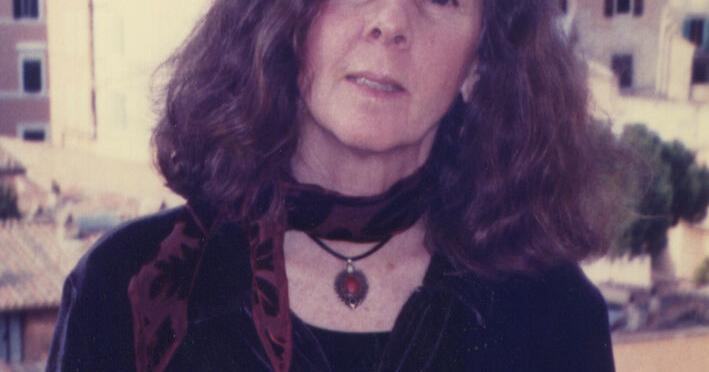
Poet and teacher Ann Gengarelly will read from her recently published collection of poems, “Loss and Invention,” at Mitchell-Giddings Fine Arts gallery on Friday, Sept. 19, from 5 to 7 p.m.
Chard deNiord, who served as Vermont’s Poet Laureate from 2015-2019, will introduce Gengarelly and her poetry.
The book’s vivid cover image is of the painting, “Reflecting,” by artist Petria Mitchell. The word reflecting resonates with many of the poetic themes of the book, e.g., journeys, dark and light, persistence, hope, ancestral wisdom, sorrow, survival, courage, compassion, healing.
Gengarelly is director of The Poetry Studio at her home in Marlboro, where for the past 25 years she has offered after-school programs in poetry and art for students in grades K-8. Summer workshops for youth (ages range from eight to 17) at the Studio combine Gengarelly’s poetry classes with art/bookmaking sessions facilitated by her husband Tony Gengarelly, Emeritus Professor of Fine Arts. Since 2002, Ann has offered adult writing classes, as well, at the Studio. She has been a poet in the schools in Vermont, New Hampshire, and Massachusetts since 1980.
Whether teaching children or adults, Gengarelly believes the quality of reverence and the practice of respect are essential to creating a safe environment so that the participants are able to dig deep in their hearts for what is begging for a voice.
Nature frequently serves as a source of inspiration and imagery in Gengarelly’s poems.
“I have been writing poems since 1970,” she said. “Moving from a city, living in the country, I embraced a slower pace of life, and in solitude, I discovered intimate company with the trees, plants, flowers. Surrounded by nature, I felt the need to write. Mary Oliver’s words: ‘Attention is the beginning of devotion,’ became not only the motto of The Poetry Studio, but also a guide for my writing of poems — attention to my inner world and outer world.”
In the mid-1980s, Gengarelly met poet Bruce Smith, professor, Syracuse University MFA program, at The Frost Place in Franconia, New Hampshire.
“We developed an email correspondence,” she said, “and when I felt I was ready for a serious dialogue about my poems, Bruce and I wrote back and forth, sometimes two emails in a day about a particular poem.
“Bruce has this wonderful way,” she continued, “of stretching the borders of my imagination and use of language without imposing his voice. He has had a big influence regarding which poems went into Loss and Invention, but ultimately, the choice was mine. There are some poems that go way back, but most of them were written in the past ten years.”
The collection is divided into four sections, each with its own title, as Gengarelly explained.
The three words in the title of the first section, “Unknown Before Arriving,” are found in the very first poem, “Visitation.” Many of the poems in this chapter, Gengarelly said, resonate with the landscape of Mystery, the unknown.
“Composing,” the title of the second section, derives from the title of the first poem in this part. It echoes the words attributed to the poet James Merrill, “The act of writing a poem is the act of composing the self.” Many of the poems here, Gengarelly said, address the most intimate journeys.
The title “The Dharma of Persistence” originates from the fourth poem in this section, about a favorite willow tree “and how its resilience spoke deeply to me,” Gengarelly said. “It also resonates with the title of the book.”
The title of the fourth section, “Pushing Through the Hard Soil” was born from the poem “Social Distance.” “This particular chapter combines both the personal and the social challenges during the Pandemic,” Ann said, “as well as so many tragic stories unfolding in the world.”
Gengarelly’s previous book, “Another World: Poetry and Art by Young People” from The Poetry Studio, which she wrote in collaboration with her husband, was published during the COVID pandemic.
“After publishing that book,” Gengarelly explained, “I was profoundly aware of the fragility of life, of what the Buddhists call Impermanence. The question ‘What have I not done that I would like to do’ visited me often. Very quickly I thought about the poetry I have written over decades and began the process of selecting poems I wanted to include in a book. Because I am a ‘different woman’ now from the woman who wrote some of the poems years ago, I found myself adding new stanzas to a few poems, often needing an intermediary — a bird, the ancestors — to guide a poem to where it needed to travel. Often when I read a poem that I have written, I feel that I didn’t write the poem; rather, the poem came to me. If my heart is open, I might become the channel to receive a poem.”
In these troubling times, poetry is more essential than ever, according to Gengarelly.
“Poetry, perhaps more than any other art form, speaks to the human condition,” she said. “When the poets at The Poetry Studio, the younger students as well as the adults, read their poems aloud to the group in the sharing circle that concludes each class, the sacred act of witnessing unfolds. The poet is heard, something we are all hungry for. Most importantly, gathering together and hearing poems invites us all to feel less alone. We might have different stories, different histories, but there is a universal emotional landscape that we all share.”
“Loss and Invention” takes the reader on a journey from where sorrow and hope intermingle to the twin promises of compassion and understanding.
Mitchell-Giddings Fine Arts gallery is located at 181-183 Main Street, Brattleboro. Phone 802-251-8290. An informal Q&A discussion with the poet will follow the reading. Everyone’s Books will have copies of Gengarelly’s book available for purchase. Refreshments will be served.
‘ The preceding article may include information circulated by third parties ’
‘ Some details of this article were extracted from the following source www.reformer.com ’