We live in an era where attention spans are getting shorter and everyone is after microcontent. Pop songs have, in a way, always been the perfect vehicle for our fractured state: three minutes of joy or sadness or heartbreak, perfectly packaged to be consumed over and over again. When MTV launched in 1981, the first music video it played was the Buggles’ “Video Killed the Radio Star,” a three-ish minute song about how video now ruled the airwaves, accompanied by absurd sci-fi-inspired imagery that evoked those same emotions. And while video may not have necessarily killed the radio star, it certainly took it to another level of fame. Listening to music suddenly became a synesthetic experience; a video could turn a simple song into a classic simply by visually capturing its essence.
In the years since, we’ve seen music videos enter trend cycles just like any other part of culture. In 1983, Michael Jackson’s “Thriller” showed what the medium could be at its maximum peak, turning a five-minute song (four for the radio edit) into a 13-minute short horror film, complete with an additional hour-long making-of film. A decade later, independent filmmakers like Spike Jonze and Michel Gondry were cutting their teeth making music videos, and the narratives became less linear and more experimental; consider Christopher Walken dancing and flying around a hotel lobby in Fatboy Slim’s “Weapon of Choice,” directed by Jonze, or Gondry turning dream logic into reality in Foo Fighters’ “Everlong.” (You still had videos like the Chicks’s revenge tale “Goodbye Earl,” though.) In 2016, Beyoncé introduced the cinematic experience known as Lemonade, which turned all 12 songs—and their individual music videos—into a carefully crafted 65-minute narrative film. More recently, music videos entered their vibes era, turning into three-to-five-minute hypersensory events intended to stimulate the senses: Zara Larsson dancing in an exaggerated Technicolor landscape for three minutes in “Midnight Sun” or Lady Gaga and Doechii squeezing into a single oversize red suit in “Runway.” (We should be clear, though, that Gaga, a master of the music-video form, has also experimented with long-form narrative. Remember her nine-minute version of “Telephone”?) We love this stuff.
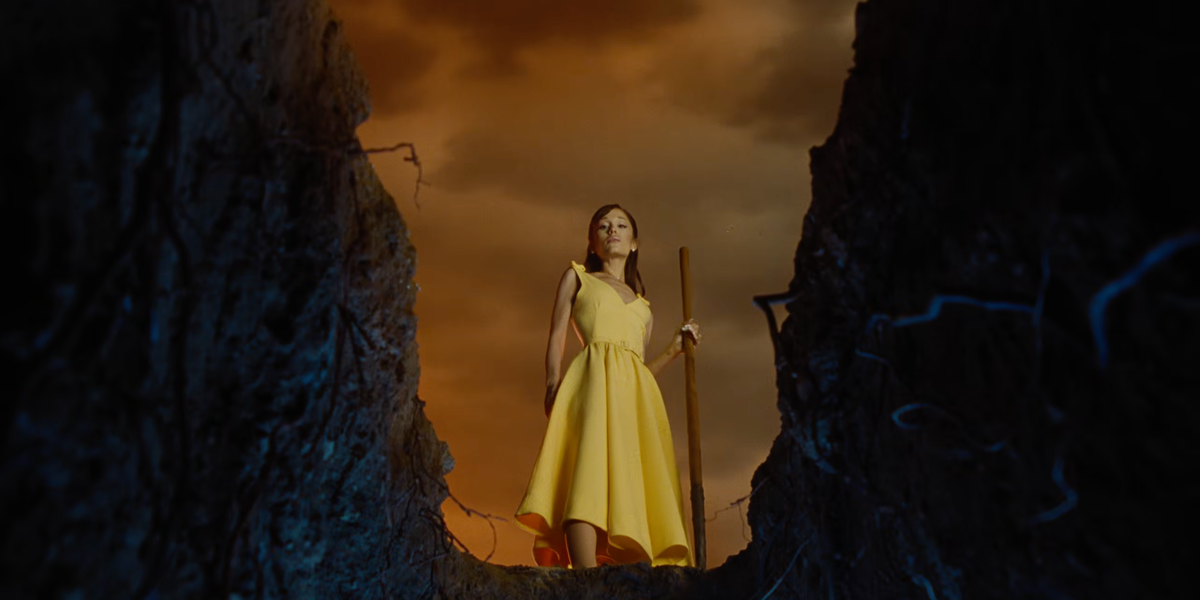
This year, we’ve seen a new wave of narrative music videos, all of which are five minutes or longer. Ariana Grande dropped the first single, “Hate That I Made You Love Me,” from her long-awaited eighth studio album, Petal. The new video, which stars Justin Long, taps directly into classic horror movies, with scrawl-like title text directly borrowed from classic horror movies like 1958’s The Thing That Couldn’t Die. The song opens with Long burying his lover, then tossing a photo of her out his window as he drives away. But it seems Grande is the thing that couldn’t die when she appears as a ghost in his backseat and then again, standing in the middle of the road, causing Long to crash his car. He survives the fiery accident, but Grande refuses to let the fire be extinguished—literally setting him on fire once he arrives at his house. Somehow, he survives again (maybe they are both the things that couldn’t die?), and later, as he arrives at a diner, he’s greeted by a room full of Ariana Grandes, Being John Malkovich–style, sending him into a frenzy. It leads him back to the grave, where Ariana is waiting to bury him.
It follows Olivia Rodrigo’s video for “The Cure,” which departs from the vibes of her previous Marie Antoinette–inspired video for “Drop Dead,” to tell the story of a nurse who is desperately trying to cure an affliction that turns hearts gray. She’s experimenting with ingredients in a whimsical set of vials and beakers when she is also stricken with the disease. The narrative arc concludes as we zoom out, revealing the nurse Rodrigo as a miniature in a diorama, and the real Olivia Rodrigo appears in the frame and stomps on the scale model. The cardboard boxes packed up around her suggest she is moving on.
But it was Harry Styles who kicked off the trend in January of this year, when he released his action-packed, five-minute-plus music video for “Aperture” (seemingly inspired by Fatboy Slim’s “Weapon of Choice”), the first single off his album Kiss All the Time. Disco, Occasionally. The video opens with Styles pacing his hotel, and suddenly he realizes he is being pursued by a hitman. The two engage in a prolonged fight scene, where they smash into vending machines and tumble down stairs. It wouldn’t be a Harry Styles video if the two didn’t break out into an intricately choreographed duet dance, breaking up the fight scene with a Dirty Dancing dive. Though Styles’s Aube Perrie–directed video veers into a more “vibes” atmosphere, the action sequence is worthy of a Nolan comparison. Think Tenet or Memento—a confusing, cyclical narrative. Styles ends up in a feedback loop, repeating the same movement patterns, followed by a docile version of the hitman. It concludes with him in his hotel room again, waiting solemnly by the phone.
The trend has no signs of slowing down anytime soon, as we gear up for the release of a short film from Madonna, which will combine samples from six of the songs from her upcoming Confessions II album and unfurl in six chapters. It is being billed as “a sexy thriller, a dance delusion, an epic fever dream.” The Queen of Pop is no stranger to narrative videos, of course, as you’ll recall “Take a Bow” (long rumored to be made as an audition of sorts for the movie Evita) and the highly controversial “What It Feels Like for a Girl.” The point is, we will always be ready for whatever story Madonna is here to tell—along with any other pop star who wants to bring us along for the ride.
‘ The preceding article may include information circulated by third parties ’
‘ Some details of this article were extracted from the following source www.harpersbazaar.com ’