Eleven production kits, REMI workflows, and cloud distribution bring 40 World Cup matches (and counting) to the now three immersive venues
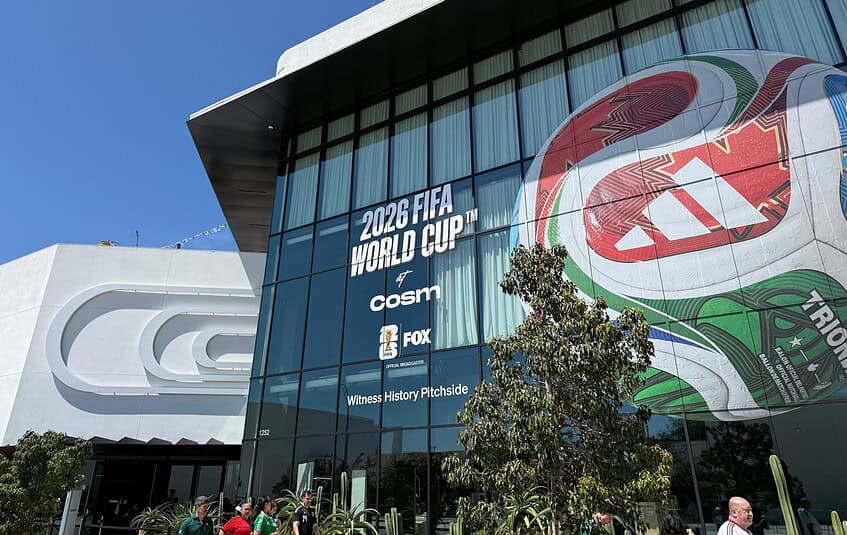
It’s the Opening Day of the 2026 FIFA World Cup, and the air is buzzing in the Hollywood Park District of Inglewood. The energy on this sunny L.A. afternoon isn’t coming from SoFi Stadium, where the US Men’s National Team would play its first Group Stage match against Paraguay the next day. Instead, just a five-minute walk up the road, fans of Mexico are singing as they pour out the front doors of Cosm, the immersive “shared reality” venue that opened here two summers ago.
These fans have just watched a World Cup match in a way no one has ever watched one before: on an 87-foot-diameter, 12K+ LED dome. They ate. They drank. They cheered two goals as if they were at the stadium; only the game was played nearly 2,000 miles away in Mexico City.
It was an electric start to the tournament and part of a remarkable stretch for Cosm. The night before, the company had presented an NBA Finals game. Later that same day, a Stanley Cup Final game was on the schedule. Cosm’s newest venue in Atlanta had opened its doors to the public for the first time the previous night. It’s a week that has the feel of a company moving from launch mode into full-scale operation.
“This is sort of like our playoffs, in essence, for our team,” says Devin Poolman, Cosm’s Chief Product & Technology Officer. “Sports metaphors are big at Cosm, as you could probably imagine. It’s something everybody looks forward to: those moments where you can be on all the time.”
This World Cup is unquestionably a big moment for Cosm. The venue has already hosted fans for plenty of massive events in its first two years in operation, but consistent major sporting events day in and day out proves these spaces can entertain at scale. The company is working with FOX Sports, FIFA, and host broadcaster HBS to bring 40 Group Stage matches to its Shared Reality venues in Los Angeles, Dallas, and Atlanta. The slate includes all three U.S. Men’s National Team group-stage matches, and plans are for plenty more matches in the Knockout Rounds, including the Final on July 19.
“Having FOX, FIFA, and HBS trust us to be there on the ground with them to bring the world’s biggest sporting event to life is something we appreciate over and over again,” says Poolman. “The World Cup is so special, and it really leans into what Cosm stands for: bringing fans to the best place to watch that event, other than actually being at the event of course.”
Five-Camera Kits Across the Tournament
For Cosm, the World Cup production is not simply a matter of taking a finished FOX Sports telecast and placing it on the dome. The company is deploying its own camera systems and production teams at stadiums across the tournament, capturing a dedicated immersive presentation in coordination with FOX and HBS.
Because of the scale of the event, Cosm expanded its fleet to 11 production kits. Each kit includes five cameras, with positions chosen specifically for the dome experience. Through previous soccer productions, Cosm found particular value in nontraditional locations, including slash positions in the corners of the stands. Those angles may not be standard for a linear broadcast, but they can be especially effective in an immersive environment.
“Those feel so special for soccer fans,” says Poolman. “The slash position really puts you into that seat in the stadium, and we’ve taken that angle from Premier League productions to now the World Cup – soccer’s greatest showdown.”

Working with HBS has been critical. At an event of this size, camera positions, venue access, and production footprints are all tightly managed. Cosm needed to work early with the host broadcaster to secure positions that would support the Shared Reality experience while fitting cleanly into the larger World Cup operation.
“The important part about a big global event like this is being a good partner to the host broadcaster,” says Poolman. “We know from our experience in the past we’ve got to work on that early, and so there has been a lot of good partnership with HBS to make sure we have the best position when we go into these great stadiums.”
REMI Production, Cloud Distribution
Although Cosm has cameras and personnel on-site, the matches are produced for Shared Reality remotely. The field kits feedback to Cosm’s REMI production studios in Los Angeles, where a light crew, typically led by a producer and technical director, switches the immersive show for fans in Cosm venues.
“As opposed to a lot of traditional productions for something like the World Cup, we’re not sitting in the IBC,” says Poolman. “It’s our kits on the ground, and we REMI-produce the event back in our office.”
That model allows Cosm to keep its on-site footprint smaller while maintaining a consistent production approach from match to match. Once the immersive feed is produced, Cosm sends primary and backup paths to the cloud, then distributes the feed to its venues in Los Angeles, Dallas, and Atlanta.
Cosm has also continued to improve the technical pipeline behind the presentation. Over the past year, the company has introduced a new immersive lens, improved image sharpness, and made encoding and pipeline enhancements that Poolman says are visible in the World Cup product.
“What you see now is actually a better, sharper picture than we had months ago, and certainly better than we had a couple of years ago,” he says. “It’s incredible the difference in quality the team has been able to produce from when we opened here in LA about two years ago to today.”
Much of that technology is proprietary, including elements of the software distribution, rendering, camera technology, and lens design.
“Any point in which we can step in and ultimately make you feel more transported, make you feel like you’re there, and make it a better fan experience, we’ll try our best to make that happen,” says Poolman.
Producing Soccer for the Dome
Although the World Cup marks a significant step forward, soccer has been part of Cosm’s live-sports playbook from the beginning. Premier League, UEFA Champions League, and other soccer presentations helped introduce fans to the Shared Reality experience in the United States and gave Cosm’s production team valuable reps in how to present the sport inside an immersive dome.
Those learnings matter because producing soccer for Cosm is fundamentally different from producing it for television. A traditional broadcast can chase the ball, cut frequently, and use tight shots to follow the most immediate action. In a dome environment, cutting too aggressively can break the sense of presence.
“We can’t chase the shot in the same way you can on television,” says Poolman. “If there’s a great cross, we can’t immediately switch to try to get the best look at that shot. We want to make sure the fans stay immersed, and part of staying immersed is not cutting frequently.”
That makes soccer one of the more challenging sports to produce in Shared Reality. The pitch is large, the tactical shape matters, and many fans want to see how plays develop away from the ball. At the same time, Cosm’s most powerful moments often come from views that feel impossible to replicate at home: behind the goal, from inside the stands, or from a perspective that places fans in the middle of the stadium environment.
“The tactics for that high wide are so important for those hardcore fans,” says Poolman, “and we have to balance that with the impact you can get from having that shot behind the goal.”
Building a Matchday Around the Dome
Inside the venues, Cosm’s World Cup presentation is designed to be more than a match on a large screen. The company is building a broader matchday experience around each event, with fans encouraged to arrive early and take in the atmosphere before kickoff.
“We spend a lot of time thinking about extending the experience beyond the dome because it’s a lot more than just showing up and watching the match,” says Poolman. “We see our fans come early and lean into the atmosphere that our team on the ground is producing.”
That can include a DJ, activities, photo opportunities with takeaway souvenir cards, food and drink specials, and other venue-specific elements. The goal is to make the entire building feel alive, not just the dome once the match begins.
“It’s really leaning in and making sure the whole venue feels alive and electric,” says Poolman. “That’s just as much part of the experience as the technology.”
That was evident for Mexico–South Africa. Across its three venues, Cosm hosted more than 1,000 fans for the opener, and the Mexico crowd brought a level of energy that underscored why the World Cup is such a natural fit for the format.
“That adds a whole other energy level,” says Poolman. “That’s also part of what makes the World Cup special. The fans of, you name that country, they will come out to support their teams.”
Atlanta Opens as Cosm Expands
The World Cup also arrives as Cosm adds its third venue. After opening Los Angeles and Dallas just months apart, the company opened Cosm Atlanta in Centennial Yards, near State Farm Arena and Mercedes-Benz Stadium.
The Atlanta venue gave Cosm a chance to apply lessons learned from its first two locations, particularly in the design of the dome seating and sightlines.
“With Atlanta, it has given us a chance to take the learnings we had from the physical design of our venues with the first two and put that to work,” says Poolman. “We’ve been able to add more dome seats, get more fans into the best seats possible, and add more seats while actually improving the quality of view.”
For a company built around the idea that location and perspective are central to the experience, those refinements matter. More fans can be placed in prime areas of the dome while preserving the quality of the view.
A High-Water Mark for Shared Reality
For all the complexity behind the World Cup project, Poolman says the definition of success remains simple.
“At the end of the day, it’s fans coming through the door and having a great time,” he says. “It doesn’t get old seeing people react in awe and excitement. It doesn’t get old seeing kids with their families who get to share a moment.”
For a tournament that is global, communal, and emotional by nature, Cosm is aiming to collapse the distance between the stadium and the fans who cannot be there in person.
“We have to remind ourselves sometimes to appreciate what’s happening, because so much is focused on the next thing,” says Poolman. “But this is a historic event for us.”
‘ The preceding article may include information circulated by third parties ’
‘ Some details of this article were extracted from the following source www.sportsvideo.org ’