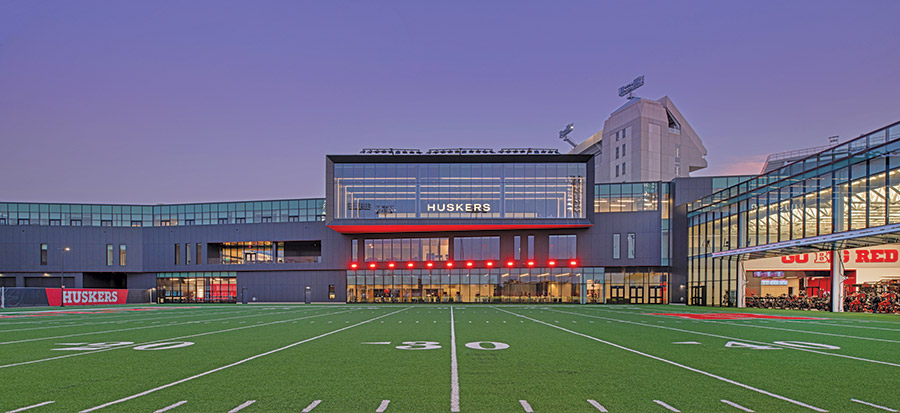
Osborne Legacy Complex
Lincoln Neb.
BEST PROJECT, SPORTS/ENTERTAINMENT, and Award of Merit, Safety
Submitted by Hausmann Construction
Owner: University of Nebraska-Lincoln
Contractor: Hausmann Construction
Lead Design Firm: BVH Architecture
Structural Engineer: Hatfield Group Engineering
Civil Engineer: Olsson Inc.
MEP Engineer: M-E Engineers
Architect: Populous
Owner’s Representative: Rainwood Development Partners LLC
Spanning 315,000 sq ft, this $125-million expansion of historic Memorial Stadium has brought new life to the University of Nebraska’s football program and its student-athlete facilities through a three-year, two-phase construction effort that balanced modernization with preservation.
The project united a new football performance center and comprehensive student-athlete amenities under one roof. The first phase added athletic medicine, strength and conditioning areas, locker rooms, meeting rooms and football offices.
The second phase delivered an academic center, a full-service dining hall and an experience lobby for visitors and recruits.
Built on a tight, occupied site, the project required that work continue around active game days while protecting the university’s iconic “Kissing Columns,” which were relocated to form a new entrance to the stadium.
The construction team faced a range of challenges, including unmapped utilities, hazardous coal-contaminated soil, buried railroad debris and more than 5,000 design clashes—each resolved through 3D modeling and building information modeling (BIM) tools that saved roughly $500,000 and months of delays.
Photo by Matt Kocourek Photography
Maintaining stadium operations during three football seasons demanded close coordination with university staff, fire marshals and event personnel.
When a key stadium gate was blocked, crews built a 30-ft-tall scaffold egress tower with ADA-compliant ramps to preserve crowd access. In addition, weekly “game day readiness” walks ensured safety and code compliance.
With more than 1.2 million work hours logged and a peak workforce of over 200 tradespeople, the contractor implemented enhanced safety measures beyond standard protocols, including pre-event inspections and continuous public-safety monitoring. Despite shifting leadership and material delays, the project stayed on schedule.
In a proactive move, the contractor resequenced construction to finish the football locker room six months early—aligning with the season start and demonstrating the teamwork that defined the stadium’s latest transformation.
‘ The preceding article may include information circulated by third parties ’
‘ Some details of this article were extracted from the following source www.enr.com ’