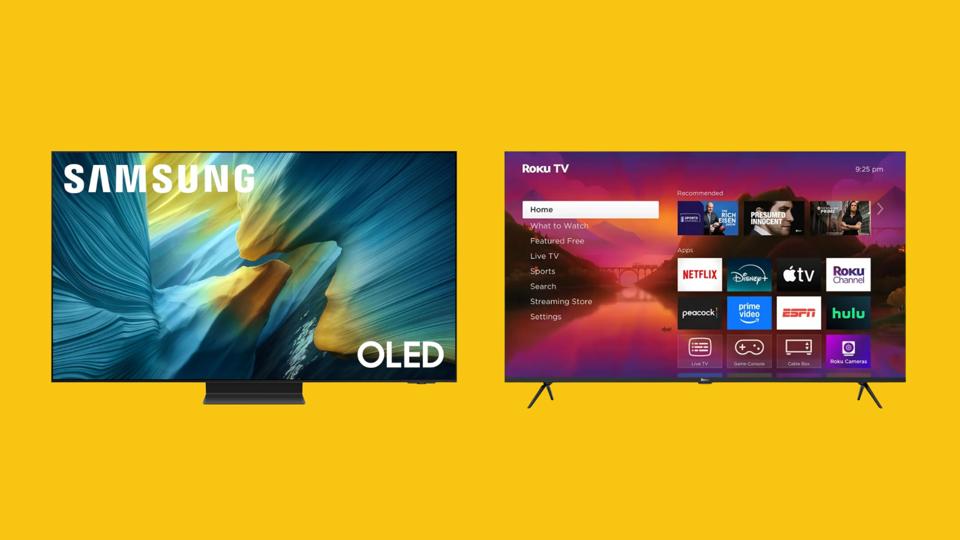
While a good TV can enhance movie night by providing a more detailed picture, the best TVs can now use AI technology to optimize your picture quality frame by frame to really make details pop on-screen. And because there is no shortage of impressive displays on the market, I set out to find the best TV. As the home entertainment expert at Forbes Vetted, after extensive research and hands-on testing with most of the models in this story, I found the best TV to be the Samsung S95F OLED TV. It showcases not only a gorgeous picture with deep contrast, but it also offers useful features like Samsung TV Plus, Samsung’s free ad-based streaming service and the cloud gaming service Samsung Gaming Hub.
These are the best TVs I recommend as Forbes Vetted’s tech editor and home entertainment expert.
Illustration: Forbes / Photos: Retailers
The Samsung S95F OLED TV is a little pricey, but you don’t have to spend thousands on a panel to enjoy a rich picture. My top value option, the Roku Plus Series, comes pre-calibrated—so no need to fiddle with picture settings—and is ideal for casual viewing. That said, if you want a dedicated gaming TV, plan to splurge on the LG G5 OLED TV, an OLED display with sky-high brightness and impressive automatic gaming modes. When researching and testing the best TVs, I took into account picture quality, software features and more. Here are the best TVs I recommend, depending on your needs.
Why Trust Forbes Vetted
For years, we’ve been testing and reviewing all sorts of screens—and we have our robust library of tech and electronic guides to prove it. By leaning on our hands-on testing and in-depth research, we’ve written dozens of TV stories and compiled tens of gaming roundups, each focused on providing the most up-to-date advice for our readers.
- Forbes Vetted consumer tech and electronics editor Rebecca Isaacs is the author of this guide. With more than six years of experience as a tech and home entertainment specialist, she has tested most panels currently on the market. In addition to firsthand testing, she covers many of the latest panel launches, traveling far and wide to get the scoop on the newest display technologies. At times, she has partaken in demonstrations where TVs have been dissected down to their processors and dimming zones to learn about their inner workings.
- Forbes Vetted executive editor Dave Johnson, who reviewed this guide, is a veteran tech journalist with decades of experience in the field. He’s authored nearly three dozen books on technology and photography, and like Isaacs, he is well-versed in the latest TV technology. To stay up to date on the latest TV trends, he regularly attends trade shows, like CES.
- To supplement our own expertise, we interviewed additional unbiased experts to get their insights on TVs. In particular, we spoke with Avi Greengart, CEO and founder of the technology consultation company Techsponential.
- We regularly revisit this story to reevaluate our gaming TV picks and add new testing insights. It was last updated in September 2025 to add all new picks, including our new top pick, the Samsung S95F OLED TV.
How To Choose The Best TV For Your Needs
If you’re shopping for a TV, there are few important features you should understand and consider before adding one to your cart. From display size to TV panel type and more, here’s what to look out for.
Panel Type
If you’re searching for a TV, chances are you’ve seen three major panel types dominating your search. Here’s how to tell them apart.
- OLED: This display type consists of millions of self-lit pixels. While they have the best contrast and showcase vibrant colors, they typically don’t get as bright as other market options, so they’re more ideal for dim rooms. They also run the risk of burn-in, which is when you see an area of permanent discoloration on the screen.
- Mini-LED: This display type uses millions of Mini-LED lights and, depending on the panel, hundreds or thousands of dimming zones. Because they can get significantly brighter than OLED panels, they’re best for brightly lit rooms. That said, their use of dimming zones means weaker contrast.
- QLED: This panel type adds a “quantum dot layer” over a Mini LED panel to enhance the colors and contrast. While this type offers a slightly darker picture, it’s a good balance between OLED and Mini-LED panels.
What you choose depends on your needs and preferences. “It depends mainly on your budget and how contrasted, bright and colorful you are willing to pay for your TV to be,” says Greengart. This especially applies when you want a larger panel, as, “Mini-LED sets are often the most affordable way to get TVs larger than 85 inches that still look good.”
Viewing Angles
When you look at your TV, you want to be able to see every detail directly without any image degradation. While Greengart recommends that you, “Don’t put a TV at an angle from the main viewing position,” you also want to be mindful of your space, too. If you have a wider viewing space, you may want to opt for an OLED, which, thanks to its self-lit pixels, doesn’t experience image degradation. But if you have a smaller space, a Mini-LED or QLED will suit just fine.
Display Size
While many of my top picks range between 55 to 65 inches—the sweet spot for most rooms—sometimes, you want a larger panel. While there’s nothing wrong with wanting to feel more immersed in your viewing, Greengart cautions against going too large. “If you need to sit close to the TV, don’t buy a set where the image will be bigger than what you can see without moving your head from side to side,” he says.
Resolution
Resolution is the quality of the image on your TV, and it’s usually referred to in pixels. There are three main resolution types on the market right now: 1080p, 4K and 8K. 1080p, or full HD, is the baseline resolution and you’ll find it on budget-friendly and smaller panels. 4K is the latest standard—if you’re going to buy a new TV, I recommend opting for this because it offers significantly sharper details and images on your display. 8K TVs are a step above 4K, and they offer the sharpest details on the market. That said, native 8K content is very limited at best, and these resolutions typically rely on AI upscaling to produce that sharper picture. They also come with a significantly higher price tag for that future-proof image quality, and as a home entertainment expert, I’ve found in my testing that the quality for the price isn’t quite there yet.
HDR Vs. Dolby Vision
The terms HDR and Dolby Vision have probably popped up in your search. If you’re not quite sure what these terms mean, “HDR is a generic term for high dynamic range, which makes highlights on screen much brighter than the rest of the image, which comes closer to matching what we see in the real world, says Greengart. But it gets much more nuanced, according to Greengart. “HDR formats like HDR10 set the brightness and darkness levels once and all of the content then uses those levels.”
Dolby Vision is a dynamic, advanced form of HDR—and it’s used to enhance shadowing and bright scenes to deliver better contrast and colors to your display. While it’s similar to HDR10+, it’s a different technology. “Dynamic HDR formats like HDR10+ and Dolby Vision allow the content owners to adjust the levels as needed throughout the content, which can result in scenes with great shadow detail followed by scenes with tremendous brightness and color,” says Greengart.
So, which is better? It wholly depends on your needs, says Greengart. “Which HDR formats you need will depend on what content you watch and which formats your streaming providers or discs support,” adding that HDR performance trumps resolution to give you a better picture. If you’re a cinephile, Dolby Vision is the ideal choice. HDR10 and HDR10+ are still great for viewing, but it’s better for casual viewers. But it’s also a matter of preference, too, depending on how you prefer your display calibrated.
Operating System
You have plenty of operating systems to choose from. The biggest brands use their own software: Samsung uses its home-grown Samsung Tizen OS; LG uses the LG WebOS. Other brands like TCL and Hisense use Google TV, and of you can find many different TVs offering RokuOS and Amazon Fire. “They vary widely not just in capability but also in ease of use,” says Greengart. “Some have built-in AI assistants, and others opt for simplicity. My favorite OS for simplicity is Roku, followed by Amazon Fire.”
If you don’t like your TV’s operating system, you can always use a dedicated streaming device to use your preferred OS. “My favorite for capability is Apple TV (by connecting an Apple TV box), followed by Google TV OS; and my least favorite is LG’s webOS, which tries to do too much,” says Greengart.
Which Brand Of TVs Are Best?
Based on my testing and research, there are a few brands that are worth the investment. Samsung and LG offer an exceptional picture quality, but you can expect to pay a hefty price tag for them. For a more affordable panel, look at the TCL QM8K QLED TV, with the caveat that it only comes in sizes 65 inches and larger.
‘ The preceding article may include information circulated by third parties ’
‘ Some details of this article were extracted from the following source www.forbes.com ’