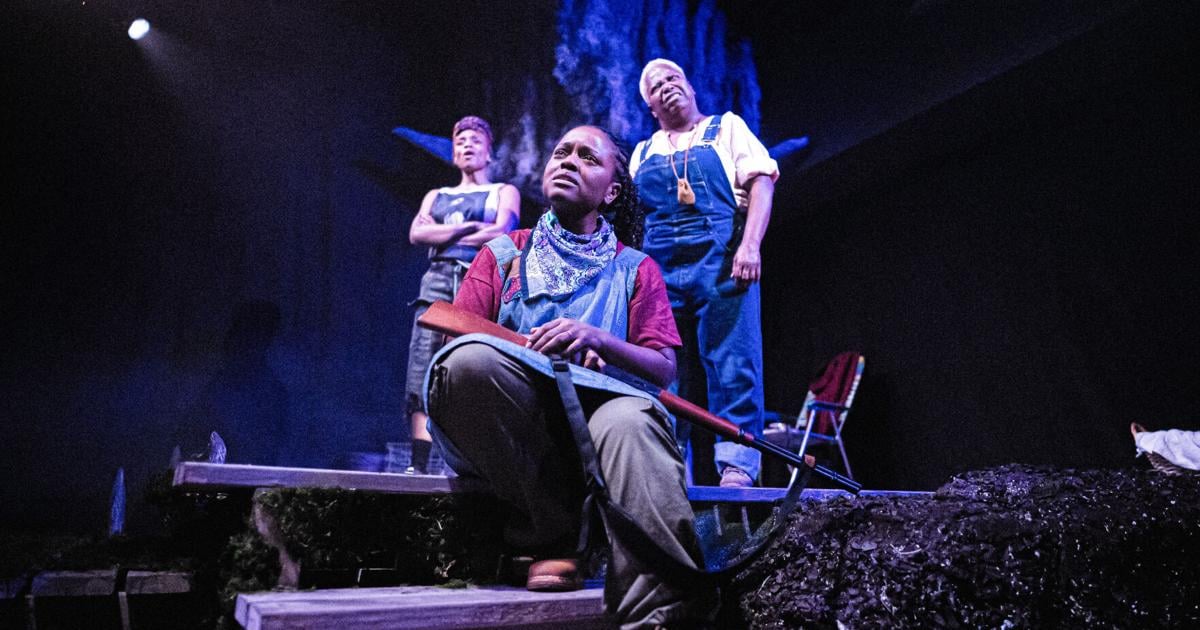
Murder mystery meets ghost story in the Chicago premiere of Kristen Adele Calhoun’s atmospheric “Black Cypress Bayou” at Definition Theatre.
Like several recent plays, among them Terry Guest’s “Oak” at Raven Theatre, this 90-minute one-act, which had its world premiere in 2024 at The Geffen Playhouse in Los Angeles, uses swampy surroundings to unearth the effects of generational trauma, pervasive racism and other injustices that shape the Black experience in the Deep South.
In this case, the setting is East Texas during the Covid-19 pandemic, and the women of the Manifold family are confronting a crisis. We first meet LadyBird Manifold (Michelle Renee Bester), a stickler for CDC rules, who thinks she’s been summoned to the bayou for some late-night fishing. Then her mother Vernita Manifold (RjW Mays) shows up bearing a laundry basket, her hands smeared with blood.
It turns out the basket holds the severed head of Clayton Rutherford, the town’s richest and most corrupt white man, as well as the family’s former employer at his meatpacking plant. Vernita claims she merely found the head on her back porch and has no idea how it got there. She and LadyBird argue about what to do until the arrival of younger daughter RaeMeeka Manifold-Baler (Rita Wicks), who is somewhat high from smoking pot and calls herself a “medicine woman.” RaeMeeka reveals what she knows about the dead man, and macabre humor morphs into panic as the three, fearing they could be sent to prison because they’re Black, contemplate how to dispose of the head.
Complications multiply with the arrival of Taysha Hunter (Jyreika Guest), who says she’s a security guard with the plant. She urges Vernita to share deep secrets about her history and their relationship with her daughters, forcing everyone to face the past and try to find forgiveness and peace in the present, things that are especially painful for Vernita to do.
Portents ranging from a tornado warning to a legend about a violence-haunted tree swirl around the action, which also involves Vernita’s social activism and association with the Caddo Nation of Native Americans. Ericka Ratcliff directs astutely, enabling each actor to craft a distinctive character.
Bester’s LadyBird stands out with her fussiness about Covid restrictions and dedication to doing the right thing. Wicks’ RaeMeeka cultivates a certain swagger to cover her insecurity. Mays’ Vernita projects unswerving determination and fierceness that she doesn’t really feel. And Guest’s Taysha is on a mission, though it takes a while to figure out what it is.
Given the limitations of the space, Definition’s designers conjure up the bayou quite well. Alyssa Mohn’s scenic design features wood-plank flooring and an abstract tree draped with plenty of moss, while Conchita Avitia’s lighting contributes moody mystery. Willow James’ soundscape complete with bird calls and buzzing insects combines with the fog machine’s mist to make us want to swat away the (imagined) mosquitoes.
There are some downsides, however. Even at 90 minutes, “Black Cypress Bayou” seems too long. Vernita and her daughters spend too much of the time rehashing their arguments, both old and new, mostly at the top of their lungs. And the play has several false endings, as if Calhoun couldn’t decide exactly where to stop.
I must admit, though, that Southern Gothic doesn’t really speak to me, whereas it might to you.
‘ The preceding article may include information circulated by third parties ’
‘ Some details of this article were extracted from the following source www.hpherald.com ’








![pt. 1446 | Sayfalse – Esse Cara! (Mega Slowed) [Edit Audio] #music #phonk #funk](https://celebrity.land/en/wp-content/uploads/2026/07/1784714374_maxresdefault-120x86.jpg)