WHEN Michael Eugene Archer died in October 2025, the world of popular music was left in shock. Under his stage name, D’Angelo, the singer had built a strong international fan base over the best part of three decades, during which he released the albums Brown Sugar and Voodoo. Both proved to be influential and inventive concoctions of soul, funk, jazz, and hip hop.
If his last work, Black Messiah, was a deeply political statement, hailing the need for a new spiritual leader in a world full of trouble, then to his followers — dare one say, disciples — the artist himself was that figure. He stood as a modern-day prophet with an electric guitar instead of a Bible.
Fittingly, D’Angelo came from the realm of sacred music. He first played the piano in the Pentecostal church in Richmond, Virginia, where his father was a minister. “Son of a Preacher Man” is a timeless song made famous by Dusty Springfield, but it could have been written for D’Angelo and many others when one considers the notable African-American artists who were born into families headed by a religious leader: think of Sister Rosetta Tharpe, Little Richard, Aretha Franklin, Marvin Gaye, and John Coltrane. They all changed the face of rock ’n’ roll, soul, and jazz in the 20th century, broadening the vocabulary of these genres and influencing pop in the process.
The prominence of the Church in black music, however, is by no means restricted to individuals who had older relatives who were preachers. Choirs and congregations also brought a joyful noise to the Creator in the form of African-American sacred song, known in the 19th century as negro spirituals. Their outgrowth in the 20th century, gospel music, is a wholly rich form of expression, predicated on considerable technical skill and high standards of performance.
Hence the church choir and backing band can act as an essential training ground for countless players who later go on to enjoy long and successful careers in the secular world, where they broach subjects that absolutely do not feature in Bible-study classes — above all, carnal relations, the trappings of material wealth, and the desire to let the good times roll.
In any case, the blues, a tall tree in modern music from which come the branches of R & B, rock ’n’ roll, and rock, was heavily influenced by early sacred songs to the extent that musicians would say “The blues ain’t nothing but a steal from the spirituals.” Instrumental and vocal styles flowed from the latter to the former. Moreover, church themes were fitted with new words for secular audiences: a key example is Little Walter’s “My Babe”, based on the spiritual “This train is bound for glory”.
THE specific technical characteristics synonymous with African-American sacred music — the impassioned vocal projection and ornamentation, the driving rhythms, often set to the jangle of a tambourine, the simmering organ chords — also become part of black secular musical language, even though artists may not be singing in the name of Jesus.
Many of D’Angelo’s songs were anything but sanctified, and yet the glorious passion of gospel choruses often marked his vocals, while he brought other elements into his work, such as the booming, dense bass lines found in hip hop and the wily, agile improvisation of jazz. This ability to combine a range of techniques across the sacred-secular divide has been a vital recurrent feature in black music history.
Many of the artists who inspired D’Angelo also crossed that line in order to develop genres such as funk. James Brown, Sly and the Family Stone, and Graham Central Station are crucial in this respect. The soul legends Ray Charles, Curtis Mayfield, Al Green, the Staple Singers, Stevie Wonder, Carla Thomas, and Marvin Gaye kept a strong church fervour in their songs as they integrated Latin riffs, rock noise, symphonic scores, and psychedelic effects to make timeless music in the 1960s and 1970s.
In the decades before, several prominent jazz artists, from Mary Lou Williams and Max Roach to Shirley Scott and Charles Mingus, also drew on spirituals when essaying innovative approaches to composition and improvisation. Many significant contemporary players, as much as they recognise their influence, seek to find a new way of using sacred and secular traditions.
In the past decade, the saxophonist James Brandon Lewis, the son of a Baptist minister, has been making highly original music, which is both emotionally engaging and structurally intriguing. He has sought to combine the shifting tonality of the Austrian modernist Arnold Schoenberg and the highly rhythmic patterns, known as “whooping”, that characterise the services that Dr Lewis attended as a child.
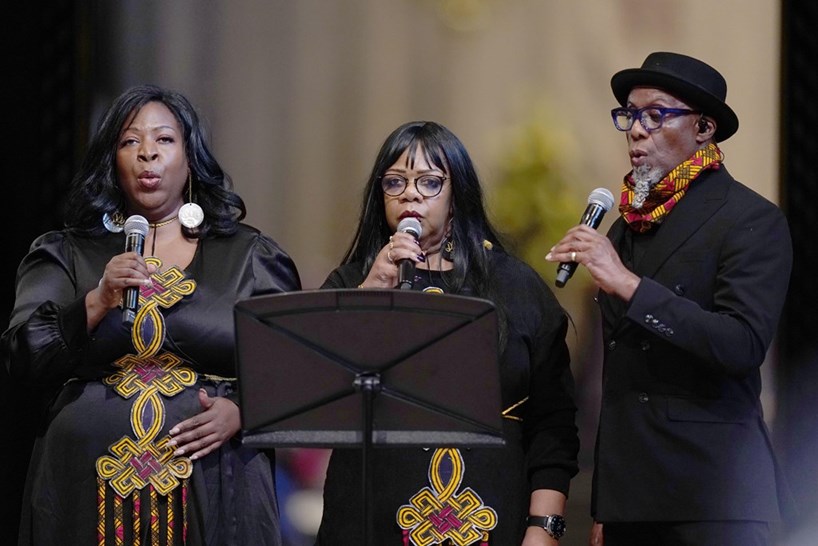
AlamyMembers of the Town Hall Gospel Choir perform during the annual Commonwealth Day Service at Westminster Abbey in March
“I was thinking of the music being like a sermon,” he says of the songs on his current album, Omni. “It has the feel of what we hear in a Baptist church. But I’m also using 12-tone systems that were developed by some of these great composers from the 20th century; so I suppose you could call it 12-tone gospel.”
The encounter of these two vocabularies is as meaningful as it is exciting, because it underlines the open-minded approach of the best creative artists who are intent on exploring as many different traditions as their muse dictates, whether the source in question is an experimental thinker in Europe or an impassioned preacher in black America. One is of no greater value than the other. The point is that each paradigm means something to Dr Lewis and enables him to craft a personal musical narrative.
In fact, one could call it the triumph of expression as well as execution. The humanist and socio-political subtext of Dr Lewis’s music, which makes resolute calls for knowledge of self, empathy, perseverance, and compassion, conveys his world-view and steadfast convictions, as well as the extensive musical knowledge on which he can draw.
Musicians who pride themselves on originality tend to be both inquisitive and imaginative. Several other contemporary artists have also developed their own methods of composition which flow from their grounding in the Church, all the while bringing a new slant to the vocabulary. For example, Amina Claudine Myers has created a vocabulary on piano and organ which evokes the strong feeling of a church service, but she has also infused it with an enormous subtlety that often eludes other players.
Sacred song has also been integral to the growth of British artists of African and Caribbean heritage. Islands such as Barbados, Trinidad, and Jamaica all have strong Christian traditions. Gospel has also filtered through Jamaica’s primary innovation, reggae, on occasion, as exemplified by a noble anthem such as Jimmy Cliff’s “Many Rivers To Cross”, a key song in the 1972 film The Harder They Come.
IN THE 1980s, there was a plethora of black British groups making gospel music — to the delight of West Indian churchgoers up and down the country. The Harmonisers and the Majestic Singers, from Wolverhampton and Birmingham respectively, were ranked among the best.
Also important is the enduring London Community Gospel Choir, which, under the direction of Monserrat-born the Revd Bazil Meade, has made several recordings and appearances on mainstream television. As in the United States, several exponents of gospel music, or those who at least learned their craft in church, have crossed over into soul and funk The most notable is Mica Paris, formerly a member of the choir Spirit of Watts. Her majestic, powerful voice graces memorable hits such as “My One Temptation”.
In the 1990s, that sacred-secular relationship played out in another style of music, which captured the imagination of a fresh new audience that eagerly embraced rapping rather than singing as a vehicle for storytelling — hip hop.
Roots Manuva emerged as one of the great “emcees” of the decade. He was born in London to Jamaican parents, and his father was a deacon in a Pentecostal church. You might well conclude that Roots Manuva has gone in as ungodly a direction as possible by opting to perform music synonymous with profanity — this is not the only signe particulier of hip hop, incidentally — but the rapper duly made thought-provoking reference to his upbringing, complete with Sunday worship, in pieces such as “Sinny Sin Sins” and “Colossal Insight”. These are starkly confessional songs with existential depth.
When evoking his younger self, “Bible in hand”, the artist states that he was “confused”. That word is a prosaic but powerful common denominator between those who keep the faith and those who do not. Doubt, struggle, tribulation, and, it is to be hoped, redemption are part and parcel of any belief system.
There have to be obstacles on the path to salvation. Roots Manuva felt the need to lay bare real dilemmas as he girded his loins against “the cold draft of the bleak winter”. This is a thoughtfully expressed, emotionally charged socio-political metaphor for a child of Caribbean migrants who was brought up in Britain, as well as for anybody grappling with the meaning of life. A modern urban “griot” (West African historian, storyteller, praise singer, poet, and/or musician), the rapper is young, gifted, and flawed: the son of a preacher man.
Kevin Le Gendre is a journalist and broadcaster with a special interest in Black music, and the author of Children of the Ghetto (Black Music in Britain Vol 2), published by Peepal Tree.
“The Music is Black: A British Story”, an exhibition exploring 125 years of Black music-making in Britain, is at the V&A East Museum, 107 Carpenters Road, London E20, until 3 January 2027. Phone 020 7942 2000. vam.ac.uk
‘ The preceding article may include information circulated by third parties ’
‘ Some details of this article were extracted from the following source www.churchtimes.co.uk ’