Where do songs come from? And where do they go?
The first is a question of inspiration, the second one of posterity. Consider the Beatles standard “Yesterday,” the indelible tune of which Paul McCartney famously received in a dream, or the Bob Dylan classic “Like a Rolling Stone,” of which its writer later said, “It’s like a ghost is writing a song like that. It gives you the song and it goes away.”
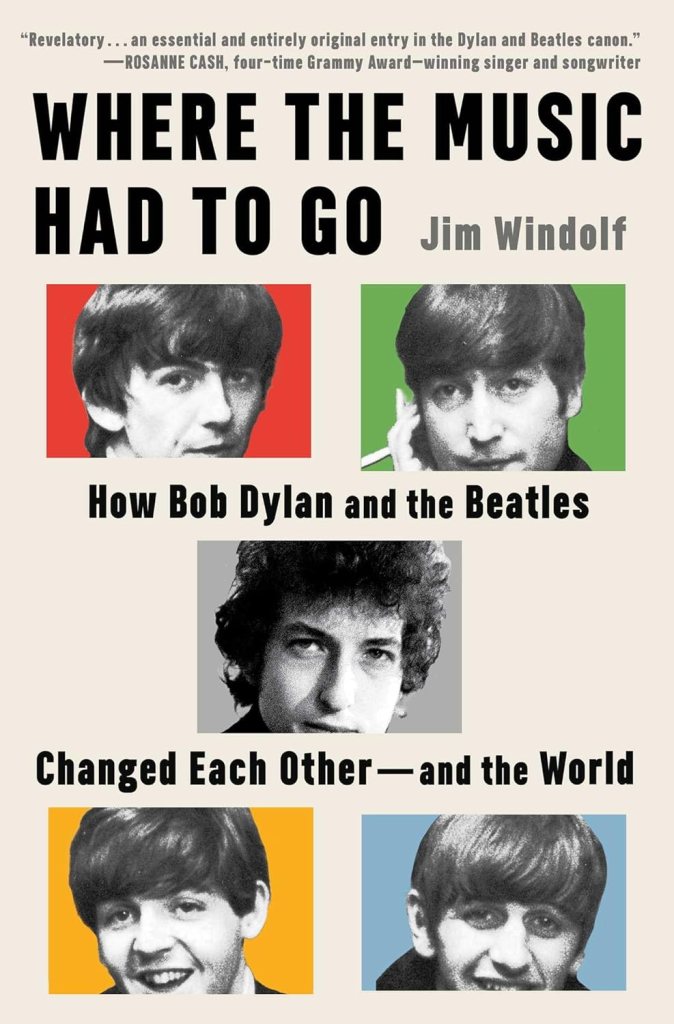
It would be hard to name two more different songs—one a perfectly poised, semi-classical ballad, the other an exuberantly angry screed overflowing with bitter rhymes. But they were written and released in the same year, 1965, by artists whose musical and personal lives were intertwined in myriad ways, as author Jim Windolf teases out in his pleasurable new book, Where the Music Had to Go: How Bob Dylan and the Beatles Changed Each Other—and the World.
On its most basic level, Windolf’s book is a deft rereading of two well-known 1960s biographies, that of the Beatles and of Dylan, through the lens of their influence on each other. It’s old news to anyone with even a slight knowledge of rock history that folkie Dylan went electric around the same time the Beatles picked up acoustic guitars and started to write more mature lyrics, with the albums “Rubber Soul” and “Blonde on Blonde” as two major signposts of this exchange. But Windolf goes well beyond this obvious convergence, finding resonances and context that had never occurred to me.
For one, he notes that the hardscrabble post-industrial towns of both Dylan’s and the Beatles’ youth—the fading mining town of Hibbing, Minn., and the once-booming English port city of Liverpool, respectively—helped to form their defiant sensibilities. He also traces how fan hysteria dogged them through their careers, from the deranged fan who fatally shot John Lennon to the crank “Dylanologist” who rooted through his idol’s garbage. He follows the spiritual paths they variously pursued, from Dylan’s long engagement with Biblical texts and his vaunted Christian period to George Harrison’s questing Hinduism and Krishna consciousness. He even tracks a particular Gibson guitar that Harrison gave to Dylan: It shows up on the cover of the latter’s “Nashville Skyline.”
Windolf’s book has its share of riveting, you-are-there storytelling. While recounting in detail the famous New York City summit of 1964, when Dylan and his entourage first met the Beatles at the Delmonico Hotel and he introduced them to pot, Windolf includes a scene that could be from a film. Suze Rotolo, Dylan’s ex-girlfriend, gets a call from the Delmonico while she’s in the midst of an activist meeting to plan protests of the Gulf of Tonkin Resolution, which would escalate U.S. entanglement in Vietnam; the invitation to join Dylan and the Beatles at the hotel, sneered at by some of Rotolo’s earnest lefty colleagues, founders after a fraught payphone call. For sheer compression of period detail, you could hardly conjure a richer moment.
The book’s centerpiece was in fact captured on film. Windolf spends a chapter poring over a nearly 20-minute clip, shot in 1966 by documentarian D. A. Pennebaker, which shows Dylan and Lennon in the back seat of a limo, seemingly talking nonsense while Dylan gets increasingly carsick. You can see the clip on YouTube, but it’s not easy viewing; the tension between these two 1960s icons is palpable.
Windolf helpfully fills in the subtext: Dylan is trying, in his own awkward way, to confront Lennon about the extent to which he feels that the Beatles have appropriated his folk sound; the stone-faced Lennon betrays no discernible response. Of course, Dylan had already leveled this charge more effectively in song, responding to Lennon’s folk-ish “Norwegian Wood” with the uncannily similar “Fourth Time Around.”
Such fly-on-the-wall passages aside, the book’s great subject is how the music changed, and how that in turn changed both its makers and its listeners. There’s a rough transatlantic symmetry to the way Dylan’s early folk material took many of its tunes from English and Scottish sources, while the Beatles’ earliest rock efforts cribbed from American country and rhythm & blues.
And Windolf makes a convincing case that later efforts to return to their roots understandably took diverging paths, given their disparate backgrounds: The Beatles drew on British music hall traditions and place names for their “Sgt. Pepper’s Lonely Hearts Club Band,” while Dylan immersed himself in old weird Americana in a series of demo recordings, later released as “The Basement Tapes,” with the Canadian musicians who would call themselves simply “The Band.”
Recalling the latter sessions, guitarist Robbie Robertson said that Dylan “would pull these songs out of nowhere. We didn’t know if he wrote them or if he remembered them.” Windolf traces this to Dylan’s dawning realization that he was working in a tradition larger than pop or even folk music, as narrowly defined in his early years: that he was writing “everybody’s song.” Music did not belong to him, in other words—even songs that seemingly only he could have created.
This is no less true of the Beatles’ catalogue. For all the distinctively Beatles-ish personality their records possess—and surely that has always been a big part of their appeal—the songs themselves have the curiously timeless quality of always having been around, as is also true of a lot of the Tin Pan Alley standards that predated them and the classic rock that succeeded them. Indeed, inevitability is right there in Windolf’s title, which comes from a Dylan quote about how the Beatles showed him the future. When he first heard them, he said he could hear “where the music had to go.”
What we revere as musical genius, in short, might be nothing more than a fine attunement to that timeless frequency.
Related
‘ The preceding article may include information circulated by third parties ’
‘ Some details of this article were extracted from the following source www.americamagazine.org ’