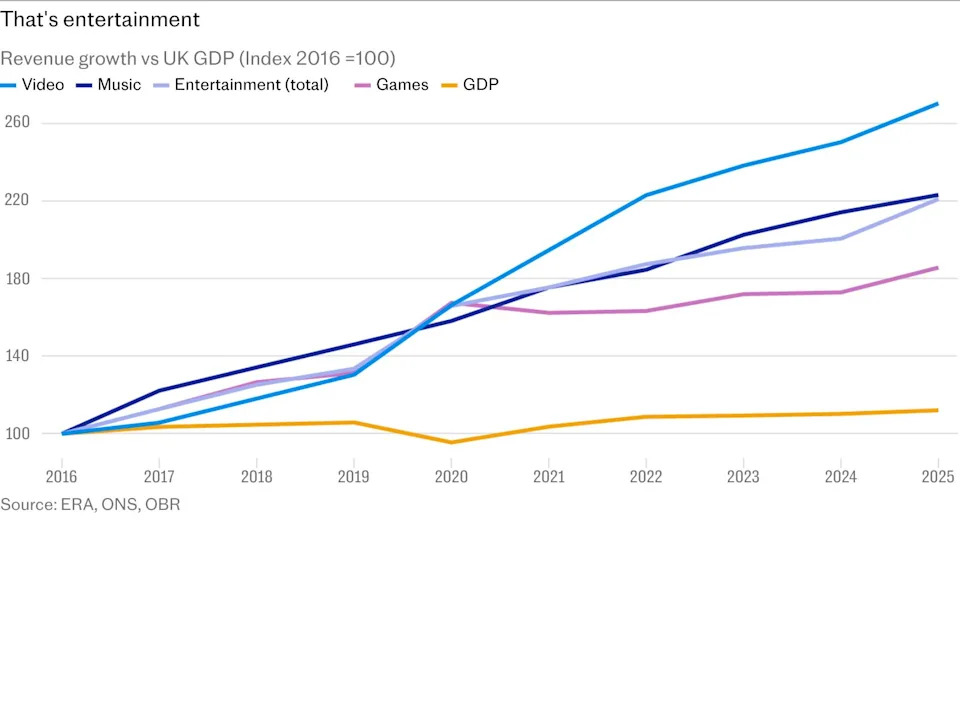
Britons are spending more than ever before entertaining themselves at home with streaming and gaming services as they fork out record sums amid a slowdown in the economy.
Revenues generated from music, videos and games rose by more than 7pc in 2025 to a new high of £13.3bn, according to figures from the Entertainment Retailers Association (ERA) released on Wednesday.
That was more than double the 3.3pc growth recorded in 2024 and the fastest pace since 2020, when Covid lockdowns forced people to stay at home.
The surge in entertainment sales last year was more than four times higher than the 1.5pc GDP growth across the wider UK economy forecast by the Office for Budget Responsibility (OBR).
Over the past decade, entertainment sales have surged by more than 120pc – 10 times faster than the 12pc growth recorded by the UK economy over the same period.
b’
0701 Are you not entertained
‘
It means entertainment is now a bigger slice of the UK economy than ever before as US streaming giants increasingly capture the attention – and wallets – of British households.
Video was the largest subsector for the second successive year as consumers spent big on subscription services such as Netflix, Disney+ and Amazon Prime.
Revenues for video hit £5.4bn after growing 8pc last year. Over the past decade, the sector’s revenues have grown more than 14 times faster than the wider economy.
Watching movies and shows is now even more popular than the mid-2000s DVD boom – when 2004 sales hit about £3bn – suggesting more time spent in front of the screen.
This was followed by gaming, which grew by 7.4pc in 2025 to just under £5.4bn, outstripping its cumulative growth over the four previous years.
The increase was driven by an 8.8pc rise in revenues from mobile and tablet games to £1.9bn.
This offset a decline in physical game consoles such as PlayStation and Xbox – though full-game console downloads grew strongly, driven by the success of EA Sports FC 26, which sold almost two million copies across digital and physical formats.
Music industry boom
Music also enjoyed strong growth last year, with revenues rising by more than 4pc to almost £2.5bn.
The music industry has enjoyed a sharp reversal in fortunes over the last decade as the rise of streaming rescued it from the brink of collapse amid widespread piracy.
Last year’s music growth was driven primarily by subscriptions to streaming services such as Spotify and Apple Music, though physical formats increased their share of music revenues to 15pc – the highest level since 2021 – thanks to continued demand for vinyl.
Taylor Swift produced the best-selling album for the second year running as The Life Of A Showgirl pulled in 642,469 album sales, 147,382 of which were on vinyl. The biggest single of the year was Ordinary by Alex Warren, which generated the equivalent of 2.2 million sales.
Booming demand for entertainment suggests that cash-strapped consumers are opting to spend their disposable income on keeping themselves amused at home rather than heading out.
The success of the sector stands in stark contrast to the travails of Britain’s leisure and hospitality industries, which are struggling to stay afloat amid crippling tax rises and as punters stay away.
One pub closed each day on average in 2025, according to data from global tax firm Ryan.
Kim Bayley, the chief executive of the ERA, said: “This result vindicates the transformational role of streaming services and retailers in driving the entertainment sector to new heights, thanks to a potent combination of technology, investment and innovation.
“While conditions may be tough in the wider economy, streaming services and retailers are winning a greater share of consumer spending and proving their central role in the UK’s creative economy, driving revenues for musicians, film-makers and games developers.”
‘ The preceding article may include information circulated by third parties ’
‘ Some details of this article were extracted from the following source www.yahoo.com ’