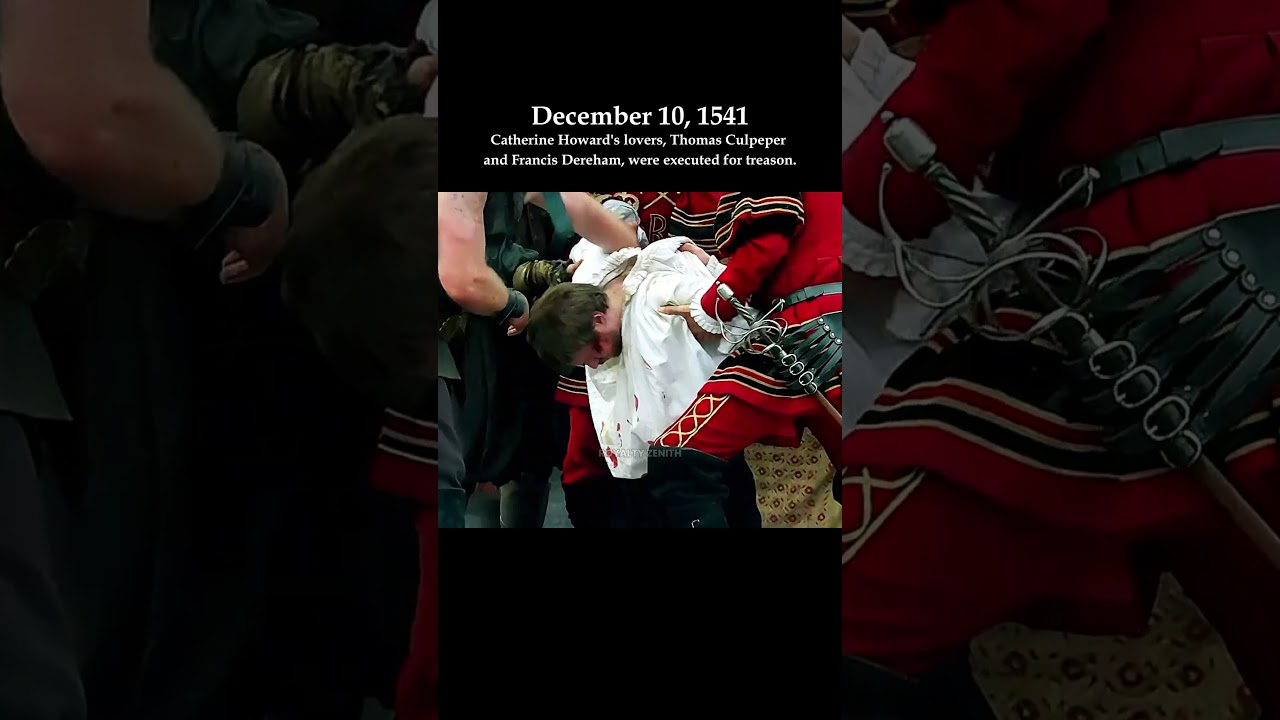
The executions of Thomas Culpeper and Francis Dereham in December 1541 were the result of King Henry VIII’s discovery of Queen Catherine Howard’s past and present infidelities. Though both men were convicted of high treason, their crimes represented two different “betrayals” in the eyes of the Tudor court.
Francis Dereham was condemned for his past relationship with Catherine. Years before she became Queen, the two had lived as a couple while in the household of the Dowager Duchess of Norfolk. Under the laws of the time, their private exchange of vows and physical intimacy constituted a “pre-contract” of marriage. When this was revealed to Henry VIII, it essentially rendered the King’s marriage to Catherine bigamous and void. Because Dereham had failed to disclose this prior relationship before Catherine married the King, he was sentenced to the most brutal form of execution: being hanged, drawn, and quartered.
Thomas Culpeper, a favorite courtier and Gentleman of the Privy Chamber, was executed for his actions after Catherine had become Queen. Unlike Dereham, Culpeper’s crime was adultery (or at least the intent to commit it). Evidence surfaced of secret late-night meetings facilitated by Lady Rochford, and a compromising letter from Catherine to Culpeper—notably ending with the phrase “yours as long as life endures”—sealed his fate. Because of his high social standing and his former personal friendship with the King, Henry granted him the “mercy” of a beheading rather than the more agonizing death suffered by Dereham.
Video Source
Catherine Howard’s lovers were executed before her #history #royal #royalty #viral #shorts #tudor
ADVERTISEMENT

Related Posts








Recommended Stories



ADVERTISEMENT