“Chief of War” transports viewers to Hawaii in the late 1700s through the details — Jason Momoa’s Kaʻiana hurls insults in Hawaiian on a blackened lava field before an epic battle while wearing a yellow ʻahu ʻula (feathered cape) and a hand-stamped kapa malo (loincloth).
Behind the scenes, costume designer Caroline Eselin-Schaefer took on the enormous task of creating all the attire for the Apple TV series set in ancient Hawaii.
“(It was) a huge responsibility to take on the telling of the history of Hawaii, and to do it as authentically as possible,” said Eselin-Schaefer, who spoke with Spectrum News Hawaii via video chat after a long day working in Chicago on the Netflix movie “Saturn Return.”
Researching ancient Hawaii
“Chief of War” is set in a time before the invention of photography. To learn how people dressed, Eselin-Schaefer first immersed herself in historical materials. She studied ʻahu ʻula at the Bishop Museum on Oahu, consulted “Royal Hawaiian Featherwork: Nā Hulu Aliʻi,” and examined historical paintings by English artist John Webber, who accompanied Captain Cook to Hawaii in 1776. She also sought inspiration from contemporary paintings of ancient Hawaii by Native Hawaiians Herb Kāne and Brook Kapūkuniahi Parker.
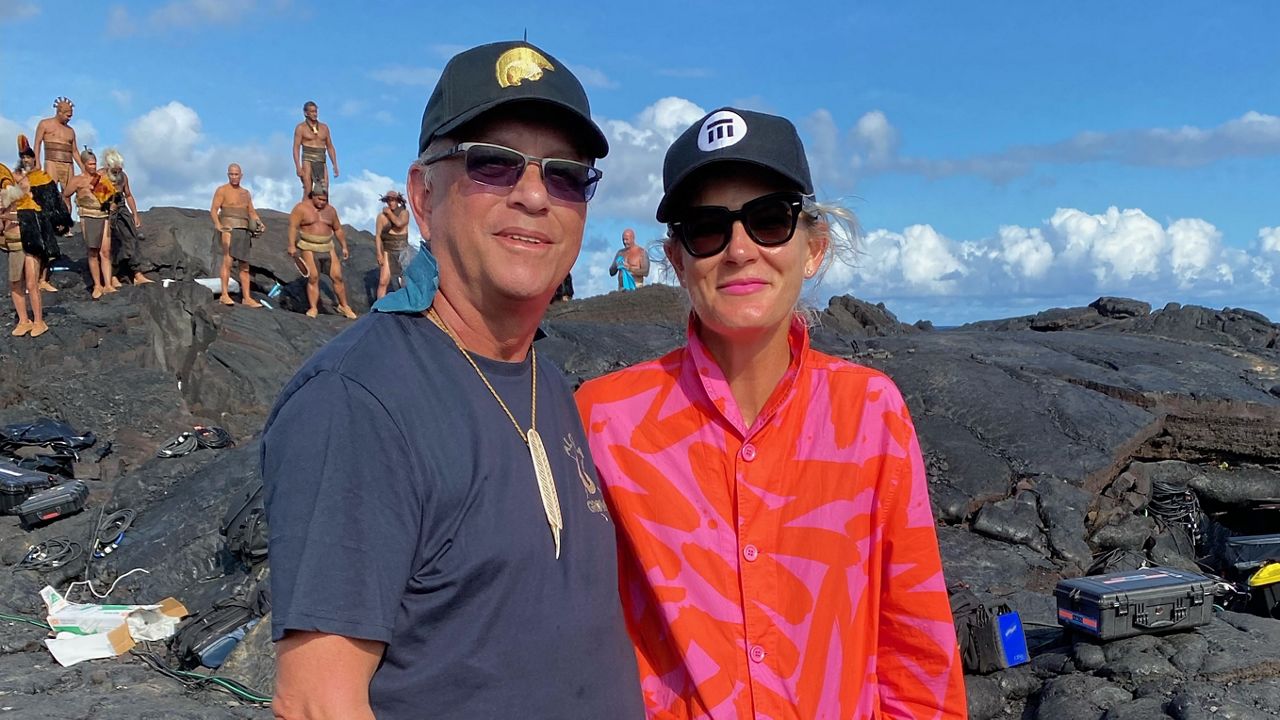
ʻAhu ʻula advisor Rick San Nicolas on set with Eselin-Schaefer. (Photo courtesy of Caroline Eselin-Schaefer)
She also worked in tandem with Hawaiian artisans and cultural advisors. “I’m so grateful for their patience, for their knowledge, for their generosity, for them just being with us and believing in us and trusting us.” An afternoon was spent at Dalani Tanahy’s home on Oahu, learning how to make kapa, a bark-cloth worn in ancient Hawaii. She flew to Hawaii Island, attended the Merrie Monarch Festival, and met with Rick San Nicolas, who is an expert in the ancient Hawaiian art of featherwork. Advisors Huihui Kanahele-Mossman and Kauila Barber spent hours with Eselin-Schaefer on video chat, helping her determine not just the aesthetics, but also how garments were worn and when.
“It was a new process for me as a designer, building a world that had never been built before,” said Eselin-Schaefer, who studied film and English at the University of Southern Mississippi. About five years ago, she worked on Barry Jenkins’ “The Underground Railroad” for Amazon Prime Video, which was similar in scale, however, she said the research was different given the abundance of mid-19th century North America images versus late 18th century Hawaii ones.
Building the costumes
Everything in the show had to be created from scratch. In a North Hollywood building, a 30-person team of stitchers, pattern makers, fabric sourcers, production assistants and others worked for months. Each room was dedicated to a different component of the costume design: creating ʻahu ʻula and mahiole (feathered helmets), crafting jewelry and adornments, testing out fabrics, dyeing kapa, and aging clothes. Throughout each day, Eselin-Schaefer went from room to room, helping her team make sure the clothes looked authentic and also moved naturally. They eventually created at least 160 ʻahu ʻula, which were worn by Hawaiian royalty, with size an indicator of rank.
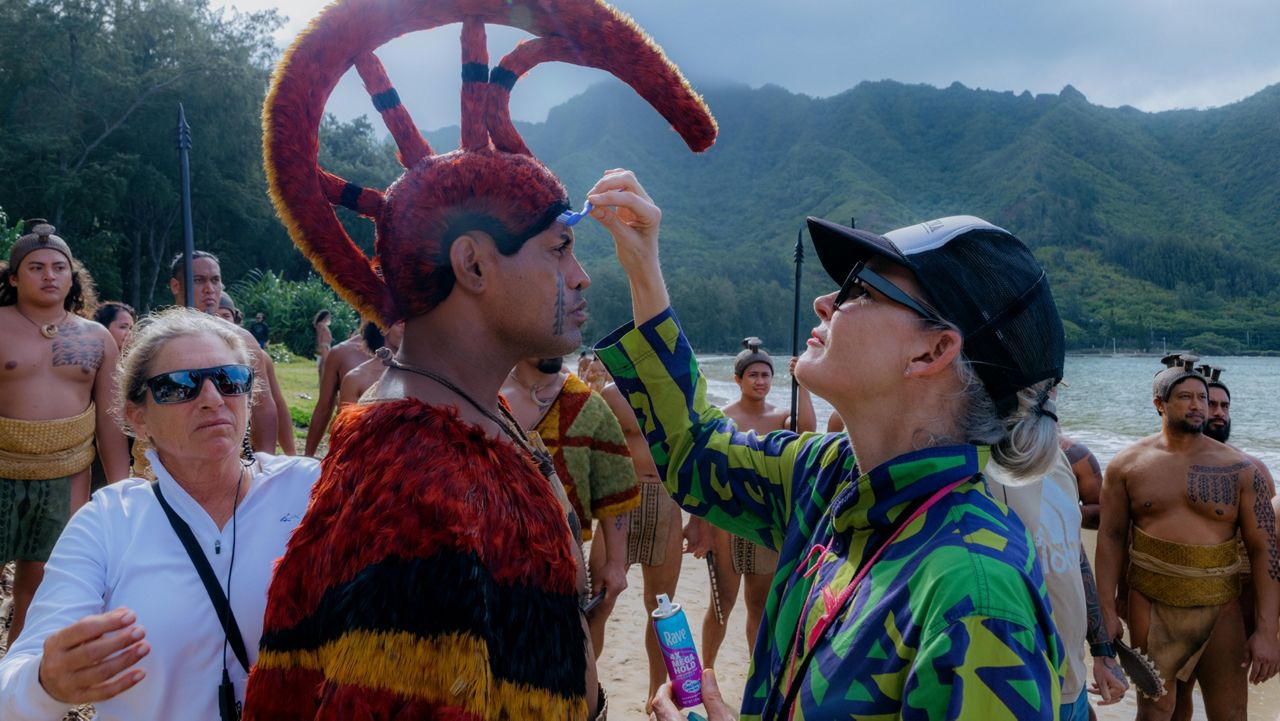
Eselin-Schaefer makes sure everything looks right on actor Keala Kahuanui-Paleka, who plays ʻOpunui. He wears a mahiole and ʻahu ʻula. (Photo by Jason Eric Laciste)
Traditional ʻahu ʻula — painstakingly made over many years by gathering small bundles of feathers from Hawaiian honeycreepers and tying them in overlapping rows on an olonā netting — were impossible to recreate at scale. Instead, the feathers were sewn onto a premade netting from India, a close match to the original.
“We sourced from all over the world to put together the right components to make the cape as authentic as possible,” said Eselin-Schaefer. “Things that were just the closest in look that would have the same weight (and) that would have the same feel.”
The feathers came from the Chinese golden pheasant, with the male birds a bright red and gold and the female birds a mottled brown, after receiving guidance from cape advisor Rick San Nicolas, who said these feathers looked the closest to the Hawaiian honeycreepers. Each island was also given its own color palette to help distinguish fighters during large battle scenes. Yellow for Hawaii Island, red for Maui (with some feathers dyed to be a bolder red), and earthy tones for Oahu, using the feathers from jungle fowl, seabirds and roosters for the latter capes.
Building costumes in the North Hollywood studio was stressful and exhausting, said Eselin-Schaefer, especially since they were far away from their advisors and collaborators. But when Momoa came for his first fitting, it reinvigorated everyone. The famous actor screamed with excitement when he saw ‘ahu ‘ula, malo and other ancient Hawaiian garments resting on mannequins and lining the shelves. “He is so supportive and really loves costume,” she said. “It was so uplifting.”
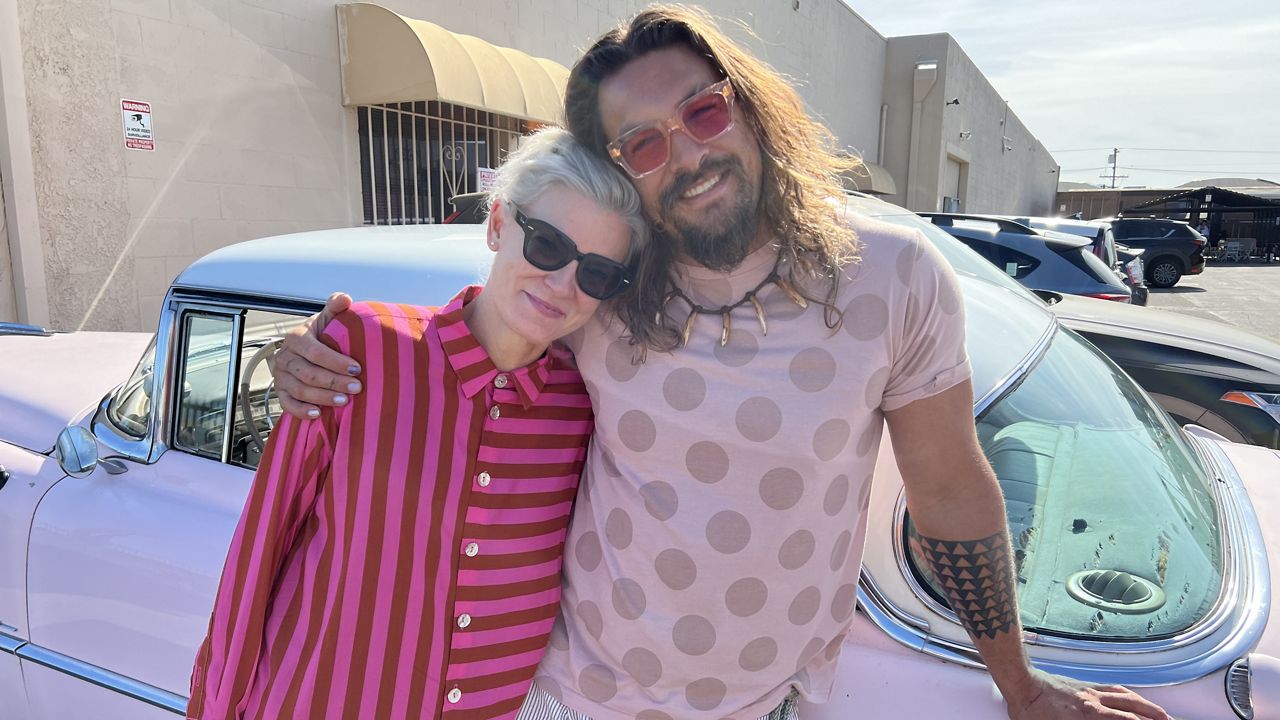
Eselin-Schaefer poses with Momoa in Los Angeles. (Photo courtesy of Caroline Eselin-Schaefer)
Seven months in Los Angeles were followed by four months of prep in Hawaii before filming started. After that, her team, which had grown to about 60 people, headed to New Zealand for six months of filming. Long days on muddy, rain-soaked sets bonded her team, making them like a family. “It’s something that becomes a real, big part of your life,” she said “‘Chief of War’ is not just a job. It is a personal journey. It’s a professional journey. There was nothing else in a lot of our lives besides that.”
Kapa, malo, and Ka‘ahumanu’s dresses
Using pounded wauke bark, Native Hawaiians made kapa for men’s malos and women’s pāʻū (skirts). Creating a kapa-like fabric that looked authentic and worked for stunts was one of Eselin-Schaefer’s biggest challenges. After three months of searching, she found a fabric in an art store’s sample bin that mimicked kapa’s movement. Made in Germany, Evelon is pressed, moisture-wicking, and can be ordered in bulk.
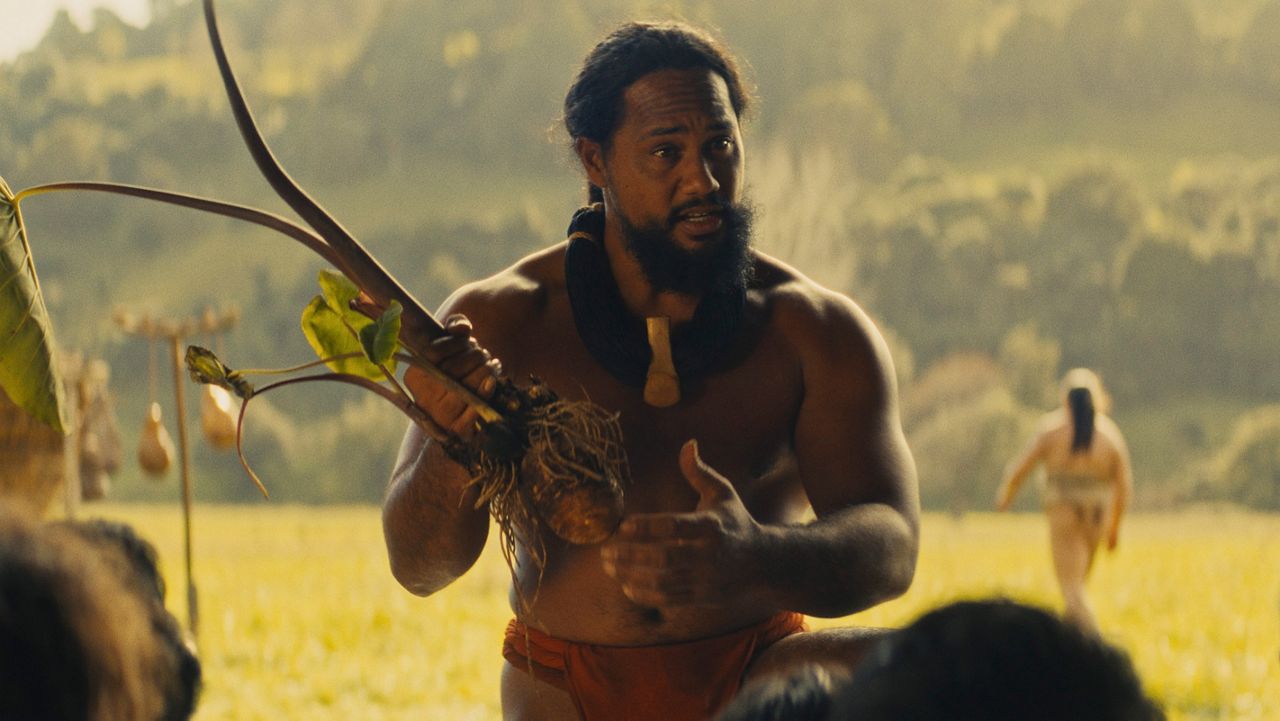
Kaina Makua’s Kamehameha wearing “the most beautiful malo” with three coils on each side, according to Eselin-Schaefer. (Photo courtesy of Apple TV)
Her team created 400 rubber stamps based on designs from “Arts and Crafts of Hawaii” by Sir Peter H. Buck, which were used to hand stamp most of the kapa. For the series, the kapa for commoners was stamped with motifs specific to their respective islands, while Ka‘iana and his family members wore kapa stamped with triangles and a shark motif to visually show their connection.
While most kapa pieces were hand stamped, a few were silkscreened for principal charters, like Kahekili, with larger motifs and patterns based on artifacts at the Museum of New Zealand Te Papa Tongarewa and the British Museum in London.
The design of the malo — whether to include the front, back, both, or no flaps — varied depending on the actor and the needs of each scene. “Some warriors wouldn’t have fought with flaps on, because that was the thing you could grab,” said Eselin-Schaefer, “but we had to make those concessions for a modern world of shooting a show.” Ultimately, some actors wore a malo with flaps and some went without the back flap, which is why some viewers gave the show the nickname ‘Cheeks of War.’ “It came down to personal preference,” said Eselin-Schaefer. “We wanted everyone to feel comfortable.”
“Kaina Makua, who portrays Kamehameha, he loves malo, and he was amazing. He ties the most beautiful malo,” said Eselin-Schaefer, who described how he included three coils on each side. “We even made a video of him tying it so we could learn.”
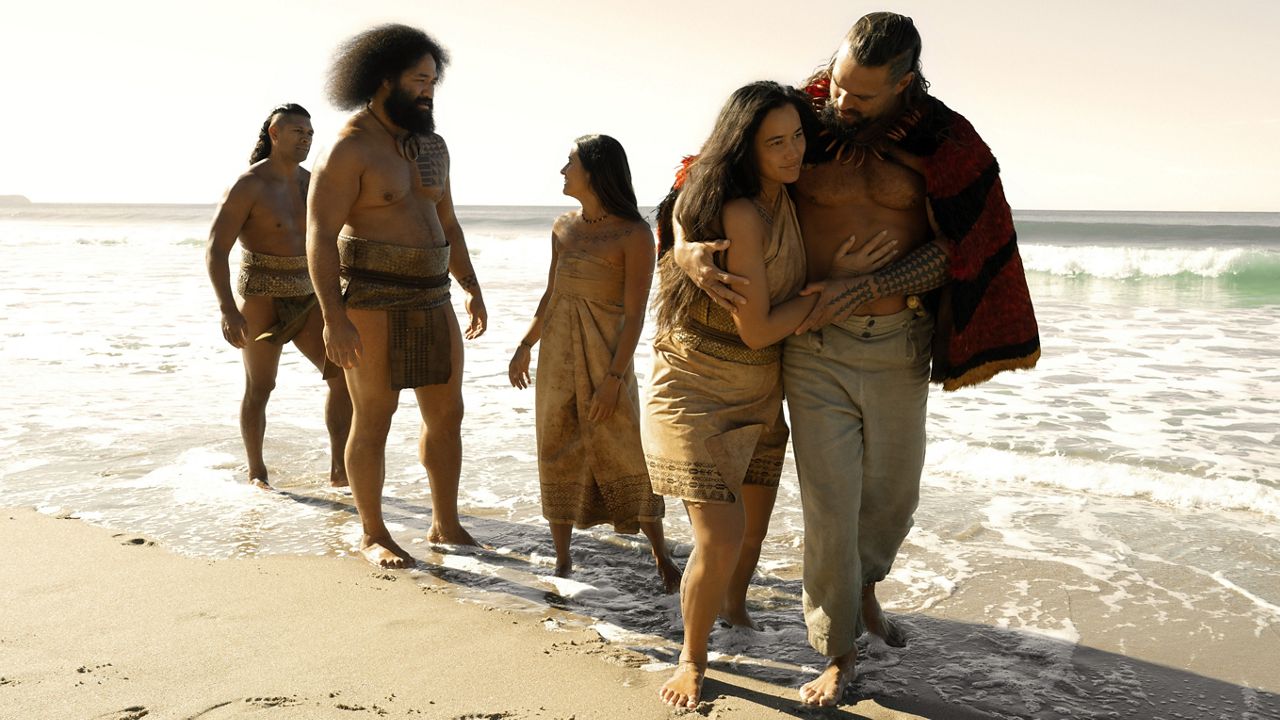
Jason Momoa’s Kaʻaina wears pants in Episode 5 after he returns from traveling abroad. (Photo courtesy of Apple TV)
Choices about malo versus pants also became a storytelling tool for Momoa’s character, Kaʻiana, whose clothing changes as he travels abroad. “Every day, I would go to Jason (Momoa) and we would talk about if he was going to continue wearing pants,” said Eselin-Schaefer. Spoiler: He starts wearing pants in Episode 3 while in Alaska and continues to after returing to Hawaii — until Episode 5 when he is competing against Kamehameha in a hōlua sled race.
For women’s clothing, Eselin-Schaefer read chants and looked at early paintings from the late 1700s to design empire-style garments, raising the traditional silhouette. “They had their own society. Women had exposed breasts, but for our show, we had to simply raise the silhouette,” said Eselin-Schaefer, who spoke extensively with her advisors for guidance. “We kind of looked at it as distracting if you had exposed breasts on our show, then the women would be sexualized.” Since there was no metal in pre-contact Hawaii, belts, or other ways to fasten clothes, Eselin-Schaefer made clothes that could be pleated, tied, folded, or wrapped on the body. One way to keep a dress secure is to take another piece of decorated kapa and tie it around the breasts, which creates the “empire” shape.
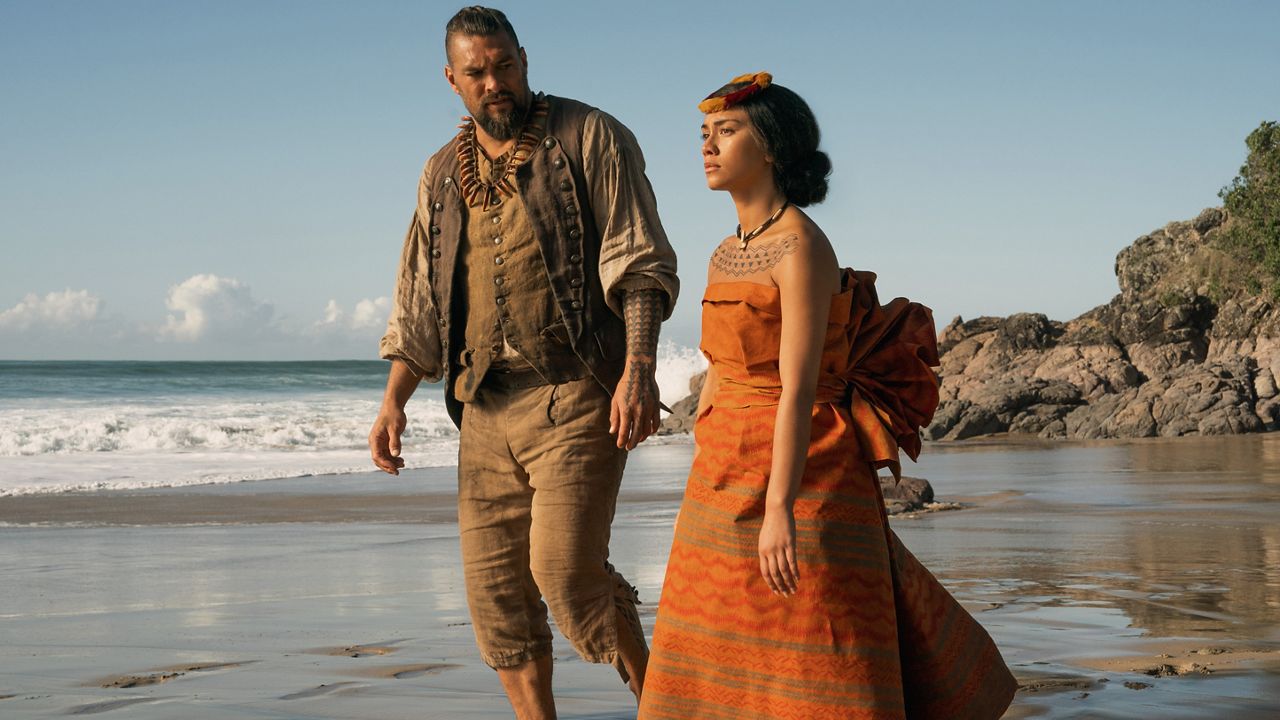
In Episode 7, Ka’ahumanu wears a bell-shaped dress with a pleated “flower” at the back. (Photo courtesy of Apple TV)
Over the course of Season 1, Ka’ahumanu’s wardrobe evolves as she grows into a powerful queen. There is only one portrait of Kaʻahumanu that was made during her lifetime — by Louis Choris, the artist on board the Russian ship, Rurik, which visited the Hawaiian Islands in 1816, according to cultural advisor Marques Hanalei Marzan. Eselin-Schaefer studied this image, along with written descriptions of her dress, but she had to fill in gaps where there was no recorded history. “I think we got the essence of her.” Early in the series, Ka’ahumanu wears a yellow one-shoulder dress, a yellow lei hulu (feathered lei) on her head, and a dainty shell necklace while still on Maui, but by Episode 7, after her marriage to Kamehameha and her move to Hawaii Island, her neck is adorned with a small lei niho palaoa (whale tooth necklace with human hair), which were only worn by royalty, and she is wearing a bell-shaped dress with a pleated “flower” at the back, a technique taught to Eselin-Schaefer by her advisor Huihui Kanahele-Mossman. “It’s kind of like couture; they were very fashionable,” said Eselin-Schaefer of the Hawaiian royal women’s pleats. Part of Kaʻahumanu’s storyline is that she never has children, so Eselin-Schaefer wanted this large shape to be on the back of the dress to ensure she doesn’t look pregnant. “We put her abundance to the back,” she said. “The more kapa you have, the higher status you are.”
The journey continues
After production wrapped, every ‘ahu ‘ula, mahiole, and piece of kapa was carefully put in storage. Eselin-Schaefer is now awaiting word on whether there will be a second season, but her research hasn’t stopped. The day before our interview, she had ordered a book on Hawaiian textiles off of eBay. “You don’t stop looking. You don’t stop researching,” she said. “You can’t stop thinking about Hawaii.”
Michelle Broder Van Dyke covers the Hawaiian Islands for Spectrum News Hawaii. Email her at [email protected].
‘ The preceding article may include information circulated by third parties ’
‘ Some details of this article were extracted from the following source spectrumlocalnews.com ’