Access to a computer gives you incredible access to a vast collection of material, and classical music enthusiasts know that this includes high-quality recorded musical performances (as well as live performances) that can bring some of the best music the world has to offer right into your home on your phone, computer or even your television.
One local group that has done much to make great music available with the touch of a button or the tap of a screen is Classical Music Chicago, the organization that gives us the Dame Myra Hess Concerts as well as the summertime Rush Hour Music Series. These concerts are presented free to the public in live performance in downtown Chicago and a day later are available at the Classical Music Chicago YouTube page.
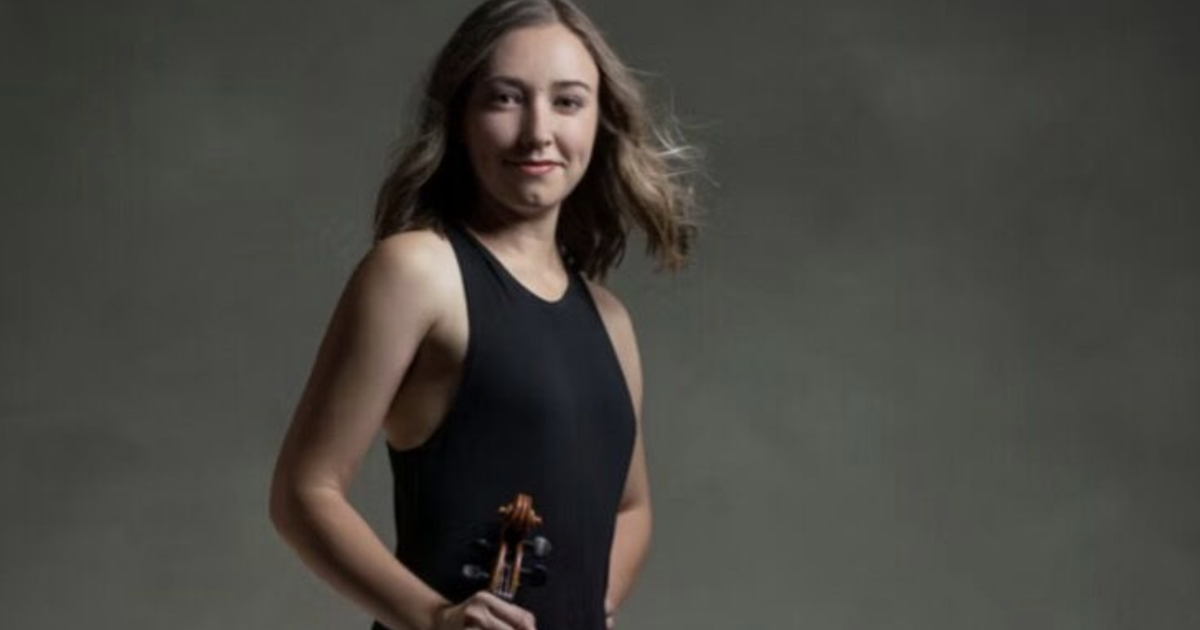
This week I stayed home and let the music come to me as I took in a splendid performance by violinist Claire Bourg and pianist Kyle Orth that took place at the Seventeenth Church of Christ, Scientist, Chicago (55 E. Wacker Drive) last Wednesday. It was also broadcast live by WFMT, and the WFMT sound feed is part of the free video available on YouTube.
Claire Bourg is a young yet seasoned violinist, a veteran of many international competitions and a graduate of the New England Conservatory, the Curtis Institute of Music, and the Juilliard School. She is currently pursuing a doctorate at the City University of New York.
Kyle Orth made his orchestral debut at the age of 15 playing the Saint-Saëns Piano Concerto with the Plano Symphony Orchestra. He has since performed across the U.S. and internationally as a soloist and a chamber musician.
Together this musical pair offered an engaging concert, opening with Mozart’s Sonata for Piano and Violin No. 18 in G Major, K. 301. The composer’s amiable side shines through in this work, and the pair were delightful in tossing the melody back and forth in the opening. Orth’s piano was fluid with pretty ornaments, and Bourg’s violin had a singing tone. In the most vibrant moments, the two created an incredibly powerful sound.
The second and concluding movement showed their ability to offer dance-like music with light steps and a sense of nobility. The performance also showcased their ability to work together seamlessly in effecting pleasing dynamic changes, and they found a strong sense of warmth in the music.
This was followed by Ravel’s Sonata for Violin and Piano No. 1, also known as “Sonate Posthume.” It is believed that this work was written for a composition class the young man took with Gabriel Fauré at the Conservatoire de Paris. It was composed after Ravel’s second admission to the conservatory. He was expelled after his first admission because his piano playing was found wanting, but he was readmitted two years later.
This work has the strange distinction that it was written 30 years before his second violin sonata yet only published 38 years after his death.
This is a one-movement piece, about 15 minutes long, with a gossamer violin part that Bourg rendered with delicacy and beauty. The piano is given more vigorous duty, but Orth ensured that it remained light, playing with a feathery approach at the piano. Cheery sections with a bit of a mystical side journey give this music its charm, and here it was executed with an airiness that seemed fitting and perfect for early spring.
The final work on their program was “Souvenir d’un lieu cher” (Souvenir of a Beloved Place) written by Tchaikovsky in 1878. The place referred to in the title is a magnificent country retreat owned by Nadezhda von Meck, one of the composer’s benefactors. Brailivo is in the Ukrainian countryside and offered Tchaikovsky privacy and comfort after the failure of his marriage.
The work is in three parts, with the opening “Méditation” being the most famous and often performed alone. There is also a Scherzo and “Mélodie.” Near the end of the 19th century, Glazunov created an arrangement for violin and orchestra, which is more famous than the original version. Bourg and Orth showed us why the original is well worth a listen.
The “Méditation” opens with an extended piano introduction, which Orth performed with simplicity, and then the music developed a thick, clouded texture that gave it a quality of a reminiscence. The violin had equal measures of sweetness and melancholy. The pair drew a vivid picture of drama and mystery and a strong sense of soul-searching.
The Scherzo (marked presto giocoso) was sharply punctuated, and the music was propulsive. Urgency gave way effectively to a tender song before returning to the strong pulse of the original theme.
The closing “Mélodie” opened with a beautiful lyrical melody. Both players treated it effectively as a song without words (the score originally had that title in French, “Chant sans paroles”), and the song-like qualities were rendered with skill, with enchanting results.
Upcoming performances of the Dame Myra Hess Concerts include music by cellist Julia-Hyunji Lee and pianist Umi Garrett. On the program: Robert Schumann’s Fantasiestücke for Cello and Piano, Nadia Boulanger’s Trois Pièces for Cello and Piano, Beethoven’s Cello Sonata No. 4 in C Major, and Florence Price’s “Adoration.” This concert is April 15 at the Seventeenth Church of Christ, Scientist, at 12:15 p.m.
Don’t forget to check out Classical Music Chicago’s YouTube page with archives of numerous performances featuring music for every taste. This is a true treasure trove of musical delights and a wonderful gift by CMC not only to Chicago but to anyone, anywhere with an internet connection. Bravi!
‘ The preceding article may include information circulated by third parties ’
‘ Some details of this article were extracted from the following source www.hpherald.com ’