While Washington, D.C., is known as the nation’s capital and the political nerve of the free world, if District Mayor Muriel Bowser has her way, the city will also be known as the country’s most vibrant entertainment hub, where tourists and residents can have a good time.
“Arts, culture, film and entertainment, and sports are such a big part of our economic growth agenda because they bring people together, they get people excited…and they generate even more pride in our city,” Bowser, 53, said at the launch of 202Creates Month at Planet World Museum in Northwest D.C. on Aug. 29. “That’s why it’s so important that we lean in and double down on the industries that are producing for our city.”
As the District braces for cuts in the federal workforce and possibly some facilities because of Trump administration policies and practices, the mayor is still emphasizing the importance of D.C.’s creative culture.
In her 10th year as the District’s leader, Bowser has consistently talked about diversifying the economy away from the public sector and industries that depend on it and reaching out to embrace tech companies, sports organizations and arts events as a means of generating revenue and employment for residents.
Data from the District government reveals that in 2016, D.C.’s creative economy generated $2.6 billion for the city. However, presently, the District gets $15.9 billion from the creatives and their work.
Bowser has said that the District is the sports capital because of the number of professional teams that play in the city, which will include the Washington Commanders as of 2030, tentatively. She now says the District is the “Capital of Creativity.”
“The creative economy in Washington, D.C. employs residents, attracts investment, diversifies our economy and strengthens the vibrancy of our city,” Bowser said.
202Creates: Local D.C.’s Hallmark Cultural Activity
Operating since 2016, the District’s 202Creates, has worked to support the District’s artists and creative culture.
Bowser, working in concert with the D.C. Office of Cable Television, Film, Music and Entertainment (OCTFME) hosts what is now known as 202Creates Month, using the event to spotlight the talents and industries that fuel the city’s creative economy.
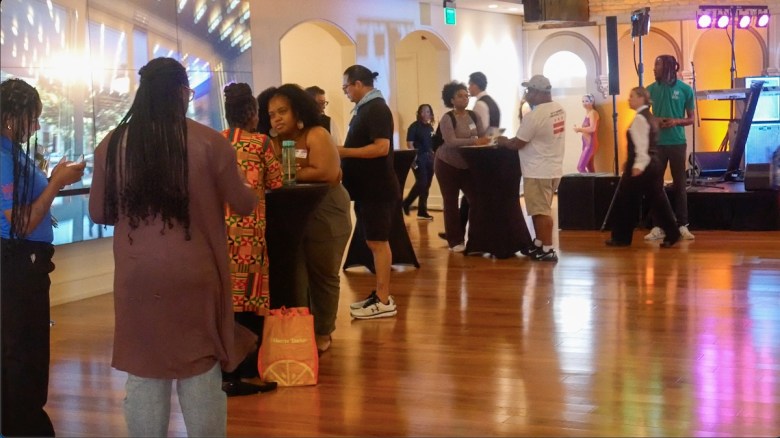
This year’s inaugural 202Creates Con, featured fireside chats, panels, immersive activations, live performances and networking opportunities for residents and stakeholders in the District’s creative community on Aug. 29.
Further, the hallmark ceremony for 202Creates Month is the annual Mayor’s Arts Awards, which will take place on Sept. 25.
Bowser praises the emergence of 202Creates Month as a force in the creative economy, saying “202Creates Month is a celebration of the important role artists, entrepreneurs, and innovators play in telling the story of our beautiful and creative city.”
LaToya Foster, director of OCTFME, emphasizes the creative economy plays a key role in spurring the District’s economy.
“202Creates is a strategic economic driver that powers our city’s identity as the creative capital and as an innovative economy,” said Foster, adding 202Creates Con offers another layer. “This year’s inaugural 202Creates Con focused on growth, building a sustainable entertainment infrastructure, and attracting new business to our world-class city.”
‘Atlanta Is Atlanta, D.C. is D.C.‘
Historically, the entertainment industry has been associated with studios and offices in California’s Hollywood, Burbank and Universal City, or in New York, with Broadway and the world-renowned theater district.
However, in the past 20 years, Atlanta, Georgia has emerged as a force in the entertainment industry. The capital of the state, Atlanta is a major entertainment hub for the film and television production industry and is noted for its diverse music scene, live venues and festivals.
Tyler Perry Studios and Trilith Studios are housed in Atlanta along with a number of independent, yet smaller studios. Films such as the latest “Superman,” “Black Panther,” “Stranger Things,” “The Walking Dead” and “Avengers: Endgame,” were produced in the Atlanta area.
Foster said while she admires the work that Atlanta has done in developing its reputation as an entertainment hub, the District stands in a class by itself.
“There is only one D.C.,” Foster said. “We are the capital of the world. We are expanding our economy, making it more diverse. This is not just a government town anymore.”
John Gibson III is the vice president for public affairs and industry relations at the Motion Picture Association, which is headquartered in Northwest D.C.
He, like Foster, emphasized that the District has a unique history and assets Atlanta does not possess.
“Before there was Atlanta, there was D.C.,” said Gibson. “We were the original Chocolate City. We are also the capital of the world.”
The Next Steps to Becoming an Entertainment Hub
Herbert Niles, the associate director for the film division for OCTFME, said his job to make the District more enticing to the film industry.
“I focus on the business and the production side of the industry,” he told The Informer. “I stress to film companies, especially Black film companies, that they can stay here and do their work, and they don’t have to go to Atlanta or New York.”
Niles said the DC Film, Television and Entertainment Rebate Fund is a key component in bringing more films and entertainment business concerns to the District. The Fund is set up to encourage the District as a production location for events, whether they are live, television, film, digital or interactive, to support the development of media industry infrastructure projects, and to urge the hiring of residents as cast and crew.
A wide range of rebates to production companies can go as high as 35% and as low as 10% depending on the category. For example, up to 35% of a company’s qualified production expenditures subject to taxation can be rebated while up to 10% of an entity’s qualified personnel expenditures not subject to taxation (non-resident cast and crew) can be given back.
“The D.C. Council should increase the tax incentives for film companies to come here,” he said.
As the associate director for the film division for OCTFME, Niles said the Fund can be used to attract film companies and build relationships within the industry.
“You have to build those relationships,” he said. “We also connect local businesses with production companies. The people who work in those companies will need to go to the cleaners, eat at restaurants.”
‘ The preceding article may include information circulated by third parties ’
‘ Some details of this article were extracted from the following source www.washingtoninformer.com ’