No one understands the art of dancing through darkness quite like South Korean singer-songwriter Kino.
Since stepping out as a soloist in 2023 and launching his one-man agency, NAKED, Kino has traded the polished confines of idol life for something far more personal: freedom. Not the glamorous kind often associated with fame, but the hard-earned freedom that comes from confronting fear, uncertainty, and self-discovery head-on.
“I became more confident and expressed my feelings,” Kino told amNewYork. “Now I don’t care about opinions. I just care about myself, promoting my songs, and meeting my fans. I’m still young and learning life, so I’m still discovering myself. But I know myself better than before.”
That freedom has become the heartbeat of his music.
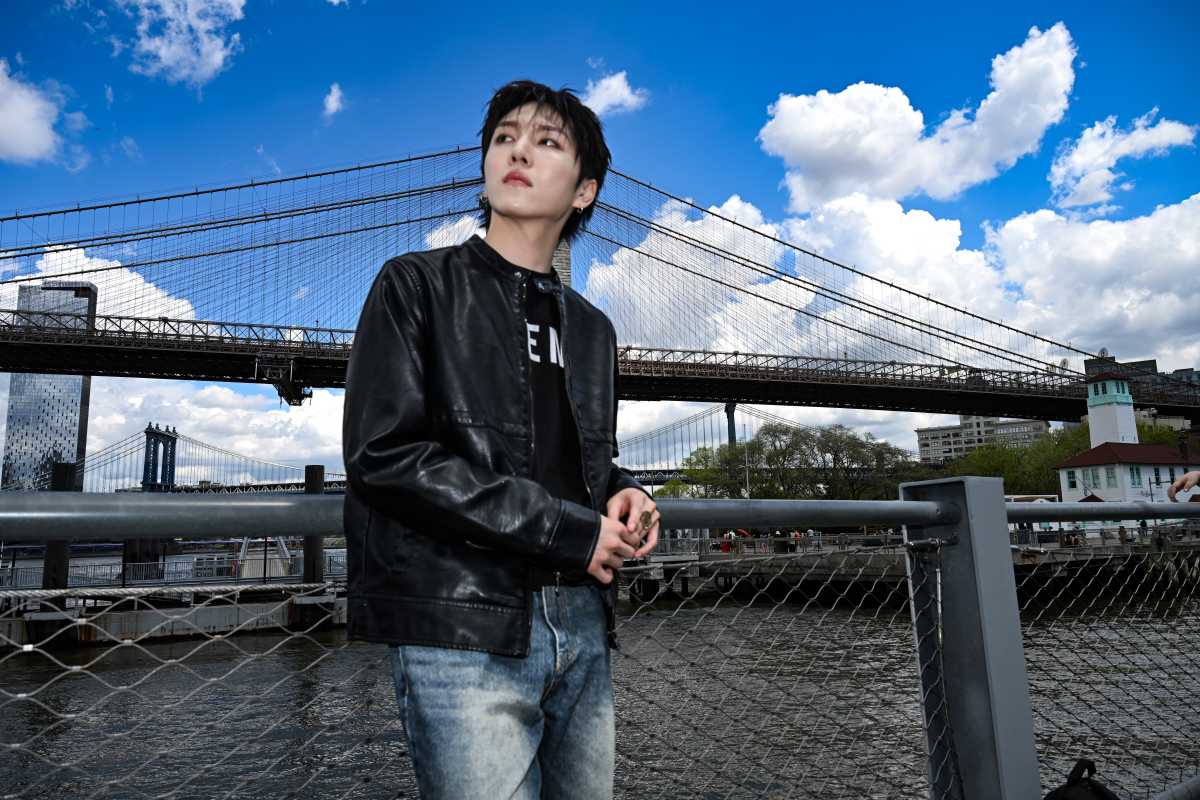
Whether he was shouting about his single “Skyfall” from the dizzying heights of the Empire State Building’s spire catwalk or gazing toward the Statue of Liberty while walking the Brooklyn Heights Promenade discussing his “Free Kino” tour, Kino carries himself with the kind of cinematic intensity that makes his artistry feel less like a discography and more like an unfolding television saga. Each release arrives like another season in a deeply personal coming-of-age story.
“I think it’s like a series,” he explained. “This is season three of ‘Lost and Found.’ After I released my last EP, I overcame a hard time because I put all the negative feelings and emotions into that music. That became my therapy. If you feel negative emotions, you have to shout them out. That’s how I express my feelings through music.”
Like chapters documenting survival and rebirth, Kino’s solo catalog traces an emotional evolution. “If This Is Love, I Want a Refund” served as a raw confession. “EVERYBODY’S GUILTY, BUT NO ONE’S TO BLAME” wrestled with pressure and blame. “Lost and Found” focused on acceptance and a realization that healing does not mean erasing pain but learning how to move with it.
For Kino, shedding the image of a flawless idol was never about rebellion for rebellion’s sake. It was about reclaiming his humanity.
“I’m pushing boundaries. My musical style has totally changed since I started my company,” Kino said candidly. “What I realized is that honest feelings create the strongest connection with fans. I wanted to show a person, not just an idol that a company makes.”
But freedom, he admits, comes with weight. Running NAKED means carrying every responsibility himself, whether that be creative, emotional, or financial. The independence he longed for also forced him to confront the loneliness that often accompanies leadership.
“The artists I respected always put all their emotions into their music, whether it was good or bad,” Kino reflected. “People relate to those stories, and that becomes their favorite music. Before, I always tried to make something people would like. Now I just talk about myself, even if it’s ugly or uncomfortable.”
He paused before acknowledging the reality of independence.
“The only thing I got [after founding NAKED] is huge responsibility. It’s heavy. Under a K-pop company, things were easier because somebody else decided everything. Now I have to take care of people and make every decision carefully. It’s always stressful.”
Yet amid that pressure, Kino discovered P.L.U.R. (Peace, love, unity, and respect), which he says grounded him in an industry often defined by relentless competition and perfectionism.
“We can’t be loved by everyone,” he said. “But we have to keep the balance and keep the value of love and peace. If we care too much about everyone liking us, we can’t truly live with love.”

That philosophy became the emotional core of his “Free Kino” tour. Rather than simply delivering polished performances, Kino wanted to create a sanctuary, a place where fans could let go of their own fears, even if only for a few hours. It allowed them to dance in the dark, without judgment.
“If you come to ‘Free Kino,’ I want you to feel the moment,” Kino said with a smile. “The lights go down, it becomes dark, and then we just feel the music together. We shout together, sing together, dance together. Along the way, we connect.”
For perhaps the first time in his career, the performance itself became secondary to the shared catharsis unfolding between artist and audience.
“Before this tour, I always tried to make perfect performances,” he added. “But this time, I wanted to share moments and feelings and connect with people. That’s what I focused on.”
In many ways, Kino’s journey has become a testament to the idea that freedom is not the absence of darkness, but the courage to move through it anyway and the willingness to reach for others while doing so.
For his fans, he hopes his music can become the same refuge that creating it became for him: proof that even in isolation, nobody has to dance alone.
“I’m putting my full energy into everything I do,” Kino said. “And after I achieve success, I want to prove something to people. I want to tell them that if you don’t give up, if you keep dreaming and push yourself to the limit, you can make it. I want to prove that.”
‘ The preceding article may include information circulated by third parties ’
‘ Some details of this article were extracted from the following source www.amny.com ’