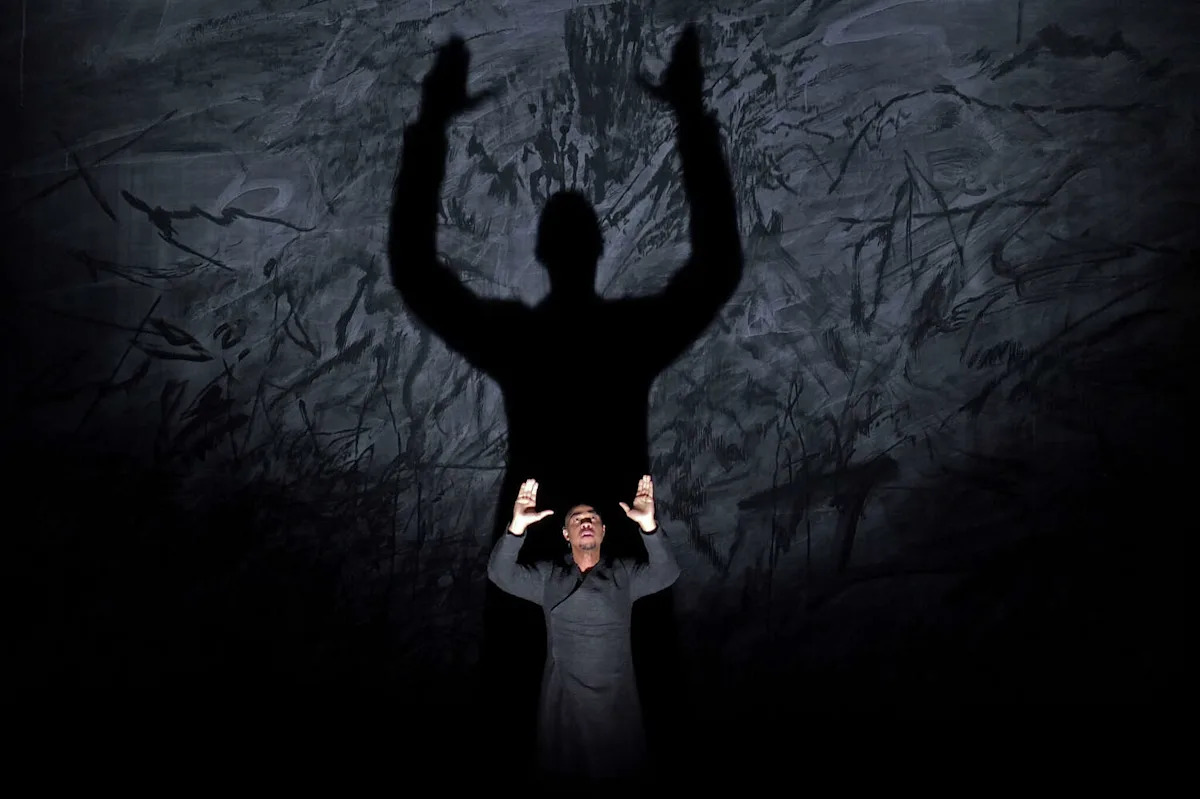
One of the most talked about and acclaimed young singers on the international scene these days is the 38-year-old bass-baritone Davóne Tines.
Local audiences have two upcoming opportunities to experience his newest concert program, titled “What is your hand in this?” performed with the seven-piece early music group Ruckus. Concerts are at 7 p.m. on Friday, Oct. 24, at the Clark Art Institute in Williamstown, Mass., and 7 p.m. on Saturday, Oct. 25, at Hudson Hall in Hudson.
Besides his expressive voice and four-octave range, Tines is also recognized for creating thoughtful and provocative programs that juxtapose music from various centuries, traditions and styles in service of a concept or idea. Honoring the 250th anniversary of the Declaration of Independence, “What is your hand in this?” is about revolution.
The roughly 80-minute program includes a Handel aria from the “Messiah” (“Why do the nations so furiously rage?”), Clifford Otis song “This Bitter Earth,” the early American hymn “Jesus Lover of My Soul” and Julius Eastman’s “Buddha,” a one-page graphic score that’s been described as “painful meditation.” There’s also “Steps to Compassion,” a world premiere by Doug Balliett, a member of Ruckus who also did some song arrangements.
More than a showcase of talent and style, the concert is described in some promotional material as “a biting exploration of America’s revolutionary music.”
“I’m very reticent to simply put on a performance. I’m always actively trying to invite the audience to reflect on themselves and for us to have an actual communal experience,” says Tines.
The local performances are considered “previews” (which sounds a lot better than “works in progress”), to be followed by appearances at numerous major venues across the country, including Carnegie Hall, during the first months of the country’s celebration of “America250” (the federal government’s preferred terminology, which sounds a lot better than Semiquincentennial).
Growing up the son of a church musician in a small Virginia town, Tines learned some things about how music works from his dad, who was a music minister.
“I’ve been indoctrinated in Black Baptist musical traditions ever since I could roll around on the floor,” says Tines. “In liturgical settings, music serves a function. It’s for particular reasons at particular times. It is not decorative but crucial to the proceedings that are actually deeply personal.”
Alongside his youthful immersion in sacred music, another major influence on Tines’ profile as an artist was his experience with early music during his work on a master’s degree at The Juilliard School. (He earned his undergraduate degree in sociology at Harvard, which recently honored him with the Medal for the Arts this year.)
“At my first rehearsal with the violinist and historical performance people, we sat in a circle and sang to the music,” says Tines. “That was counter to everything I knew about how classical performance happened. In the time leading up to that, the Juilliard training was very hierarchical. Singers are at the mercy of the conductor, and there’s no cross-pollination with colleagues in the orchestra. But in historical performance, we all sat in a circle.”
One could say that the experience was a personal revolution.
“That really broke down assumptions about what historical performance was,” he continued. “It proved to me that within white Western musical practice, there was an actual place for collaboration and variation. This program itself expounds on that idea, and for me, it’s foundational to understand why we’re doing these pieces.”
These same values are at the heart of Ruckus, which has been described as “the world’s only period instrument rock band.” Working without a conductor, the players bring a tidal wave of energy and life to Baroque repertoire or whatever is at hand. The playing felt like another voice or character in the recent stagings of Handel operas by R. B. Schlather at Hudson Hall (“Rodelinda” in 2023 and “Julius Caesar” last summer).
For this program with Tines, Ruckus will have traditional period instruments, including a theorbo, an oversized lute. The players will also utilize a synthesizer, banjo and electric bass.
“Forget ‘great singer’ – Davóne is a singular force in music today. His rooted and formidable curatorial mind didn’t just help this project: it defined our purpose,” says bassoonist Clay Zeller-Townson, founder and artistic director of Ruckus, in an email. “When you add his intensely improvisational spirit as a performer, it’s clear: he’s exactly the caliber of artist Ruckus is built to collaborate with.”
More information on the Hudson Hall performance can be found at HudsonHall.org. For the Clark performance, go to: clarkart.edu.
A “Boheme” for the holidays
If you’re already missing the summer season and longing for more live opera, here’s something for your holiday calendar. Opera Saratoga – “the home team” is how my friend Peter Halley (of Siena Opera Club) refers to them – is making a rare mid-year outing with Puccini’s classic “La Boheme” at 7 p.m. on Friday, Dec. 5.
Playing the role of Mimi is soprano Kayla Rae Stein, who was named one of the elite Renée Fleming Artists at this summer’s Aspen Music Festival. Other soloists have performed at the Metropolitan Opera and the Salzburg Festival, and additional singers are drawn from the Skidmore College music program and locally based Excelsior Vocal Ensemble.
The concert performance will be accompanied by pianist Adam Nielsen and partially staged by the company’s general and artistic director, Mary Birnbaum. Tickets are $27.50 – $127.50. For more information, go to operasaratoga.org.
This article originally published at Classical Notes: Davón Tines aims for ‘revolutionary’ program.
‘ The preceding article may include information circulated by third parties ’
‘ Some details of this article were extracted from the following source www.yahoo.com ’