The news from Iran continues to be alarming. Delhi lies safely removed from that volatile part of the world, but only up to a point. For our city is a confluence of many cultures and languages, Persian among them. This week, that inheritance comes alive in the form of an anniversary, even as the world beyond is growing more dangerous.
Delhi is observing the 722nd Urs, or death anniversary, of Amir Khusro, the 14th-century poet who principally wrote in Persian, the language of the elite in Khusro’s Delhi. Khusro’s poetry is particularly admired for weaving the formal Persian with the colloquial Braj Bhasha, the earthy language of parts of northern India.
That said, one might wonder why a person’s death anniversary is being celebrated rather than mourned. It is because in Sufism, the death of a revered figure is interpreted as a union with the divine; and Khusro’s grave lies within the Sufi shrine of Hazrat Nizamuddin Auliya in central Delhi. Khusro was in fact the beloved disciple of the aforementioned Sufi saint. Tradition at the shrine obliges a pilgrim to first offer flowers at Khusro’s tomb before proceeding to Nizamuddin’s shrine.
Indeed, Khusro’s place within Sufism is that of a poet, a devotee, and a musician. He is credited as a foundational figure in Hindustani classical music, and as a pioneer of qawwali, the devotional songs offered as prayer in Sufi shrines across the subcontinent. At Nizamuddin’s dargah, many of the qawwalis sung are Khusro’s own compositions.
The poet’s oeuvre is vast. You might, of course, be familiar with some of Khusro’s verses. Consider this one:
Khusro darya prem ka, ulti va ki dhaar,
Jo utra so doob gaya, jo dooba so paar.
(Khusro’s river of love, it runs in inverse,
one who steps into it drowns, one who drowns in it is carried safely to the other side.)
Spiritual in his poetry, Khusro also ably networked within the capital’s VIP corridors. While being the devotee of a mystic who famously despised rulers, he simultaneously remained a favoured poet among a succession of rulers, some of whom happened to be each other’s rivals. Legendary scholar Annemarie Schimmel remarks in her entry on Khusro in the definitive Encyclopaedia Iranica that “one should not blame Khusro for his shifting allegiances in a confused political situation; this was the normal practice of medieval poets.”
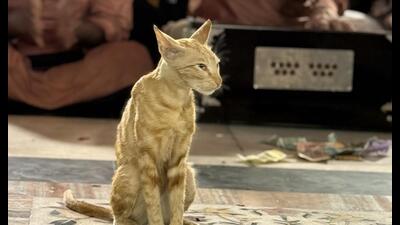
Khusro’s Urs began at Nizamuddin’s shrine on Sunday and concludes on Thursday. On Wednesday night—tonight—the dargah courtyard will host qawwalis from around 10 pm until late into the night. While there, look for the dargah’s cat, who likes to sit with the qawwal singers (see photo). More importantly, do snatch a moment to peer into Khusro’s tomb chamber, which lies behind the qawwali courtyard. Within, you will see inscriptions in… well, Persian.
‘ The preceding article may include information circulated by third parties ’
‘ Some details of this article were extracted from the following source www.hindustantimes.com ’