Gustavo Dudamel steadily ups his commitments with the New York Philharmonic. Carnegie Hall celebrates the inimitable Arvo Pärt. And the Metropolitan Opera again begins its season with a score by a living composer.
Here are some of the highlights of a typically busy fall music calendar. (Locations are in Manhattan unless otherwise specified, and dates are subject to change.)
September
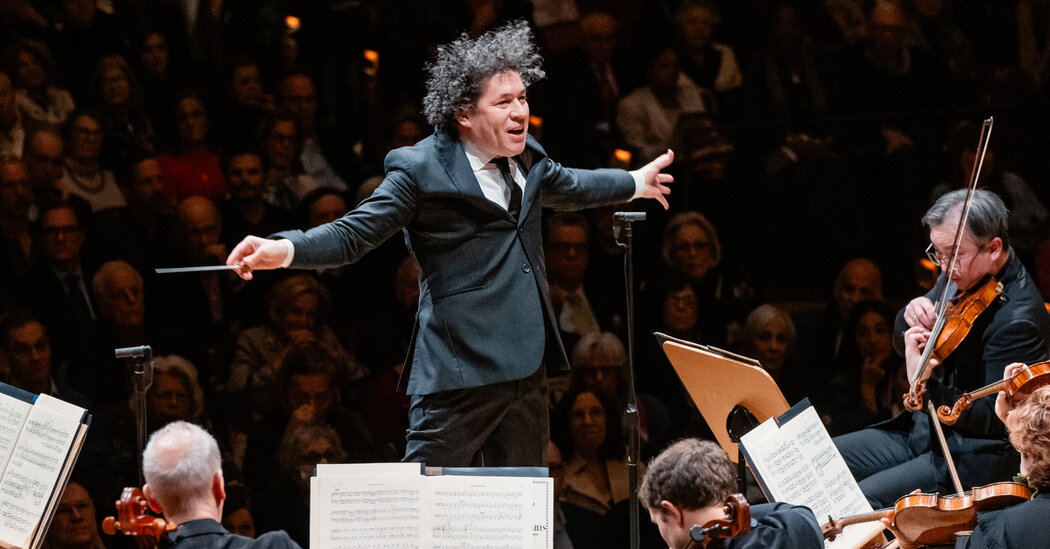
GUSTAVO DUDAMEL IN NEW YORK You can practically hear the New York Philharmonic counting down the days until Dudamel becomes its music and artistic director for real. The wait is nearly over — but not yet. (He takes over in fall 2026.) Still, Dudamel will open the Philharmonic’s season, leading two programs that look strong on paper: The electrifying young pianist Yunchan Lim joins him for the first one, playing Bartok’s Third Concerto on a bill that also includes a Leilehua Lanzilotti premiere and Ives’s Second Symphony; the second program is intellectually hefty, with Beethoven’s immortal Fifth Symphony preceding John Corigliano’s First, a shattering response to the AIDS epidemic. (Sept. 11-21; David Geffen Hall)
‘THE AMAZING ADVENTURES OF KAVALIER & CLAY’ As increasingly seems the norm these days, the Metropolitan Opera opens the curtains on a new year with a work that is contemporary if not wholly a debut. Mason Bates’s adaptation of Michael Chabon’s Pulitzer Prize-winning novel, with a libretto by Gene Scheer, had its premiere at the Jacobs School of Music in Indiana last year. Expect a handsome staging from Bartlett Sher, with projections by 59 Studio. Miles Mykkanen and Andrzej Filonczyk play the comic book writers confronting the threat of fascism; the Met’s music director, Yannick Nézet-Séguin, conducts. (Sept. 21-Oct. 11; Metropolitan Opera)
GUSTAVO DUDAMEL IN LOS ANGELES As Dudamel conducts an extended hello at Lincoln Center, he continues his long goodbye at Walt Disney Concert Hall, where his tenure with the Los Angeles Philharmonic will end in spring after 17 transformative years. His first programs of the year have typical panache: Strauss’s vertiginous “An Alpine Symphony” is paired with the premiere of Ellen Reid’s “Earth Between Oceans”; Stravinsky’s pulverizing “Rite of Spring” follows a new piece by John Adams, “Frenzy”; and Mahler’s Second Symphony, the “Resurrection” — well, that stands alone. (Sept. 27-Oct. 12; Walt Disney Concert Hall, Los Angeles)
‘11,000 STRINGS’ The Park Avenue Armory lost its artistic director, Pierre Audi, who died in May, but his adventurous spirit lives on in ambitious programming this season. The composer Georg Friedrich Haas’s music has a rare ability to redefine the experience of listening; some of his string quartets are played in complete darkness. His “11,000 Strings” is likely to be a less intimate affair, embracing the full scale of the Armory’s drill hall: The work encircles the audience with 50 pianos — each microtonally tuned to exploit the merest smidge of difference in pitch — as well as a chamber group of 25 musicians, here drawn from the Klangforum Wien. (Sept. 30-Oct. 7; Park Avenue Armory)
October
SALONEN AND BOULEZ The time has already come to celebrate Pierre Boulez’s centennial, but it’s gratifying that as the 20th century that he so dominated recedes further into the past, there are still musicians eager to play his works. Step forth, Esa-Pekka Salonen, for two programs with Boulez’s own New York Philharmonic: One focuses on Debussy but includes an exploration of Boulez’s “Notations” in their orchestral and piano versions (the soloist is Pierre-Laurent Aimard), while the second ends with the unearthly beauty of “Rituel,” for which Salonen and the Philharmonic are joined by Benjamin Millepied’s L.A. Dance Project. (Oct. 3-11; David Geffen Hall)
‘LA SONNAMBULA’ The last time Rolando Villazón appeared at the Met, it was to reinvent himself as Papageno in “The Magic Flute,” an unexpected role for a tenor who had been among the house’s brightest young prospects, before suffering a series of vocal crises. This time, Villazón will work entirely from the wings, directing a new production of Bellini’s opera that features a house favorite, the soprano Nadine Sierra, in the starring role of Amina. Riccardo Frizza conducts a cast that includes Xabier Anduaga, Sydney Mancasola and Alexander Vinogradov. (Oct. 6-Nov. 1; Metropolitan Opera)
JACK PLAYS LACHENMANN Not only does this Miller Theater composer portrait offer an infuriatingly rare opportunity to grapple with the fractured, exploratory music of Helmut Lachenmann, who turns 90 in November and is one of the most influential composers of the past five decades. But it also provides a chance to hear all three of his string quartets played by the indispensable JACK Quartet, which owes its rise to its exceptionally tight relationship with the composer and his works. (“I don’t find better groups for my music than them,” Lachenmann has said.) There is unlikely to be a more enticing contemporary music concert this year. (Oct. 9; Miller Theater)
THE FRICK Buried two floors below street level, the Frick Collection’s new concert hall has impressed early listeners, and the museum seems intent on putting it to good use. Isabelle Faust opens proceedings (Oct. 10) with Baroque solo violin works by Bach and Nicola Matteis; other events of interest include the distinguished mezzo-soprano Anne Sofie von Otter singing Schubert’s “Schwanengesang” with Kristian Bezuidenhout at the fortepiano (Oct. 12), and a trio of the former Berlin Philharmonic clarinetist Andreas Ottensamer, the cellist Kian Soltani and the pianist Alessio Bax playing Beethoven, Mendelssohn and Brahms (Nov. 16). The early music group Sonnambula will be in residence, including for a recital with Davóne Tines (Nov. 2), and there will also be concerts tied to special exhibitions in the galleries above, not least an appearance by the essential vocal ensemble Les Arts Florissants (Oct. 26).
ISRAEL PHILHARMONIC ORCHESTRA Carnegie Hall’s usual parade of touring orchestras doesn’t really get going until later in the season, but take note of this early appearance by the Israel Philharmonic Orchestra, an ensemble still admired for its distinctive Old World sound. Led by its young, talented music director, Lahav Shani, it brings with it the music of Paul Ben-Haim, who worked as an assistant to the conductor Bruno Walter before fleeing Germany in 1933, and eventually becoming the most eminent composer in Israel. Each of the three concerts pairs a notable Ben-Haim work with a major Tchaikovsky symphony; in the first, Pinchas Zukerman plays Ben-Haim’s violin concerto. (Oct. 15-18; Carnegie Hall)
CHAMBER MUSIC SOCIETY OF LINCOLN CENTER The artistic directors David Finckel and Wu Han continue to blend classic chamber works and forgotten gems, with their concerts often exploring historical links like the tight relationships that formed between Robert and Clara Schumann, Brahms, and the violinist Joseph Joachim (Oct. 19; Alice Tully Hall). But the Society is at its freshest when it deviates from its usual fare: The wonderfully articulate French pianist Jean-Efflam Bavouzet, for example, will play the complete solo piano works of Ravel in a single evening (Nov. 18; Alice Tully Hall); and in the first of the season’s Sonic Spectrum new music events, the New York Philharmonic clarinetist Anthony McGill, the mezzo-soprano Fleur Barron and the pianist Gloria Chien give a Valerie Coleman premiere (Nov. 6; Rose Studio).
ARVO PÄRT AT 90 Carnegie Hall celebrates the start of Arvo Pärt’s 10th decade by making him its Debs Composer’s Chair, and by scheduling two concerts of his music with expert ensembles based in his native Estonia. Paavo Järvi leads the Estonian Festival Orchestra in works including “Cantus in memoriam Benjamin Britten,” “Credo” and “Tabula Rasa” (Oct. 23; Carnegie Hall); and the Estonian Philharmonic Chamber Choir is joined by the Tallinn Chamber Orchestra and the veteran Pärt champion Tonu Kaljuste for a program that includes the “Stabat Mater,” “Magnificat” and “Te Deum” (Oct. 24; Zankel Hall).
YARN/WIRE Ensembles like Yarn/Wire — the pianists Laura Barger and Julia Den Boer, together with the percussionists Sae Hashimoto and Russell Greenberg — are the backbone of New York’s contemporary music scene, and they should be celebrated whenever they can for their persistence and their excellence. Miller Theater rightly marks Yarn/Wire’s 20th birthday with three early-evening pop-up concerts — free tickets, free drinks — that feature music by Zeena Parkins, Sam Pluta, Enno Poppe, Craig Taborn, Linda Catlin Smith, Mei-Fang Lin and Tyshawn Sorey. (Oct. 27-29; Miller Theater)
PHILHARMONIA ORCHESTRA For this visit to Carnegie Hall, the Philharmonia brings music that New York audiences would have been familiar with decades ago — Bartok’s “Concerto for Orchestra” and Sibelius’s Fifth Symphony were both on the bill when Herbert von Karajan led the ensemble in its debut concerts in the city in 1955. On that trip, Karajan declined to share the spotlight with any soloists, but here two superb, thoughtful pianists will grace the stage for concerto performances: Alexandre Kantorow in Prokofiev, under the principal guest conductor Marin Alsop, and Vikingur Olafsson in Beethoven, with the music director Santtu-Matias Rouvali. (Oct. 28-29; Carnegie Hall)
CZERNOWIN AND ABRAHAMSEN Chaya Czernowin has spent much of her professional life teaching in the United States, but her raw, unsparingly powerful music still does not receive enough attention in this country. Good on the New York Philharmonic, then, for commissioning “Unforeseen Dusk: Bones Into Wings,” a major work for six amplified voices and orchestra. It’s partnered for this Sound On event — in which Brad Lubman conducts musicians from the Philharmonic, the Juilliard Orchestra and the Neue Vocalsolisten — by “Vers le Silence,” a pandemic piece by Hans Abrahamsen, whose “Let Me Tell You” is one of the great works of the century so far. (Oct. 29; David Geffen Hall)
November
‘HILDEGARD’ “I’ve often thought to myself,” the composer Sarah Kirkland Snider has written, “‘Are you crazy?! Writing your first opera about one of the most beloved female composers in history?’” Maybe so, but the overflowing life and legend of Hildegard of Bingen — medieval nun, visionary, writer, composer and much else — would appear to be perfect operatic material, and particularly ideal for Snider. Making its debut at the L.A. Opera in a presentation with Beth Morrison Projects, her opera focuses on Hildegard’s complicated, mysterious relationship with Richardis von Stade, another religious sister. Elkhanah Pulitzer directs singers including Nola Richardson and Mikaela Bennett in the two major roles. (Nov. 5-9; The Wallis, Beverly Hills)
ORCHESTRA OF ST. LUKE’S Any time the enthralling French conductor Raphaël Pichon is in town to perform, it’s a good idea not to miss it. One of the many things that he does superbly is to put works we think we know in an unfamiliar context, and that’s certainly the case for this program with the versatile Orchestra of St. Luke’s: Before Beethoven’s Ninth Symphony comes a selection from Beethoven’s music for “Leonore Prohaska,” a play celebrating a female Prussian soldier who battled against Napoleon’s armies. (Nov. 6; Carnegie Hall)
DANIIL TRIFONOV Once the wunderkind of the piano world, Daniil Trifonov has matured into one of its most intriguing artists, eager to explore and collaborate. Early in the season he partners the intense baritone Matthias Goerne for Schubert’s “Die Schöne Müllerin” (Oct. 19; Carnegie Hall), but in November he lets his hair down for not one but two virtuosic concertos with the Orchestre National de France: the gorgeous, glorious Ravel in G and the second of five by Saint-Saëns. Cristian Macelaru conducts. (Nov. 9; Carnegie Hall)
‘THE MONKEY KING’ After working together on “An American Soldier” and “M. Butterfly,” the composer Huang Ruo and his librettist David Henry Hwang partner again for an important premiere at the San Francisco Opera. Chinese literature provides the source material this time, in the form of the 16th-century novel “Journey to the West,” and the music will similarly blend Eastern and Western traditions. Carolyn Kuan conducts a production by Diane Paulus, with puppetry by Basil Twist; Kang Wang sings the title role. (Nov. 14-30; War Memorial Opera House, San Francisco)
ALTSTAEDT AND DUNFORD One of the early music highlights of the fall, at this recital the cellist Nicolas Altstaedt and the lutenist Thomas Dunford each perform a Bach cello suite, with Dunford playing the first of the six, with its famously rippling opening prelude, in his own transcription. Pieces by the French Baroque composers Marin Marais and Antoine Forqueray fill out much of the rest of the program, but a contemporary work also pokes through: Pärt’s ethereal “Spiegel im Spiegel,” in another arrangement by Dunford. (Nov. 18; Weill Recital Hall)
AIMARD AND BENJAMIN There is plenty to enjoy at 92NY this fall, including an anniversary performance of Bach’s “Goldberg Variations” by the veteran interpreter Angela Hewitt (Oct. 24), a Gabriel Kahane show (Oct. 31) and a recital from the guitarist Sean Shibe that ranges from Bach to Adès (Nov. 7). But an evening with Pierre-Laurent Aimard deserves special attention for the appearance of “Divisions,” a new four-hand work by George Benjamin, the composer of “Written on Skin.” Benjamin joins his longtime interpreter at the keyboard for that local premiere; Aimard also plays Obukhov, Boulez, Ravel and more Benjamin. (Nov. 19; Kaufmann Concert Hall)
‘ The preceding article may include information circulated by third parties ’
‘ Some details of this article were extracted from the following source www.nytimes.com ’