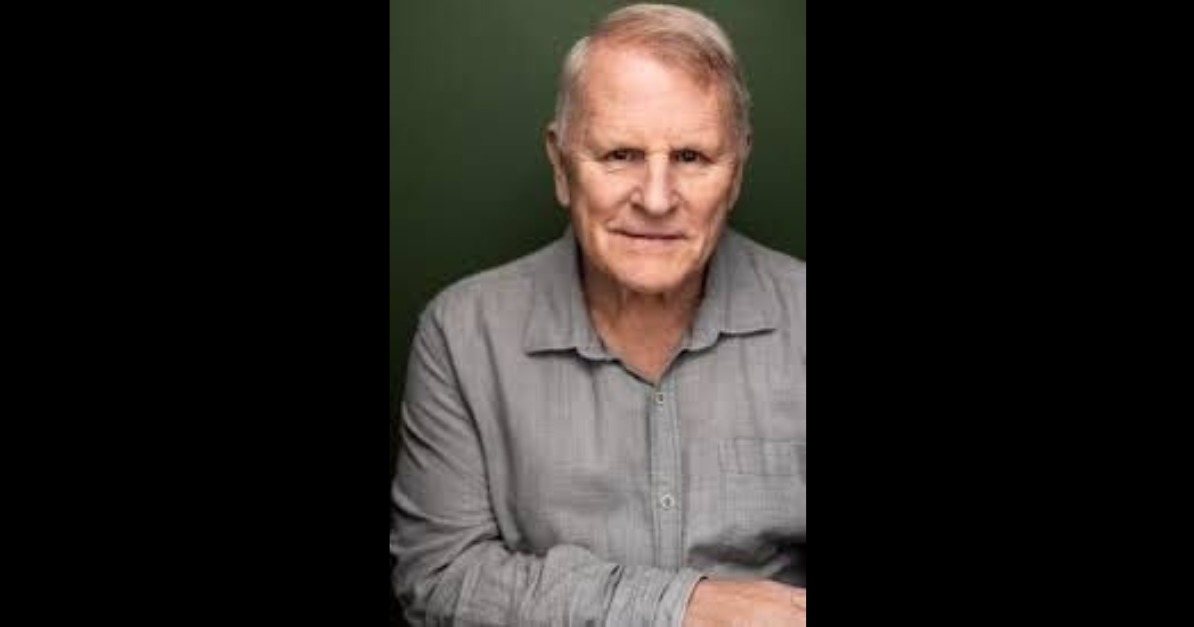
BENNINGTON – The last time Gordon Clapp appeared in Bennington, he portrayed Robert Frost in A. M. Dolan’s one-man show “This Verse Business” at the Bennington Theater. This time, the Emmy winner makes his debut at the Monument Arts & Cultural Center (MACC) in “Timor Mortis” by Roger Kirby, a play about another famous New England poet with local ties, Donald Hall.
Despite its title, which means “fear of death”, “Timor Mortis” is an often humorous, witty and poignant unveiling of Donald Hall’s love of baseball and his devotion to his wife, Jane Kenyon, who haunted him long after her death. Kenyon, a poet in her own right, will be portrayed by actress Caroline Kinsolving.
Clapp, a New Hampshire native, is most well-known for his 12 seasons (1993-2005) as Detective Greg Medavoy on NYPD Blue, a role that earned him an Emmy award in 1998.
His love for acting, though, was sparked decades earlier when, at age 12, he had his first stage experience in North Conway near where he grew up.
“My father took me down to the local summer stock and said, Will you apprentice my boy?” Clapp explained.
“I spent a whole summer with an equity company,” he continued. “At the end of the season, I got to play a major role in a play called ‘The Happy Time.’ I played a 12-year-old boy, and I got the bug. My father came to pick me up on the last day and I said, ‘Let’s cut to the chase. I want to go to Broadway. Now’.”
It would take 44 years before that happened.
As a young actor, Clapp honed his craft while a student at Williams College following a stint at a boarding school (“My first two years of high school were disastrous,” he notes), Wherever he could find acting work he did, including locally, performing youth theater for three seasons in Bennington and adjacent communities.
He looks back on that time with fondness.
“There was a group of us who lived in Salem, New York, and then Bennington, and then Hoosick Falls for three seasons of youth theater. We would get up at six o’clock in the morning and go to some school somewhere and do three shows for $100 between us,” Clapp said. “It was great, because we were working. And then in the summers, we’d go up to North Conway.”
Clapp’s acting career eventually developed a rhythm as he traveled back and forth between a string of gigs in Canada and the northeast.
“I stumbled into a job in Canada on a sightseeing trip with my first wife, before we were married. I walked into the Neptune Theater in Halifax and asked them if they hired Americans and they said ‘no,'” he explained. “But I just kept talking and, thankfully, they decided that since I was from what they called ‘the Boston states,’ I qualified as a ‘maritime’ and they let me into the company. I was in Canada for about 15 years, on and off.”
By 1986, Clapp had compiled a long list of film and television credits and, despite his honorary maritime status, decided the time was right to make the leap to bigger acting waters with a move to Los Angeles.
“When I got to L.A., I hadn’t yet told anyone I was American and that I was living there. I was basically considered a high-profile Canadian actor which led to a second billing opposite Farrah Fawcett in a popular mini series called ‘Small Sacrifices,'” Clapp said. “That put me on the television map. It took about three years more to really get established in L.A. and that’s when I made a kind of a random choice to audition for NYPD Blue.”
The rest was history.
Though NYPD Blue wrapped in 2005, Clapp remains an active and in-demand actor, with a long list of credits in addition to NYPD Blue including roles in television, films and on Broadway. Clapp was in the cast of the 2005 revival of David Mamet’s “Glengarry Glen Ross” which earned him a Tony nomination.
Despite his success and recognition at the pinnacle of the art, Clapp eagerly dives into new projects, including roles in local theater.
For “Timor Mortis,” Clapp taps his own history and cultural voice having grown up in rural New Hampshire surrounded by aphoristic and salty Yankees that make rural New England so well-known.
“The Robert Frost voice has been in my head since I was 12, when he read at the Kennedy inauguration,” Clapp said. “That’s a voice I grew up with—the voice of the people of northern New England. The characters in his poems were like the people I lived with.”
The first Frost poem that captured Clapp’s imagination was “Out, Out,” a poem about life’s precarious and sometimes unfair nature that describes the death of a “big boy/ Doing a man’s work…” who loses his hand while working at a saw mill.
“I was 15, living in a small town in northern New Hampshire. The poem just frightened the hell out of me. But I had a fascination with it.”
That impression stuck with Clapp.
“And so I wrote a paper on frost, and I would do readings in high school and in college. And I read the biographies,” he explained. “In 1977, I’d been six years out of college. I was living in Canada, and I was going through a dry spell so I read the three-volume biography, and I said, I got to bring this guy to the stage. But I want to do it when I’m older. The older Frost is the one that I know.”
Eventually, the opportunity presented itself.
“I stumbled across this script by Andy Dolan, which all took place in a lecture hall and said nothing about Frost or his family–nothing autobiographical,” he said. “So I got together with Andy, and we did a couple of public readings of it and I thought ‘It’s sea worthy’. People really love his poetry, and they love his personality.”
“We gradually started changing the script. We went from the lecture hall to his cabin, or place that represented his cabin, and the Frost voice became more personal,” Clapp continued. “He talked more about the family. He talked about his losses.”
The one-man production draws, in large part, from Frost’s lectures and poems to create the text. This time, Clapp aims to capture something a little more ineffable.
“I am not reading poems (in ‘Timor Mortis’) but much of the script contains echoes of Hall’s poetry,” he said. “I try to capture that energy in the language. He was an incredibly energetic soul and his reading style is very distinct in terms of his intensity, how he finishes every line and glides into the next.”
Donald Hall, a native of Connecticut, lived for many years in Wilmot with his wife and former student, poet Jane Kenyon who passed away from lymphoblastic leukemia at the age of 47. Their marriage and literary relationship captured the attention of journalist and public television star Bill Moyers, who made the documentary, “A Life Together: Donald Hall and Jane Kenyon” that aired on PBS in 1993.
“He was a great admirer of her, of her spirit,” says Clapp about their relationship. “But they weren’t inseparable. His proposal to her was just out of nowhere, very random. And it wasn’t this great passion like you would imagine.”
Clapp says that Kenyon even trivialized rapture, that kind of romantic love.
“She didn’t take (the marriage) so seriously but it’s very clear that they became incredibly intimate,” he said. “They did readings together, but he was doing more than she was and she periodically felt abandoned.
But their love just grew and grew and grew and there was euphoria for a short time until she was diagnosed. Hall talks in the play about how he was never more alive than when she was dying.”
Donald Hall was no stranger to Bennington and taught on occasion in the Writing Seminar at Bennington College where he also gave memorable readings both solo and with old friend and contemporary, poet and essayist Robert Bly, in Jan. 2000 and 2001.
Hall died in 2018 just short of his 90th birthday. He never attended a performance of “Timor Mortis,” but Clapp says that he gave his blessing to the production.
“We invited Hall,” Clapp says, “when we were doing a full production at Northern Stage (in White River Junction) in 2017 and I think we invited him to an earlier production at the Briggs opera house with the old Northern Stage company. But he was never able to make it.”
Clapp reflects on all the “little coincidences” that led to his identification with Hall.
“The very first play I ever saw in New York was called ‘An Evening’s Frost.’ And it was written by Donald Hall,” he said. “He was a New Hampshire soul. Even though he was born in Connecticut, he had the soul of a Yankee. I grew up just outside of North Conway in Kearsarge, New Hampshire.”
“We had our own Mount Kearsarge,” Clapp added. “Its original name was Pequawket, but the state changed it to Kearsarge North. So I grew up in the shadow of Kearsarge North, like he lived in the shadow of Mount Kearsarge.”
Clapp’s Yankee soul continues to fuel his commitment to acting. And it’s a quality that travels.
“We’re in our 18th year of doing productions (of ‘This Verse Business’) in different places,” he said. “We talked about (bringing the play to) Edinburgh this summer, but I think we’re going to wait a year.”
“After ‘Timor Mortis,’ I’m doing a reading of a new play by Ernest Thompson, another New Hampshire guy, which is very dark, a different kind of darkness. It’s beautifully written. There’s a lot of cleverness in it,” Clapp said. “Basically, I’m doing as much theater as I can.”
Performances of “Timor Mortis” will be held at the Monument Arts & Cultural Center Feb. 14 and 15 at 2 p.m. For information about tickets call the box office at (802) 318-4444 or email [email protected].
‘ The preceding article may include information circulated by third parties ’
‘ Some details of this article were extracted from the following source www.benningtonbanner.com ’