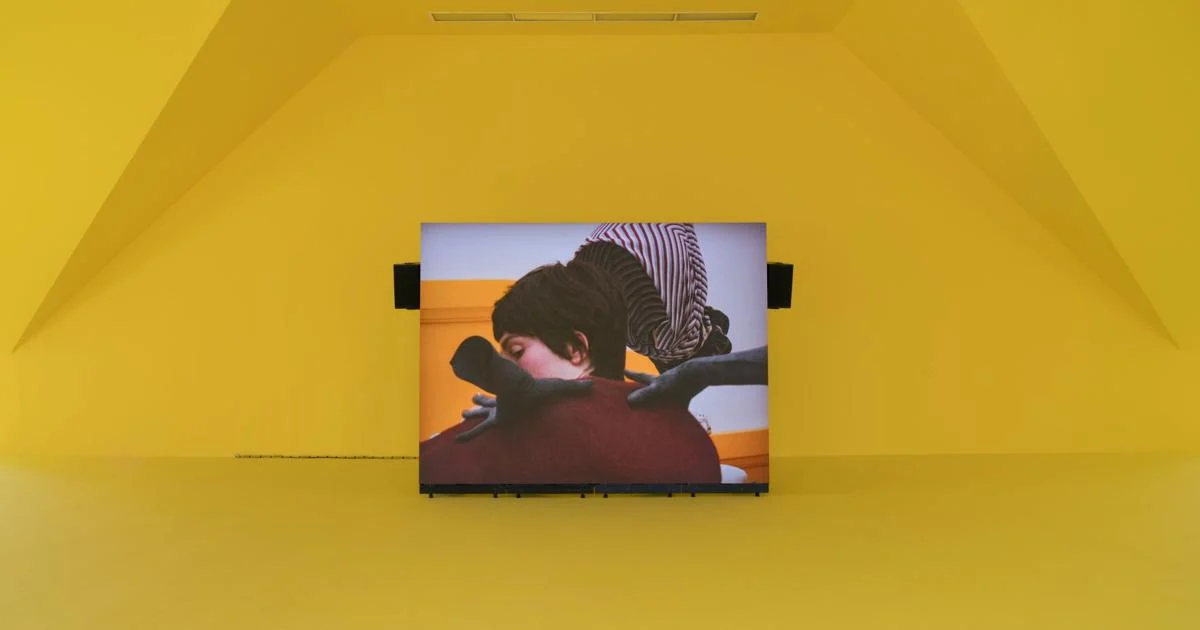
Surrounded by citrine yellow walls and matching carpet, a single screen dominates in an otherwise empty room. Upon entrance, however, viewers are met not by the glow of the media but rather the screen’s technological backing, requiring visitors to roam around before settling in for this compact but conceptually expansive film. It is this corporeal trajectory, resembling a mosquito to a blood vessel, that attracts unrelenting fascination in the work. Such is the spatial arrangement for the currently on-view exhibition, “Diego Marcon: Krapfen” at The Renaissance Society, a show well worthy of bemused head tilts and joyful grins full of approval for the Italian artist’s debut in the United States.
Hastily summarized, the film unfolds as follows. The presumed young protagonist (played by Violet Savage) dressed in a red sweater and grey sweatpants, seemingly wakes (though who can say for sure) to encounter a wild reality. Within moments, individual clothing items spring to life — a pair of socks, gloves, foulard, trousers and pullover— and eerily move around the space (Marcon uses both digital animation and live physical movement for these effects). This choreography frequently finds them controlling the only human in the room. Working in tandem, the objects manipulate the body, enacting a strange form of play that inverts the puppeteer-marionette relationship. With suspicious free will, the garments move this way and that, often dominating the figure with semi-salacious but never entirely transgressive gestures (at one point the gloves stick their fingers in the character’s mouth, at another time they choke the individual).
As the sequence reaches its climax, the props fling the human body out of a door, whereupon the scenery drastically changes, revealing a single spotlight dimly cutting through the darkness. The figure adjusts, and so begins what might otherwise be described as an interlude if not for the video ending shortly thereafter, only to loop to the supposed start. Here, too, ominous ambiguity seeps in. Viewers are left with no clarity watching as the individual moves sneakily and hauntingly about, clasping their hands over their mouth, only to then fall to the ground and begin to crawl. In its entirety, Marcon’s feat feels as if Stephen King were put in charge of a foreboding remix of “Toy Story” (1995). Here, the items that you know are not afraid to express their desires in your presence, even in their darker projections.
Marcon, who lives and works in Milan, is a connoisseur and conductor of the moving image. Exhibited widely across Europe, notably at the Venice Biennale in 2022, the artist has built a reputation on a decades-long practice of exploring cinematic archetypes. Ambiguous and elusive in their emotional speculation, his films, which typically draw on more than one filmmaking technique, share a common trait of only ever offering a glimpse of specificity; always, there is something just around the corner.
That the visual images of “Krapfen” play only a part in the bewildering mixture of narrative structure is a twistedly enjoyable component of the work. Accompanying the film is a song that sonically resembles a piece from an opera/operetta, which would otherwise place an overtly macabre tenor over the work if not for its saccharine lyrics. Singing presumably to the figure, the clothing items belt out a motley assortment of lines, first individually, then as a chorus as they spring to life, ringing out a cacophony of instructions. In this case, a “how to” for baking a krapfen, or a German jam-filled donut. “No need to boil or bake / Mix water and flour / Let it rise for an hour,” the wardrobe proclaims. All this, for a donut with apricot jam?
A still image from “Diego Marcon: Krapfen,” at the University of Chicago’s Renaissance Society, 5811 S. Ellis Ave., Sept. 2025.
But here is the thing about the universes Marcon creates, anything is up for grabs, play is everywhere, freezing the insatiable desire to make sense of everything. Take the name “krapfen,” for example. A scrumptious dessert that finds form through its filling. Completion emerges from its structure, an outcome derived solely from its ability to become whole. It is the sugary delight found at its core that is precisely what gives it definition and allows it to come together. And, like any eater that zealously awaits their treat, there is nothing more satisfying than extracting the filling in the middle. But there is no jam in the film’s structure, and a hopeful bite laments only with an empty mouth.
The logic of the film is precisely that there is no sweet excess in the center; rather, to find value, one must first accept the terms that would conventionally render meaningful transparency. Every attempt to pin down meaning encounters the addition or subtraction of an idea that not only doesn’t adhere to a prior understanding of the narrative, but rocks an already shaky foundation. Take, for instance, the spatial logics of the scene in the film, where viewers gather to watch the narrative unfold. The room we witness is yellow, and so is the one that surrounds us.
A perfectly executed mise en abyme, the mirrored image takes on a deeper psychological and sociological significance. Suddenly, relationships between subjects, objects, image and structure rush out and crash into each other. Are we actually just watching ourselves? Or, what about the precise arrangement of items in the room’s habitat that forms an exacting curatorial selection, abounding with ghostly references? In one corner of the room, a ghost figurine stands; in another, a ghost drawing is displayed, and on a bookshelf, movies like “Casper” (1995) and “Scream” (1996), as well as board games like “Ghost Castle” and “Labyrinth,” are stacked. Not only do all feature ghosts, but the winning tactic of either board game is to literally escape or make your way out of the dubious world you find yourself in. Survival and meaning are predicated on navigation away from and out of your ghostly environment.
Marcon is at his mischievous best here, masterfully commanding illusionary planes, an architect of sensorial figurations. For curious visitors, leave your preconceptions at the door, as they will only hinder a journey that is already impossible and diminish the very work itself. Every once in a while, we encounter a thing that is enjoyable as it is. And with Marcon, that is how it’s best enjoyed. Sometimes art, sometimes life, just is what it is.
“Diego Marcon: Krapfen” is on view at The Renaissance Society, 5811 S. Ellis Ave., through November 23.
‘ The preceding article may include information circulated by third parties ’
‘ Some details of this article were extracted from the following source www.hpherald.com ’