I could be anywhere
In my heart I’m always there
Where they drink sweet tea and they raise you to be polite.
No changin’ who I am
That’s the way I’ve always been
No matter what state I’m in
I’m in a Southern state of mind.
—Dairus Rucker, “Southern State of Mine”
Darius Rucker doesn’t need to pinpoint a specific place when he closes his eyes and thinks of home.
And though home for the rocker-turned-country singer-songwriter is Charleston, South Carolina, he knew when writing “Southern State of Mine” that he could be home anywhere in the South.
Because it’s in the South where storytelling is an art — where people will stop and listen to a tale about a kid named Billy Joe or contemplate the heartache of a man who is mired in the blues of his personal crossroads.
Sometimes, when the stories aren’t enough, they pack their bags and follow the lyrics to see where these stories happened. It doesn’t matter if the stories are truth or fiction, they were inspired by a place in the South.
Once there, with a little bit of imagination set to a melody, they come to life.
If you’re willing to follow the lyrics, the South becomes a map.
Here are three suggestions of lyric trails to follow:
There is a house in New Orleans
It’s said the House of the Rising Sun, inspiration for the blues song, is located at 826-830 St. Louis St. in New Orleans.
In 1964, The Animals made an international hit from an old blues song, “The House of the Rising Sun.” It shot up to No. 1 on music charts in both the United States and United Kingdom, yet the group wasn’t the first to record it.
The earliest versions of this song can be found in musicologist Alan Lomax’s collection at The Smithsonian. Other recordings were made and commercialized beginning in the early 20th century, probably the most notable being renditions by Woody Guthrie and Louisiana’s own blues legend, Huddie “Leadbelly” Ledbetter.
But The Animals immortalized it through lead singer Eric Burdon’s haunting vocalization, which naturally piqued the curiosity of listeners not just in the States but throughout the world.
Was there really a House of the Rising Sun?
First take into consideration that the melody originated out of the Appalachian folk tradition and preceded the lyrics by quite a few years. No single songwriter is credited for the “House” lyrics, though Georgia Turner and Bert Martin first wrote them down from Lomax’s original recording.

The 45 rpm cover for The Animals’ 1964 hit, ‘The House of the Rising Sun.’ In 2000, lead singer Eric Burdon visited the house on New Orleans’ St. Louis St., said to be the song’s inspiration. He said the house was speaking to him.
That said, a popular theory for the inspiration behind the lyrics points to a French Quarter house at 826-830 St. Louis St. It’s said the house, a former brothel, was named for Marianne LeSoleil Levant, whose surname in translation would mean “The Sun.”
But is it true? Some historians and musicologists are skeptical, saying “Rising Sun” could have been a common name for various disreputable establishments. Still, the St. Louis Street house offers travelers a specific address to a place perfect for speculation.
Even The Animals’ lead singer made his own pilgrimage there in 2000 to experience what may have been the inspiration for his hit.
Burdon told the Los Angeles Times that he connected with the house at once when the owner invited him for a visit. He joked that the owner made him sing “House of the Rising Sun” a cappella for 40 minutes.
“What can I tell you?” he said. “The house was talking to me.”
Pass the biscuits, please

A historical marker at the Tallatchie Bridge on Grand Boulevard at Greensville, Mississippi, tells the story of Bobbie Gentry’s hit song, ‘Ode to Billie Joe.’
The usual questions surrounding Billie Joe McAllister have more to do with what he and the narrator were throwing off the Tallahatchie Bridge and what, exactly, drove him to jump off said bridge to his death.
The question of where the bridge is located usually ranks third when Bobbie Gentry’s 1967 hit, “Ode to Billie Joe” flows through earbuds or speakers.
The song follows a lunchtime conversation among a Mississippi Delta family in the heat of summer, where it’s revealed that Billie Joe has jumped to his death from the Tallahatchie Bridge, which crosses the Tallahatchie River.

In 1967, Life Magazine published this photograph of Bobbie Gentry walking across the wooden bridge that crosses the Tallahatchie River at Money, Mississippi. This bridge inspired her song, ‘Ode to Billie Joe,’ but later burned, It has been replaced by a metal structure.
The town is called Choctaw Ridge in Carroll County. Both are real, as is the Tallahatchie River, which flows through the county. Gentry, whose real name is Roberta Lee Streeter, lived there.
But what about the bridge?
There are two bridges that cross the river near Choctaw Ridge, but the State of Mississippi has marked only one with a historical marker, which stands on Grand Boulevard on the edge of Greenwood, Mississippi.
The second bridge is a metal structure in Money, Miss., that replaced a wooden bridge, which burned in 1972. It has no marker, but Gentry has said the original wooden bridge was the inspiration for her song.
Check out both for good measure. That way, all bases will be covered in the story of Billie Joe McAllister.
Poor Bob is sinkin’ down

The sign at the intersection of U.S. 61 and U.S. 49 in Clarksdale marks the crossroads, where legend says master blues musician Robert Johnson sold his soul to the devil.
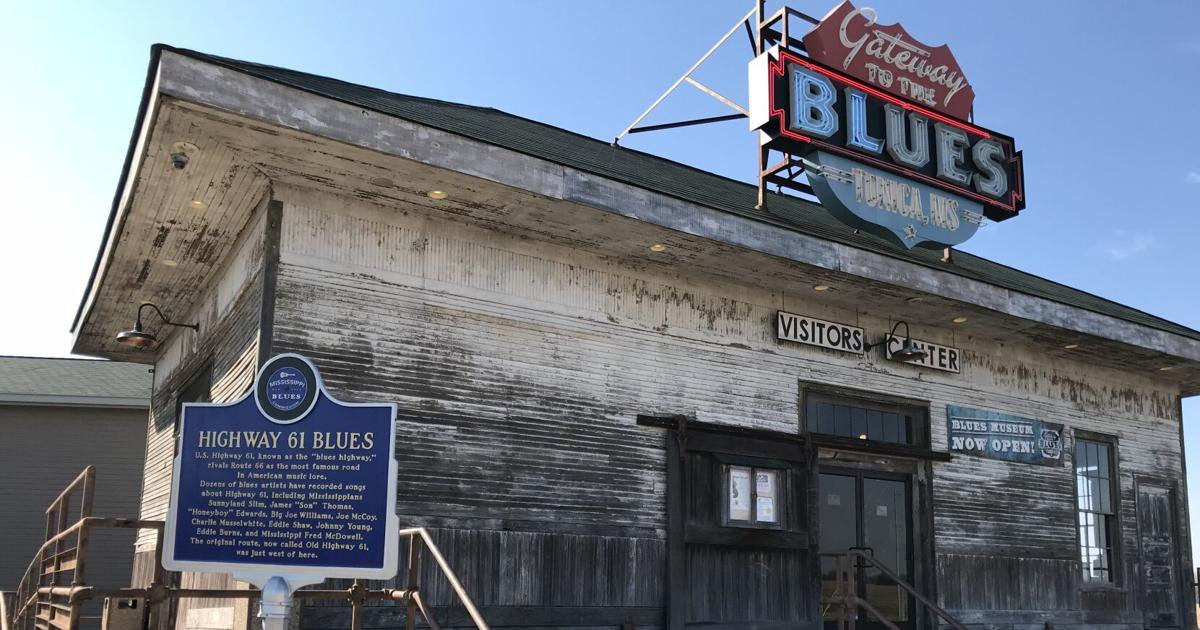
Ah, the crossroads along what is now the Blues Trail on U.S. 61 through the Mississippi Delta. It’s said this is where an aspiring musician named Robert Johnson sold his soul to the devil to become one of the greatest legends to play the blues.
Movies have been made about the story, books have been written, but intrigue doesn’t necessarily mean the tale is true.
The intersection where Johnson’s purported conversation with the devil is marked by guitar-shaped signs topped by a U.S. 61 highway sign where the highway crosses U.S. 49 in Clarksdale, Mississippi.
The spot is the perfect landmark for selfies, but, as is the case with so many lyric trail stops, there’s contention about this location.
Other fans of the story, including blues guitarist Joe Bonamassa, believe the true crossroads are located where Mississippi Highway 8 crosses state highway 1 at Rosedale, where Johnson grew up. Rosedale is 38 miles south of Clarksdale, so it might be worth stopping to take a photo at its quiet crossroads before continuing to the more celebrated stop along U.S. 61.
As for Johnson’s song, “Crossroads Blues,” it was recorded in 1936 and released in 1937. The lyrics asks for God’s mercy at the crossroads, yet they don’t mention the devil. The focus seems more about a man at a decision-making crossroads in his life.

Blues musician Robert Johnson wrote and recorded ‘Crossroads Blues’ in 1936. The song was released in 1937.
According to the legend, Johnson aspired to be a great blues musician and was instructed to take his guitar to a crossroad near his home on the grounds of Dockery Plantation in Rosedale at midnight. There, he was met by the devil who tuned the guitar and returned it to Johnson.
This gave Johnson mastery of the instrument, allowing him to become the foremost player of the Delta Blues.
True or not, the legend has endured — and it makes a good story to chase on the lyric trail.
In the South, the stories don’t just live in the lyrics — they wait at the crossroads.
‘ The preceding article may include information circulated by third parties ’
‘ Some details of this article were extracted from the following source www.nola.com ’