Theater review
Have you ever thought about the geography of Auschwitz?
Until the opening night of “Here There Are Blueberries,” the documentary theater piece now running at Seattle Rep, I never had, not really.
My education and media consumption have been focused, appropriately, on the horrors of the Auschwitz camp, where more than 1 million people, primarily European Jews, were murdered during World War II.
But the complex sprawled over some 15 square miles of occupied Poland, and encompassed both the camp and its barracks and crematoria, as well as an administrative center, factories that relied on forced labor and a vacation resort on the Soła River called Solahütte, where officers and staff from Auschwitz could relax with their families and take time off from work.
“Here There Are Blueberries,” which was a 2024 Pulitzer Prize finalist in Drama, sprawls over more than 60 years of history: From 1944, when an enthusiastic amateur photographer and Nazi official chronicled his days at Auschwitz, to 2006, when the photos arrived at the United States Holocaust Memorial Museum, courtesy of an enigmatic American serviceman who discovered and held on to the photos for decades.
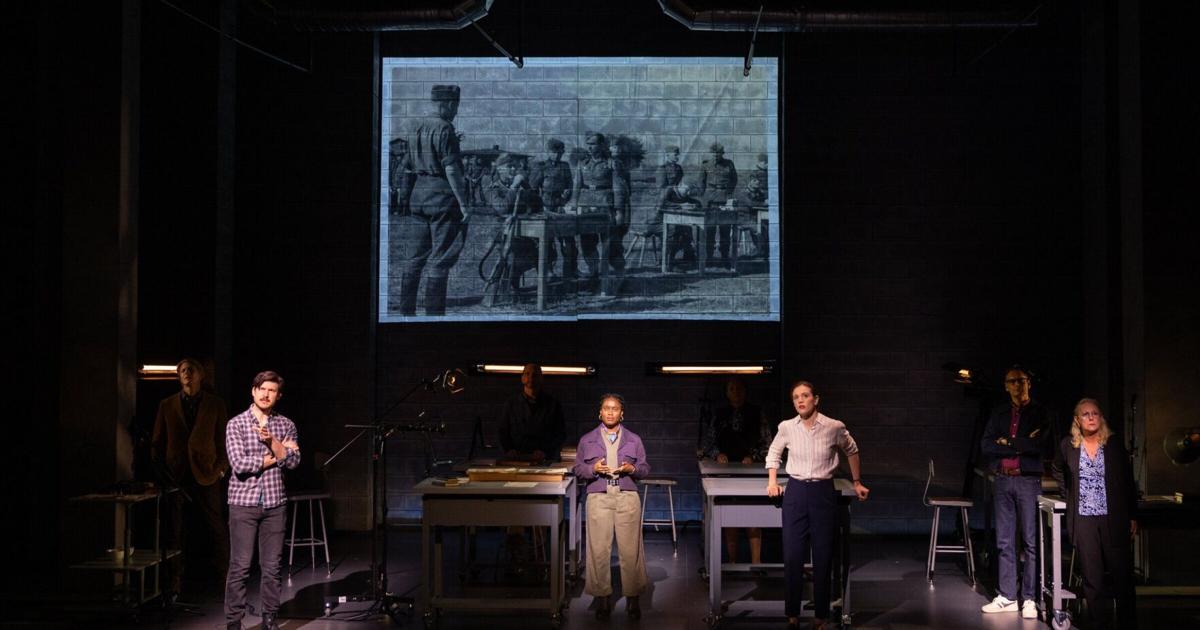
And so our story begins, when these photos arrive on the desk of junior museum archivist Rebecca Erbelding (Delia Cunningham), who finds herself gazing at some of the few extant photos of Auschwitz, and photos in which, critically and bizarrely, no prisoners appear. These 116 photos are of Nazis at rest — many at Solahütte, singing to accordion music, flirting with female employees, eating wild blueberries — and thoughtfully laid out in a captioned album, a memory book that seems designed for posterity.
This national touring show is a Tectonic Theater Project production, conceived and directed by Tectonic co-founder Moisés Kaufman, and written by Kaufman and Amanda Gronich.
Tectonic launched in 1991 and often builds shows based on real-world reporting — most notably with “The Laramie Project,” the explosive, reported inquiry into the shocking 1998 murder of Matthew Shepard that first put the company on the map.
As source material for “Blueberries,” the creators used the album, of course, as well as interviews and personal accounts from relevant figures.
Erbelding’s historical sleuthing, aided by colleagues like the museum’s head of photography Judy Cohen (Barbara Pitts), reveals that the album belonged to Karl Höcker (Christian Pedersen), the right-hand man to the head of Auschwitz, Richard Baer. Also in the photos: Auschwitz architect Rudolf Höss, the infamous “angel of death” Josef Mengele and dozens, if not hundreds, of other Germans who ended up, in one way or another, facilitating a genocide.
Herein lies the show’s central mysteries: Who are these people, and how did they end up working for the Nazi extermination machine?
As Erbelding investigates, a man named Tilman Taube (Sam Reeder) recognizes his grandfather in photos published by the press and agrees to work on finding more descendants of the perpetrators, which leads him to Rainer Höss (Marrick Smith), grandson of Rudolf Höss. Why hasn’t Rainer changed his name? “It’s my best revenge,” he says.
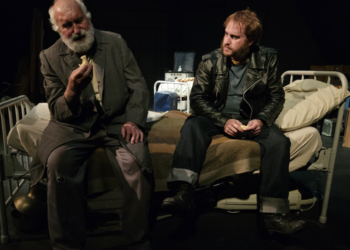
The entire ensemble cast delivered strong (if workmanlike) performances, but historians, bless them, aren’t the most dynamic character studies, and building a show around an academic pursuit presents real dramatic challenges. It didn’t help that the design of the show feels quite dated, particularly the projections of dialogue in giant white letters, which feels like a way to add dramatic heft to a story whose villains must remain two-dimensional.
Unlike Jonathan Glazer’s 2023 film “The Zone of Interest,” which treads much of the same blood-soaked ground, in this play (as in a museum) it’s up to the viewer to imagine the implications of these photos and the unseen, unspeakable horror nearby. And it’s no surprise that “Blueberries” is having a moment right now, as shows about fascism — and “the banality of evil,” as Hannah Arendt stunningly described the mundane ways corruption spreads — either overtly or obliquely, resonate with our current headlines.
Perhaps more than this show itself, I expect the conversations that follow it are a dynamic treasure trove, which is its own kind of dramatic success. There’s so much to mine. The idea that layer upon layer of middle management leads to a diffuse sense of responsibility that allows atrocities to happen. How much Germany’s professional class — lawyers, journalists, bankers — participated in the Nazi machine. How much we owe to the advent of hobby photography, and how important a role imagery still plays in accountability.
But I will give the last word to an employee of the Auschwitz-Birkenau State Museum interviewed for the play, who, along with his colleagues, found the photographs that made them see the SS as people, not monsters, very difficult.
“Sometimes, when people look at the world of Auschwitz, they focus on the killing, and they forget that the killing is the result of a long process,” he says. “No genocide starts with the killing. Every genocide starts with words.”
‘ The preceding article may include information circulated by third parties ’
‘ Some details of this article were extracted from the following source www.yakimaherald.com ’