On Saturday evening, the Belgian Embassy in Chanakyapuri — Satish Gujral’s celebrated brick masterpiece — opened its private terraces and corridors to the public. As part of Delhi Art Gallery (DAG)’s “City as Museum” series, choreographer Manju Sharma directed a site-specific performance that unfolded across window sills, terrace ledges and courtyards.
Dancers Parinay Mehra, Kunal Sood and Riya Mandal traced arcs of movement through Gujral’s interlocking volumes, unveiling spaces within spaces through form and gesture.
Before the performance, Giles Tillotson, DAG’s senior vice-president for exhibitions, introduced Gujral’s multidisciplinary practice. Belgian ambassador Didier Vanderhasselt, whose official residence is part of the complex, told HT, “We wanted to open up our place to the public to strengthen India-Belgium ties and engage in soft diplomacy. Gujral’s work should be known to all, not just architects or diplomats.”
For many visitors, stepping into a functioning embassy and watching performers poised on its ledges was itself a rare event in Delhi’s cultural calendar.
Earlier in the day, another DAG initiative, “The Fifth Circle: Institution, Memory, Resistance”, unfolded at Triveni Kala Sangam in Mandi House. Conceived by theatre director Amitesh Grover, the programme examined how the neighbourhood’s institutions, protests and architecture shaped Delhi’s artistic identity.
Grover’s guided audio walk, “Echo Root”, took participants past National School of Drama, Triveni Kala Sangam, Sriram Centre, Rabindra Bhavan and Doordarshan. “These streets have been my classroom, my stage, and my refuge,” Grover said of his 25-year relationship with the area “as a student, a director, a teacher, and an artist”.
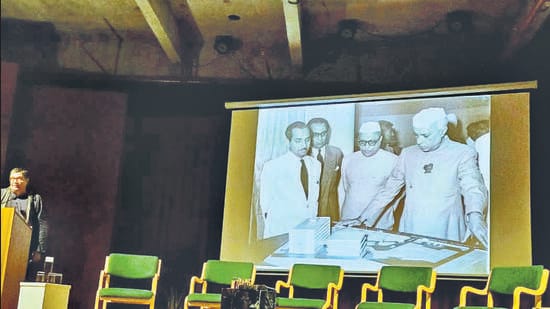
The afternoon panel brought together photographer-activist Ram Rahman, art historian Shukla Sawant, anthropologist Sarovar Zaidi and theatre director Zuleikha Chaudhari — a diverse group whose perspectives bridged activism, scholarship and performance.
Opening with an old map of Delhi, Rahman reminded the audience: “This whole area between Shahjahanabad and the old fort was filled with ruins of some major buildings like Firozabad, smaller masjids, smaller shrines.”
He traced that layered history till the 1950s, when his father, architect Habib Rahman, designed Rabindra Bhavan. Reading from Habib Rahman’s notes, he said: “This building belonged to India. Here I used traditional Indian elements such as chajjas, jalis and overhanging roofs. It was the first functional building that gave me aesthetic satisfaction… Maybe it was Rabindranath’s artistic genius that inspired me.”
Shukla Sawant highlighted newly surfaced archives about early planning for Delhi’s art spaces. Quoting a 1959 government file, she noted: “The ground floor of the block has been kept at two levels to lend variety… The upper-level galleries can be reached by a freestanding spiral staircase… The shape and size of the galleries has been carefully worked out to avoid monotony and at the same time achieve maximum flexibility.” She called the 1950s and 60s “the period of institutional building during the early Nehru years,” and cited Maulana Abul Kalam Azad’s words at the Lalit Kala Akademi’s inauguration: “In the field of art the role of the government must be secondary…”
Friday night’s concert by Chaar Yaar at Triveni Amphitheatre, the second movement of The Fifth Circle, set the tone for the weekend. Led by Madan Gopal Singh, the band wove Kabir, Bulleh Shah, and Faiz with unexpected strains of the Beatles and Brecht. Their mix of folk, qawwali and protest song cut across genres, offering what attendees described as both playful and profound — an echo of the plural voices Mandi House has long nurtured.
‘ The preceding article may include information circulated by third parties ’
‘ Some details of this article were extracted from the following source www.hindustantimes.com ’