Not long after the indie folk-rock band Big Thief parted ways with its bassist in 2024, the remaining members gathered out in the New England countryside to start work on their first album without him.
“We tried to record just as a trio in the woods, but we were feeling a little stuck in that arrangement,” says guitarist Buck Meek, who with singer-guitarist Adrianne Lenker and drummer James Krivchenia had formed Big Thief with the now-departed bassist Max Oleartchik in 2015.
“I think it was mostly just kind of emotional, going through the transition with Max,” he says of parting ways with Oleartchik due to what the announcement of his departure called “interpersonal reasons.”
“Feeling like we were still processing that, and being in a vacuum, just the three of us, felt like a bit of an echo chamber of our own feelings around that.”
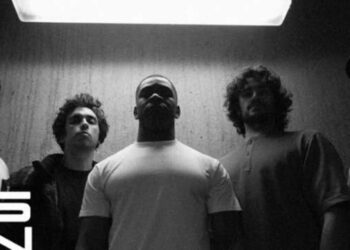
Big Thief, left to right, is drummer James Krivchenia, singer-guitarist Adrianne Lenker, and guitarist Buck Meek. The band headlines the Hollywood Bowl on Saturday, Sept. 27. (Photo by Michael Buishas)


1 of 6
Big Thief, left to right, is drummer James Krivchenia, singer-guitarist Adrianne Lenker, and guitarist Buck Meek. The band headlines the Hollywood Bowl on Saturday, Sept. 27. (Photo by Michael Buishas)
So Meek, Lenker and Krivchenia packed up and headed to New York City, where the band formed in 2015 after drifting south from Boston, where all four members attended the Berklee College of Music.
“We decided to go to the city and put together a big band and shake it up,” Meek says. “Just being part of the culture, surrounding ourselves with a bunch of musicians that we admired and essentially just improvising together and jamming and having a lot of stimulus to react to kind of helped us come into the present moment.”
Big Thief’s sixth studio album, “Double Infinity,” arrived in September, the band still sounding like Big Thief but with denser arrangements in place of the sparser Americana sound of much of its earlier work, and the accents of electronic music and loops now added to the jazz-inflected palette of its usual guitars, drums and bass.
On Saturday, Sept. 27, Big Thief makes its debut as a Hollywood Bowl headliner, with alternative hip-hop artist Noname opening the show.
In an interview edited for length and clarity, Meek talked about the making of the new album and how it freed the band from past patterns, the way he, Lenker and Krivchenia balance their Big Thief and solo music, how the Hollywood Bowl compares to the band’s first Southern California show, and more.
Q: The musicians who joined you at the Power Station in New York, were they people you knew well?
A: Yeah, a lot of them are our old friends from New York. We started 10 years ago in Brooklyn. We were just a small part of a pretty awesome music community there, playing shows with just tons of bands around town. So we brought in a lot of our old friends from that scene.
Mikey Buishas, who’s making live tape loops and playing keys on this album, was one of our best buds back in the day. And Hannah Cohen and Alena Spanger were both people that we’d known. Alena Spanger’s band Tiny Hazard, I think she played one of the first Big Thief shows ever with us.
Then we brought in some new musicians who we’d never played with before like Laraaji and also Joshua Crumbly. That was our first time really playing with Joshua [who is now the band’s touring bassist]. I had met him actually doing that Bob Dylan movie [“Shadow Kingdom”] a few years ago, and we really got along.
Q: In the past, had it usually been just the band in the recording studio?
A: It was typically just the four of us. Every once in a while, we’d have someone join us. Noah Lenker, Adrianne’s brother, played jaw harp on “Spud Infinity.” Matt Davidson played piano on “Mary,” maybe, and pedal steel on some tunes on “Dragon New Warm Mountain [I Believe in You].”
Q: What did it feel like to have so many people in the studio this time?
A: Honestly, it felt really natural, because we’ve all grown up playing music with so many different people. Big Thief is actually one small part of our musical life. Collectively, we all come from different places and very different musical backgrounds, and all of us have played with so many different people over the years and had so many teachers and collaborators and countless jam sessions in between.
Most of the music we’ve made has not been on stage or in front of a microphone, it’s just for ourselves. It felt good to kind of break that construct, a little bit of Big Thief being this four-piece defined entity. It was nice to kind of crack that open.
Q: To me, the new record feels bigger and more layered with less open space in it. How do you see where it takes Big Thief compared to previous records?
A: Totally, yeah. I mean, historically we’ve been really devoted to the four-piece rock and roll combo, and trying to make the most sound with four people. Often, the solution to that is creating a lot of space and just focusing on your attack and your tone, and the negative space between the four people is actually just as impactful as what you play.
Which could be said for all music, I think, but with four people it’s really obvious when there’s space, and then it’s also really obvious whenever there’s a note. So I guess the difference, playing with 10 people, it was dense, but that actually really encouraged everyone to play way less than they would if it was just four people.
There were so many people that everyone had to kind of naturally find their little slot and focus on finding a range that wasn’t already taken.
Q: How did it work directing all of that?
A: It kind of had this self-organization without any spoken arrangement. We didn’t give anyone direction at any point. We never gave anybody an arrangement idea or any sort of production language. Once we were in front of microphones, we just let people respond naturally to the songs and trusted that the songs would guide everybody.
Q: Did it take more work to let things develop organically?
A: I think it was much quicker in our experience than trying to control the arrangement. Often when we try to delegate arrangement ideas to each other, even as a four-piece, we end up needing to undo a lot of knots and work backwards from that projected idea and return to our intuition.
I guess we’re learning that usually the most efficient way to arrive at something that feels good is to give people the space to follow their own instincts.
Q: You mentioned that Adrianne wrote a large batch of songs, and then some of them, like “Los Angeles,” were cowritten by the three of you. How do you collaborate?
A: Historically, Adrianne has been the writer for Big Thief. For the most part, she’s brought most of the songs completely finished to the table, and we arrange them as a band. But she and I have written together from the beginning, here and there, but my relationship with her as a writer is more like an editor. She’ll bring a song to me that is almost finished, and I’ll help round out the edges or just kind of trim the fat.
There’s a handful of songs that we wrote from scratch together, like “Certainty” on “Dragon Mountain.” But for this record, the intention was to write together from scratch, the three of us. We actually met up for a month and just wrote every day. Tried to write a song every day from scratch together, or at least finish a song.
Like for “Grandmother,” we went on a walk and thought, “OK, let’s write a song about generations and the loss of information.” I think for “Los Angeles” Adrianne had two verses and a chorus and she asked us to help her finish the third verse. “How Could I Have Known,” we helped her edit the chorus a little bit here and there.
Q: You’ve all done solo projects between Big Thief music. How do you know when it’s time to do one or the other?
A: For Adrianne, Big Thief is her primary focus as a songwriter. When she writes, she starts most songs with the idea of writing for Big Thief, and then she’ll bring those songs to us, and we’ll kind of feel out if it fits. Then the songs that don’t make it onto Big Thief records, she will then do on a solo record.
When Adrianne and I first met, we were playing as a duo and cowriting and also playing both of our own songs. We were backing each other up and traveling for a couple of years as duo. At some point, we split the project intentionally to have Big Thief be her songwriting focus and for my solo project to be my songwriting focus. We were married at the time, and it just kind of felt healthy to have some creative autonomy.
Q: This is your first headline show at the Hollywood Bowl. Have you played there before though?
A: We played there in 2018, opening for Father John Misty and Gillian Welch and David Rawlings.
Q: Does it feel different to be headlining?
A: It does because I’ve been living in Los Angeles for seven or eight years now, so it feels like a hometown show. My family’s coming and so many of my friends. I really love Los Angeles, my city, and so I feel really excited to play my new hometown.
Q: What’s the last show you saw at the Bowl?
A: I saw Beck there with the orchestra.
Q: Oh, that was great. I was just there Monday night for Neil Young.
A: I wish I could have been there. We had to ship out that night, but I wish I could have seen that.
Q: Do you recall the first time Big Thief played Los Angeles?
A: Definitely. We played a house show in Silver Lake with our friends Fell Runner, one of our favorite bands. We played this house party on the east side. It was a total rager. It was on our first tour as Big Thief. I think it was 2014, if I’m not mistaken, or 2015. We were living in New York, but we made our way across the country to play a bunch of house shows.
I think the first venue we played in, like an official venue, was the Bootleg Theater with Here We Go Magic. I loved the Bootleg, RIP. Happy it’s still a venue, though.
Q: What kinds of reactions are you hearing for “Double Infinity” so far?
A: I try not to pay much attention to it, either the positive praise or the criticism. For me, the album isn’t really released until we’re on stage. It’s pretty abstract to put an album out online, at least for me. It’s the relationship with the actual people in the crowd that makes these songs feel real.
Big Thief
When: 8 p.m. Saturday, Sept. 27
Where: Hollywood Bowl, 2301 Highland Ave., Los Angeles
How much: $29-$170
For more: See Bigthief.net or Hollywoodbowl.com.
‘ The preceding article may include information circulated by third parties ’
‘ Some details of this article were extracted from the following source www.ocregister.com ’