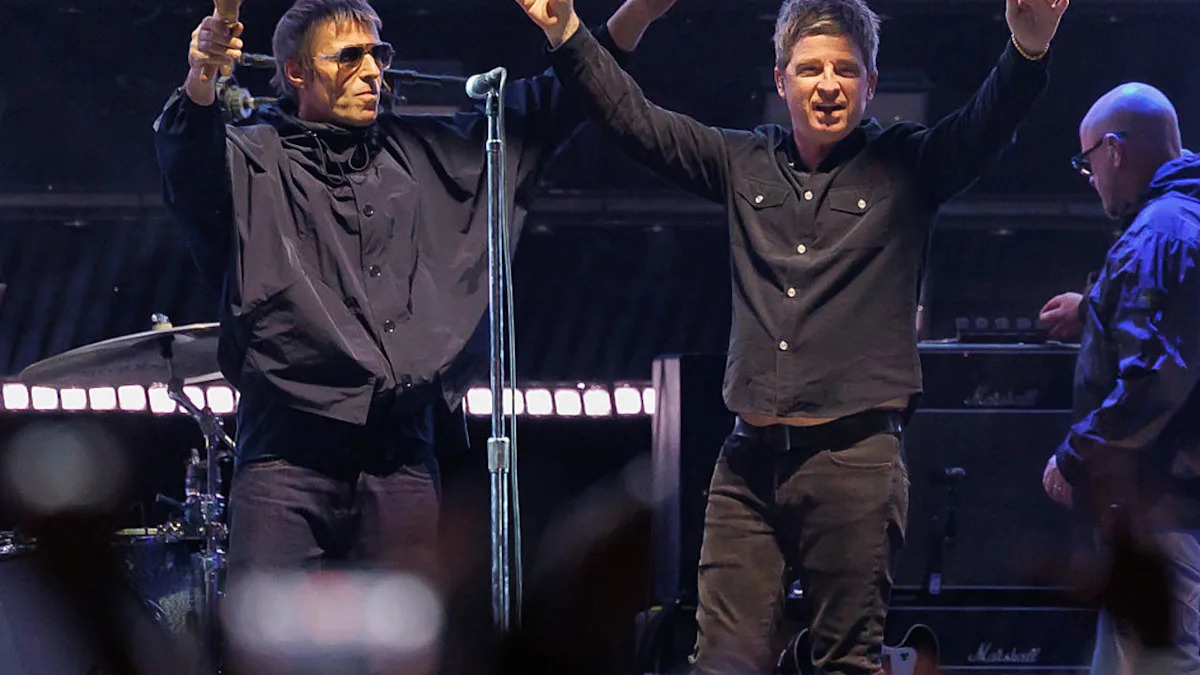
Oasis played the final U.S. date of their reunion tour on Sunday, Sept. 7 at the Rose Bowl in Pasadena, Calif. and by most accounts that show–and the rest of the tour that kicked off on July 5 in Cardiff, Wales–has been a smashing success.
By coincidence, Oasis’ stadium triumph coincided with the 60th anniversary of the penultimate tour by a band that they were heavily influenced by and frequently compared to—the Beatles.
On Aug 15., the Beatles opened their 1965 U.S. tour with a show at Shea Stadium. That tour also stopped for a pair of historic dates at the Hollywood Bowl, as shown in Ron Howard’s 2016 documentary The Beatles: Eight Days a Week – The Touring Years.
The following summer, the Beatles staged their last U.S. tour, once again hitting stadiums, with their final paid concert date ever occurring on Aug. 29, 1966, at Candlestick Park in San Francisco.
There were multiple factors that led the Beatles to give up touring, including the backlash over John Lennon’s “more popular than Jesus” comment and the social and racial unrest at the time, but one of the most important was the technological limitations of performing in stadiums at the time. The Beatles couldn’t hear themselves over the screams of the fans and most of the fans couldn’t hear either. Their music was advancing to new heights with experimentation in the studio that would lead to some of the greatest albums in the history of popular music, but it was impossible for the Beatles to replicate those sounds in concert due to technical limitations at the time. On that 1966 final tour, the band didn’t play any songs from Revolver, although the album was released just prior to the tour’s kickoff.
“It was the first time that anyone had played any of those stadiums,” Paul McCartney recalled in 2003, per Rolling Stone. “It became kind of normal for people like the Floyd. We were playing through the baseball speakers and you couldn’t hear a thing with the crowds screaming—those 56,000 ‘seagulls’.”
Simply put, sports stadiums weren’t designed for music, yet on their Live ’25 reunion tour, Oasis is having none of the problems that plagued the Beatles 60 years ago with the primitive technology at the time, thanks to a state-of-the-art sound system provided by L-Acoustics. It allows Oasis—singer Liam Gallagher, singer-guitarist Noel Gallagher, guitarists Paul “Bonedhead” Arthurs and Gem Archer, bassist Andy Bell, and drummer Joey Waronker—to play the band’s songs with near studio quality. I’ve seen Oasis at least once before–in 1998 at the Universal Amphitheater in Los Angeles, a hall that was designed for concerts–and on Sunday night at the Rose Bowl, the band sounded as good or better than they did 27 years ago.
Related: Oasis Announces Major News for North American Fans
Visually, the band employs a stunning video wall that runs nearly the entire width of the stadium field. While the Beatles biggest gigs were in baseball stadiums, with over 55,000 filling Shea Stadium, the recent Oasis shows were even bigger, with estimates between 60,000 and 70,000 fans a night turning out for the band’s two shows at MetLife Stadium in New Jersey, and similar numbers on the tour’s other stops.
Oasis even includes a nod to the Beatles in their set. During “Whatever,” a song from the band’s 1994 debut album, Definitely Maybe, Liam Gallagher slipped in a few lines from the Beatles’ Ringo Starr-sung deep cut “Octopus Garden.”
McCartney–who continues to be a top touring attraction in his own right with the latest leg of his Got Back tour kicking off Sept. 29 in Palm Desert, Calif.–was spotted at the Oasis show Saturday night at the Rose Bowl, recording some of the band’s performance on his phone. You can’t help but wonder if Sir Paul didn’t stop for a second and think–if only the Beatles were able to reunite for a tour of this magnitude (prior to the deaths of John Lennon and George Harrison), with the kind of sound system Oasis is using now.
Oasis Live ’25 now heads to Mexico City for a pair of shows Sept. 12 and 13 before returning to the U.K. for two shows at London’s Wembley Stadium. In October and November, the band will play stadiums in Seoul, South Korea; Tokyo, Japan; Melbourne and Sydney, Australia; Buenos Aires, Argentina; Santiago, Chile; and São Paulo, Brazil.
This story was originally reported by Parade on Sep 8, 2025, where it first appeared in the News section. Add Parade as a Preferred Source by clicking here.
‘ The preceding article may include information circulated by third parties ’
‘ Some details of this article were extracted from the following source www.yahoo.com ’