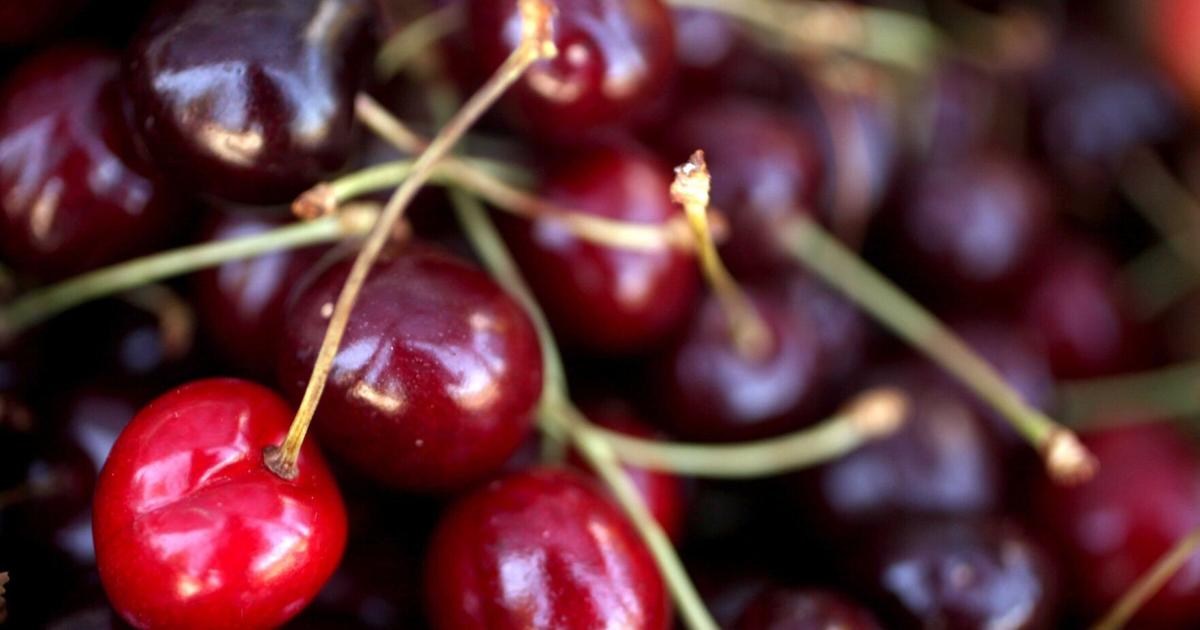
AS A KID EATING BIG, SWEET BING CHERRIES, it occurred to Livia Blackburne that their name sounded Chinese.
The fleeting thought was correct, she learned decades later, when her friend and colleague Julia Kuo came across that detail in a history book.
The book, “The Making of Asian America” by Erika Lee, credited a Chinese orchard foreman named Ah Bing, who worked in Oregon, as the name behind the nation’s most popular cherry. The Bing — firm, heart-shaped, a dark mahogany red — makes up more than half of Washington state’s cherry production, according to Washington State University.
Upon discovering Ah Bing, Bellevue-based illustrator Kuo immediately searched for more details on him. Only scraps of history were available, all almost mystical: Bing was nearly seven feet tall. He was known to sing a mournful song as he worked. At home in China, he had seven adopted sons.
“What a folk tale, just sitting there waiting to be known,” Kuo tells me. She and Blackburne, an author now based in Los Angeles, had collaborated on an earlier children’s book. Kuo suggested they team up again.
Their work came to fruition in “Bing’s Cherries,” (Penguin Random House, $18.99), a new picture book that takes the few known facts of Bing’s life and spins a tall tale around them.
What’s known: Bing came to the U.S. around 1855 and found work with Seth Lewelling at the Lewelling Orchard in Milwaukie, Ore. That would place him in the early wave of Chinese immigration to the West, sparked by the California Gold Rush. By the 1870s, many others were recruited to work on the railroad, in the lumber industry and in canneries, as well as in agriculture.
Lewelling and his brothers are far better documented than their workers in archives and history books. A Milwaukie elementary school is even named for Seth Lewelling. Pioneers of West Coast horticulture, they were also Quakers and anti-slavery abolitionists. Seth Lewelling was known to oppose “the increasing anti-Chinese discrimination and violence of the times,” according to the Milwaukie Museum website. And when a giant new crossbred cherry was deemed a success on Lewelling’s farm, he reportedly named it for Bing, who oversaw the orchard rows where it was grown. The new cherry was bred from the now-heirloom Black Republican and Napoleon varieties.
After Bing traveled to China for a visit, according to the Milwaukie Museum, “he was never able to return to Oregon.” The Chinese Exclusion Act of 1882, which restricted Chinese laborers immigrating to the U.S., apparently prevented his return.
Blackburne and Kuo, both Taiwanese Americans, used that foundation of facts to create a dreamy original fable about a present-day girl who daringly eats cherries on a rooftop, as a young Blackburne once did. She recounts what her father has told her of the fruit’s background.
In this telling, Bing was so tall he created waves while wading on the San Francisco shore. Trees grew taller just so they could listen to his “rich and deep” voice. A single hair from his long traditional queue could build “a comfy home for an entire family of blue jays.” And he protects his workers from what adult readers may understand were anti-Chinese riots of the era targeting immigrant workers.
“We did want to include some of the uglier parts of history, because, you know, that was part of the reality that Bing was living in,” Blackburne says. The folk tale format let them reference that difficult history in a more abstract or symbolic way — “the loneliness, the feeling of not belonging.”
In the book, a tear falls from Bing’s eye — delicate and detailed as a Faberge egg, in Kuo’s illustrations — watering a tree that bears fruit “a red as deep as Bing’s love for his family and friends,” as sweet as his gentle lullabies. Seth Lewelling, as the creators picture the conversation, says “We should call them Bing cherries. Because they’re remarkable, just like you.”
Kuo, who has visited the Milwaukie Museum, says that the more she uncovers about Seth Lewelling the more she sees he was “a very radical” man.
She appreciates that Blackburne communicated his support for immigrant workers who were too often mistreated, “and that this Bing cherry, the staple of the Pacific Northwest, represents someone with ideals that we can appreciate today,” Kuo says. “At one of my book visits, a kid said that Seth was his hero.”
Blackburne, whose family came to the U.S. in the late 20th century, tends to think of Chinese influence on America in recent terms, she writes in the book’s afterward. “Bing’s story reminded me that Chinese Americans have been leaving their mark on this country for far longer.”
And Kuo recalls that growing up, she’d hear stories of Paul Bunyan and Johnny Appleseed at school, then go home to hear tales from ancient Chinese mythology. There was never a place where both existed.
She would have loved to hear Ah Bing’s story in those days. Weaving him into that tapestry seemed one of the best things they could do as picture book authors, an American tall tale with more than a kernel of truth.
Candied Cherries
It’s hard to beat a chilled bowl of fresh Bing cherries, but the season is brief, and fresh cherries don’t keep well. Lengthen their lifespan by turning them into a sweet topping for ice cream sundaes, with this recipe (very lightly adjusted) from dessert king David Lebovitz’s ice cream book, “The Perfect Scoop.” Lebovitz says the candied cherries will keep in the refrigerator for up to 2 weeks.
If you just want the cherries without the syrup (to, for instance, chop and mix into your homemade ice cream when it comes out of the machine), Lebovitz says to drain them in a strainer first for at least an hour.
1 pound fresh sweet cherries, stemmed and pitted
1½ cups water
1 cup sugar
1 tablespoon freshly squeezed lemon juice
1 drop almond extract
Heat pitted cherries, water, sugar and lemon in a large, nonreactive saucepan until the liquid starts to boil. Reduce heat to a low boil and cook for 25 minutes, stirring frequently during the last 10 minutes to make sure the cherries are cooking evenly and not sticking. Once the syrup is reduced to the consistency of maple syrup, remove pan from heat, add almond extract, and let cherries cool in their syrup.
(Recipe from David Lebovitz, “The Perfect Scoop”)
‘ The preceding article may include information circulated by third parties ’
‘ Some details of this article were extracted from the following source www.yakimaherald.com ’