A down-at-heel screenwriter, on the run from dogged repo men trying to requisition his car, pulls up at a dilapidated, apparently vacant Hollywood mansion in order to hide out.
But someone’s at home.There’s a ghostly face in a distant upstairs window, its eyes covered by massive sunglasses. A huge, bald manservant appears in a doorway below, beckoning our hero inside, where the desiccated corpse of his mistress’s pet monkey is about to be laid to rest. Our hero enters tentatively. He’ll never truly leave.
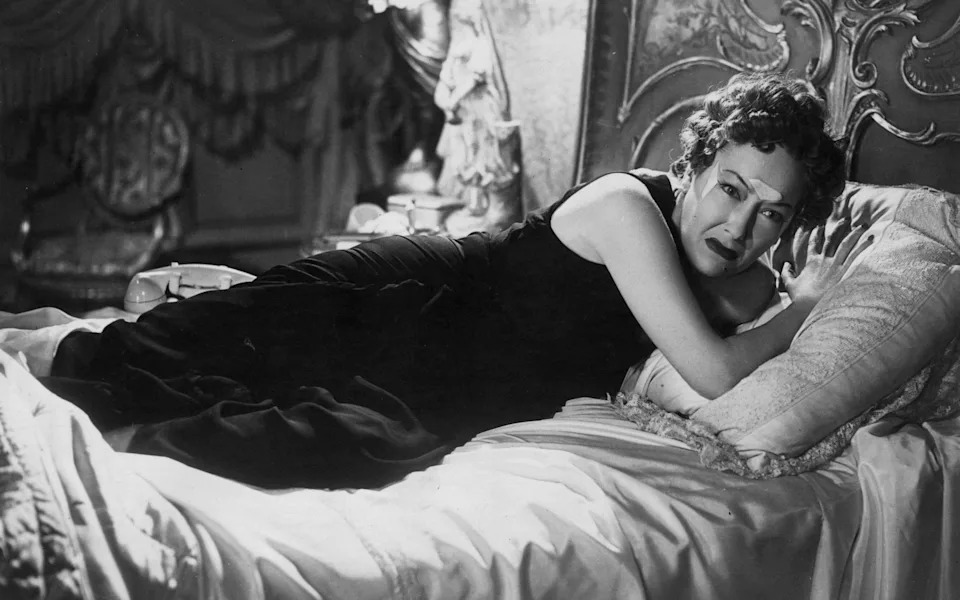
That’s the moment, 15 minutes in, when Sunset Boulevard gets going. The figure glimpsed by Joe Gillis (William Holden) is Gloria Swanson’s Norma Desmond, a fallen star of the silent movie age who, from the confines of her once splendid home, plots a fanciful return to the big screen.
“You’re Norma Desmond,” Gillis says when he first recognises her. “You used to be in silent pictures. You used to be big.”
“I am big,” she famously replies. “It’s the pictures that got small.”
Gloria Swanson plays unhinged Norma Desmond – a role she later tried to reprise on stage – Hulton Archive/Moviepix
After foisting her terrible screenplay on him, Desmond keeps the beleaguered Gillis as a live-in script doctor in the misguided hope that his tenuous connections with the studio system might offer her a chance at redemption. She also falls in love with him, showering him with gifts, restyling his scruffy wardrobe so that he resembles a much older and more debonair leading man, and throwing magnificent parties to which only she and her terrified new lover are invited.
But Gillis himself has fallen in love with Betty (Nancy Olson), a much younger (and newly engaged) budding scriptwriter. The heart of the film is this tragic age-gap love triangle. Imprisoned by Desmond, pursued by the law and infatuated with a soon-to-be-married young woman, things look bleak for our hero – but they’re bleaker yet for Desmond, who’s remaking her ageing body ready for a sensational career finale that is still shocking, 75 years on.
Desmond remains a memorable reference point in pop culture discourse, and Sunset Boulevard’s story lives on, not least in Andrew Lloyd Webber’s musical adaptation, a revival of which starring Nicole Scherzinger has just closed on Broadway. But the film itself is lamentably underseen.
It shouldn’t be. This is one of the most hypnotically entertaining and unremittingly savage depictions of Hollywood ever put on film. Without mercy, without remorse, it exposes the true extent of Tinseltown hypocrisy, venality and egomania – and reveals the absolute horror of being a woman in the movies.

A poster for Billy Wilder’s gloriously contentious drama – Movie Poster Image Art/Moviepix
After the film was shown at a private screening for Hollywood insiders, Louis B Mayer, producer extraordinaire and co-founder of MGM, furiously approached Billy Wilder, its Austrian-born director: “You befouled your own nest. You should be thrown out of this country, tarred and feathered, god damn foreigner son of a b—-!”
“Why don’t you go f— yourself?,” Wilder replied. That’s very much the ethos of the film.
The director had first intended to make a much lighter picture, about a silent movie star making a glorious return to the big screen. But Wilder’s traumatic personal history had made him an inveterate cynic. As a young Jewish man he had been forced out of Nazi-dominated Europe; his mother, grandmother and stepfather stayed and were all murdered in the Holocaust. “The pessimists are in Hollywood and the optimists are in Auschwitz,” Wilder is supposed to have said.
Consequently, his films were often brooding, bitter and nocturnal (dark comedies in every sense). Even Some Like It Hot, perhaps his most famous and insouciant picture, opens with a massacre.

Director Billy Wilder (left) with actors Gloria Swanson and Erich von Stroheim on set – John Kobal Foundation/Moviepix
So the fluffy optimism of first-draft Sunset Boulevard quickly dissipated. Converting the film from a harmless, pro-Hollywood comedy to a satirical nuclear bomb of studio-wrecking magnitude would be a huge challenge, though. Thankfully, Wilder had a plan.
Step one was to pretend, for a long time, that he was making a different project altogether: a lightweight comedy called A Can of Beans.
Step two was to work without a finished screenplay, so that no higher-ups would be able to discover the full extent of the film’s subversive potential. When shooting began in 1949, only a third of the script had been completed and given to the cast and crew.
Step three was to keep what existed of the screenplay as below-the-radar as possible. Its front page began with an ominous note: “This is the first act of Sunset Boulevard. Due to the peculiar nature of the project, we ask all our own coworkers to regard it as top secret.”
Next, Wilder needed to find someone willing to play Desmond. This was a tricky and somewhat offensive proposition. For maximum piquancy, Wilder wanted a real ex-starlet with Desmond’s downward career trajectory and reclusive reputation.

Glora Swanson as Norma Desmond and William Holden as Joe Gillis in Sunset Boulevard’s leading roles – John Springer Collection/Corbis Historical
Hollywood abounded with examples of faded silent movie stars who had inspired the character in the first place, including the psychologically devastated Clara Bow, Mae Murray and especially Norma Talmadge, who had been extraordinarily popular and well-paid in the 1920s, before falling out of the industry, developing an addiction to painkillers and marrying her doctor.
To Wilder, the obvious choice was Greta Garbo, the greatest female icon of the studio era, who had shocked Hollywood by quitting the movies in 1941 and disappearing into blissful obscurity. In 1948 she went to Wilder’s house for a drink and he offered her the part, only to be turned down. Unlike Desmond, Garbo was happy in her newfound privacy; she had not, as the media implied, gone insane.
Approaches to other faded icons of the silent era, including Mae West, Mary Pickford and Pola Negri, were all rejected. Director George Cukor then suggested Gloria Swanson. After first appearing on screen aged only 15, Swanson had become one of United Artists’ most valuable stars, and a favourite of pioneering director Cecil B DeMille, who appears in Sunset Boulevard as himself.
In her heyday, Swanson enjoyed a Desmond-ishly glamorous lifestyle, spending her mammoth contract salary on maximalist outfits often encrusted with jewellery and festooned with ostrich feathers.
But her film career had collapsed after the advent of sound and before Sunset Boulevard she was mostly working in radio and theatre in New York. Her most recent film was nearly 10 years old.
Nevertheless, she did not take Wilder’s offer appreciatively and was especially affronted by the demand that she do a screen test (“I’ve made 20 films for Paramount! Why do they want me to audition?”). Yet Cukor ultimately persuaded her, presciently arguing that Desmond was the role Swanson would be remembered for. (Her subsequent affection for the part led her to try to make a musical adaptation of the film years later, without success.)

William Holden was eventually chosen to play Joe Gillis after a long casting struggle – Silver Screen Collection
William Holden was chosen as the male lead, after another casting struggle. Wilder first wanted Marlon Brando, who had not yet appeared in a single film, while Montgomery Clift allegedly turned the Gillis part down because the story’s central age-gap relationship too closely resembled his own affair with a much older singer.
Ultimately, critics adored its hard-boiled script and stunning photography, while audiences loved seeing Hollywood’s behind-the-scenes melodramas acknowledged and played out on the big screen. Before Sunset Boulevard, these stories had been confined to best-selling gossip magazines, and studios slaved to pretend that stars lived morally unimpeachable existences. Hitherto, the narrative of Tinsel Town was as a place of dreams and aspirations, its dark underbelly conveniently hidden from view. Now the fourth wall had been broken. Hedda Hopper, whose scurrilous columns were read by 35 million people at their height, even makes a cameo as herself.
Sunset Boulevard holds up exceptionally well today, and its influence has been potent and long-lasting. A decade after its release, there were echoes of Gloria Swanson in Bette Davis’s performance as a hysterical former child actor in What Ever Happened to Baby Jane? More recently, Sunset Boulevard had a deranged spiritual successor in The Substance, in which Demi Moore’s isolated former star takes a mysterious serum to hatch a second, younger body, which lives vicariously in Hollywood before turning resentfully on its menopausal parent.
Sunset Boulevard’s lasting insight is not that by reducing women to their appearances, Hollywood dismisses their talents and puts a time limit on their financial lives. Depressingly, we knew that already.
Its critical argument is that by rewarding women for their appearance so stupendously – with magnificent riches, public adoration and global prestige – Hollywood penetrates and wrecks the minds inside its most precious bodies. And when those bodies age even slightly (Swanson was only 53 when she made the film) it tosses them into the wilderness and pretends they didn’t exist.
Swanson’s unique, slightly perverse contribution was to make the wilderness look so fun. It’s an outrageous performance – the theatrical line readings, the Bride of Frankenstein eyebrows, the claws frozen in attack posture as if by premature rigor mortis, cigarette holder fixed on an elevated talon. It’s a glorious pantomime, played on the edge of an abyss.
Sunset Boulevard is available on Amazon Prime and Sky Store
‘ The preceding article may include information circulated by third parties ’
‘ Some details of this article were extracted from the following source www.yahoo.com ’