James Cameron doesn’t just want to show you the internal politics of a hive; he wants to change how you see your own species.
“We are the despicable creatures,” the Academy Award-winning executive producer says of humanity’s impact on the natural world. The comment, made during a recent Q&A for National Geographic’s Secrets of the Bees, got a laugh from the intimate crowd of press — but the philosophy behind it is no joke.
More from Gold Derby
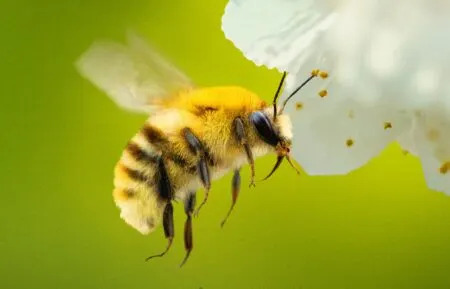
The series, which resists turning nature into a simple story of heroes and villains, instead uses a “bee’s-eye view” to focus on how these vital insects actually behave in the wild. Led by National Geographic Explorer Bertie Gregory, the two-part event explores the extraordinary lives of bees, which are among the planet’s most important animals. Over three years, special cameras opened a rare window into a single hive, revealing a hidden world of astonishing architecture and intelligence.
With more than 20,000 bee species pollinating one-third of the world’s food, Secrets of the Bees pairs Cameron’s storytelling instincts with the expertise of entomologist Dr. Sammy Ramsey to unlock the secrets of a species far more complex than most audiences expect. The series premieres March 31 on Nat Geo and streams April 1 on Disney+ and Hulu.
Watch the full Q&A with James Cameron and Dr. Sammy Ramsey
What surprised even the experts
Even for Ramsey, who has spent his career studying insects, some of what the team captured was completely unexpected.
“One of those huge, jaw-dropping moments for me,” he said, came while watching Asian honeybees fend off an invading hornet — not by brute force, but by outsmarting it using pungent leaves to mask the hornet’s pheromone trail. It was a display of strategic adaptation that scientists had never documented on film before.
Up until now, that behavior had only been theorized or glimpsed in still images. “This is the first time that’s ever been shown on video,” Ramsey said.
Cameron, naturally, couldn’t resist putting it in more cinematic terms. As Ramsey described the showdown, the filmmaker joked that it played out less like a nature doc and more like “a giant bitch fight,” comparing it to “Sigourney Weaver versus the alien queen.”
Moments like that are what drew Cameron to the project in the first place — not just what science already knows, but what it’s still discovering.
“There’s two levels to ‘secrets,’” Cameron explained. “There’s the secrets that science knows that the public doesn’t know — and then there are a few secrets that the bees have managed to keep from science until this exact project.”
And while the series doesn’t get lost in the weeds, it does highlight just how surprising these creatures can be. At one point, Ramsey pointed to bees’ ability to pass along information within a hive — something that still catches people off guard.
“To be able to see bumblebees teach each other — how is that not the coolest thing in the world?” he said.
The $150,000 lens (and how they got the shot)
Of course, capturing behavior no one has ever seen before requires more than patience — it takes some seriously cutting-edge filmmaking.
At one point during production, Ramsey recalled being handed a massive piece of equipment on set.
“They’re like, ‘Could you hold this for a second?’” Ramsey said. “Don’t worry, it’s only $150,000.”
Moments like that underscored the level of precision — and investment — behind the series. But when it came to filming inside the hive, the approach was entirely different.
The team built custom environments that allowed bees to behave naturally while tiny lenses — including medical-grade endoscopic cameras — captured their world from inches away.
The result is what Cameron describes as something closer to stepping into the bees’ perspective.
“We’re trying to be in the bees’ point of view and observe their behavior,” he said.
For Cameron, that process blurs the line between filmmaking and research.
“When you wind up with hundreds of thousands of hours of observation of certain species, you learn things,” he said. “The sharing of the story becomes a form of science itself.”
No shortcuts in the storytelling
That commitment to observation extends to how the story itself is told.
“We can’t just make up stories,” Cameron said. “We can’t anthropomorphize this or project ourselves onto it.”
Instead of forcing a narrative onto the natural world, the series leans into what’s actually happening — even when it challenges human assumptions.
“We’re all just trying to do the same thing,” Cameron added — comparing humans with every other animal species. “Get by, feed our kids, and keep a reasonably peaceful society going.”
Why it matters (and why people will care)
For both Cameron and Ramsey, the challenge isn’t just documenting the natural world—it’s getting audiences to connect with it.
“You won’t protect what you don’t love,” Cameron said. “And you’re not going to love what you don’t understand.”
That’s why Secrets of the Bees leans into storytelling—not to sensationalize the science, but to make it accessible.
“There are problems, but we can fix them,” Ramsey said, emphasizing the importance of striking a balance between urgency and hope by addressing the “Three Ps” of bee decline: Parasites, Pesticides, and Poor nutrition. Instead of overwhelming audiences, the goal is to leave them with something more tangible.
“You’ve got to give people a challenge,” Cameron said. “Give them something actionable that makes them feel that they have agency.” Or, as he put it more simply, the takeaway is bigger than bees.
“We’re like bees,” Cameron said. “We collectively make a difference.”
And if Secrets of the Bees does its job, audiences might start seeing them — and themselves — a little differently.
Best of Gold Derby
Sign up for Gold Derby’s Newsletter. For the latest news, follow us on Facebook, Twitter, and Instagram.
‘ The preceding article may include information circulated by third parties ’
‘ Some details of this article were extracted from the following source www.yahoo.com ’