Truth is often complex and hard to hold. But truth held with integrity can be healing, even when painful.
Such was the subtle joy that the New York dance company A.I.M. by Kyle Abraham brought to the Bay Area for its remarkable Cal Performances debut.
A rare kind of freedom permeated UC Berkeley’s Zellerbach Hall on Saturday, Feb. 21, as Abraham took to the stage at curtain and offered his thanks during a standing ovation. His nine-member company had just finished dancing to a spectacular live performance of legendary jazz drummer Max Roach’s “We Insist! – Freedom Now” suite as reinterpreted by Grammy-winning composer Robert Glasper.
Nothing about this call to freedom, or the way Abraham’s liquid dancers embodied it, was simple.
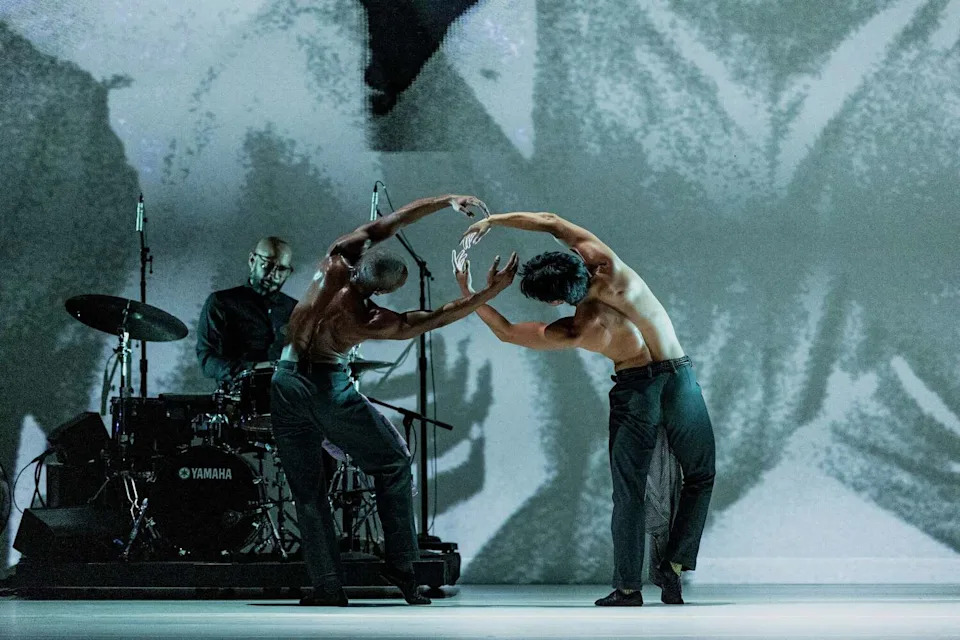
Roach’s music, released in 1960, was a response to sit-ins at the segregated lunch counters in North Carolina, and to apartheid in South Africa. That history resonated anew Saturday as vocalist Charenee Wade, singing live onstage, let her voice fray into a near scream while Abraham’s dance “The Gettin'” incorporated video of Eric Garner’s 2014 killing at the hands of white New York City police officers. “The Gettin'” makes clear that the fight against segregation and white supremacy persists – a reality that has only become more glaringly relevant in the nearly 12 years since its creation. Yet what lingered just as powerfully as strife was tenderness.
Stunning intimacy suffused the music and the dancing of this two-hour show, giving even this longtime Abraham fan a sensation of rediscovery.
Jamaal Bowman, left, and William Okajima in “The Gettin.'” (Alexander Diaz)
The Pittsburgh-raised choreographer has been no stranger to the Bay Area since his 2012 work “Pavement,” loosely based on the 1991 movie “Boyz n the Hood,” introduced a movement style melding hip-hop and club influences into a nuanced, loose-limbed postmodernism. During Abraham’s rise to becoming a MacArthur “genius” fellow, he became in demand at companies as far-flung as England’s Royal Ballet and brought his 20-year-old troupe to our region three times.
What unfolded Saturday, the first of two performances in Berkeley over the weekend, underscored a striking paradox. Here was a choreographer who knows how to command vast spaces – in 2024, Abraham even filled Manhattan’s mammoth Park Avenue Armory – and now that he was finally getting the huge Bay Area venue he deserves, he was making the evening one of deepest intimacy.
This was keenly felt in 2021’s “If We Were a Love Song.” Singer Crystal Monee Hall joined the world-class band onstage for this one, singing tunes associated with Nina Simone, shooting long arcs of sound across the auditorium.

Niya Smith in “The Gettin'” (Alexander Diaz)
Abraham has the wisdom to let the music hold its own at times – certainly no listener could want for pleasure with Luther S. Allison on piano and Otis Brown III on drums. But oh what beauty when Jayden Williams strutted on for “Keeper of the Flame,” arms moving through semaphores that seemed to merge flamenco, voguing and classical Indian forms.
It was also hard to resist leaning in when Suzy Mondesir lowered her head to the floor for “Little Girl Blue,” dancing most of it in some variation of a backbend that seemed to melt into a fetal coil.
The golden lighting, by Dan Scully, felt like candle glow, turning dancers Alysia Johnson and Niya Smith into bird-like silhouettes for “Don’t Explain,” and casting warmth on William Okajima’s rippling torso for “Wild Is the Wind.”
Faith Joy Mondesire had the final solo with “Images,” during which Hall sang a cappella: “She thinks her brown body has no glory.” It’s a story left without triumphant resolution, as the final line tells us that “dishwater gives back no image.” The vulnerability could not have been more perfectly channeled than through the lament of Hall’s voice and the honesty of Mondesire’s presence.

A.I.M by Kyle Abraham’s “2×4.” (Alexander Diaz)
The most recent work on this program, 2025’s “2 x 4,” felt like a curtain-warmer, but in the most delightful way. Two baritone saxophonists, Guy Dellacave and Thomas Giles, stood at opposite corners of the stage with their bleating instruments, calling to one another like whales sounding the depths as they played Shelley Washington’s spectacularly syncopated composition. In between these two veritable foghorns, the four dancers referenced in the title gallivanted between balletic jumps and funny little jives.
Mykiah Goree constantly commanded the eye with his superhumanly flexible back. The mercurial geometric formations ended with him sweetly holding Johnson’s hand.
An unguarded willingness to connect was the throughline of the evening. Clearly, a love story between Cal Performances and A.I.M. has just begun.
Rachel Howard is a freelance writer.
This article originally published at In Cal Performances debut, Kyle Abraham proves big stages can hold deep intimacy.
‘ The preceding article may include information circulated by third parties ’
‘ Some details of this article were extracted from the following source www.yahoo.com ’