An increasing number of Bollywood stars are calling for an end to the use of live elephants in films, saying CGI and robotic alternatives can now recreate the animals without cruelty.
Actors and filmmakers such as John Abraham, Shriya Saran, Richa Chadha, Farah Khan, Dia Mirza, and Pooja Bhatt are supporting a Peta India campaign seeking an end to the use of live elephants in movies, television series, and advertisements.
The campaign promotes the use of computer-generated imagery, visual effects, and life-sized robotic elephants in place of captive animals. According to Peta India, 24 film and production companies have already signed its “Elephant Freedom Pledge” launched in June 2025.
Peta told The Independent that it began contacting film and content companies last year to highlight the treatment of captive elephants used in entertainment, including claims that they were separated from their families, kept chained for long periods, and controlled using weapons.
“Films should be fun for everyone, elephants included,” Abraham argued. “Elephants shouldn’t suffer for our entertainment. With today’s technology, we can bring elephants to life beautifully through CGI and mechanical artistry, without confinement or cruelty.”
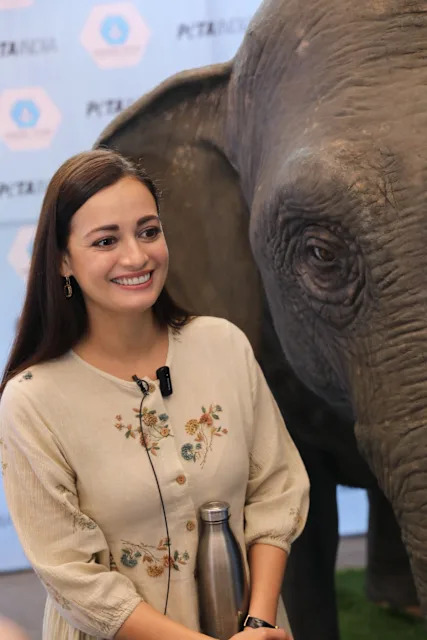
Actors Dia Mirza is among Bollywood stars supporting a Peta India campaign urging filmmakers and production houses to stop using live elephants in films, television projects, and advertisements (Peta India)
Actor and filmmaker Pooja Bhatt said: “Good cinema requires empathy, to know how someone else is feeling to be able to act it on screen. But empathy must extend beyond the frame. Elephants and other animals endure psychological and physical trauma when forced to perform. We can tell wonderful stories on screen without exploiting animals.”
Elephants have long held a distinctive place in Indian cinema. The tuskers were most notably featured in the 1971 blockbuster Haathi Mere Saathi, which followed the relationship between a man and four elephants.
Peta India says elephants used for entertainment are kept almost constantly chained (Peta India)
The use of elephants in films is regulated by the Animal Welfare Board. In a 2021 advisory, the board urged film producers, advertisers, and streaming platforms to prioritise using CGI, visual effects, and animatronics over live animals, saying the move would help prevent “unnecessary pain and suffering”.
It added that animals used in entertainment were often transported long distances to film sets, exposed to crowds, bright lights, and chaotic conditions, and even forced to perform actions that were unnatural to their behaviour.
According to India’s environment ministry, there are more than 2,600 captive elephants in the country, many of which Peta India says are used for tourism, entertainment, and temple ceremonies. Depending on the location, availability, and permissions, the elephants are “rented” for shoots when needed.
Peta India says elephants used in entertainment are forced to stand on hard concrete floors, leading to lifelong foot and musculoskeletal problems like arthritis (Peta India)
Peta India pointed to Richie Mehta’s Malayalam crime drama miniseries Poacher, which premiered in 2024 and was centred on an ivory-poaching ring in India, as well as films like Tanhaji (2020) and Krrish (2006) as productions that used CGI imagery and visual effects for elephant sequences.
Some filmmakers, however, continue to favour live animals over CGI. The makers of forthcoming Malayalam film Kattalan said earlier this year they had consciously chosen to use real elephants because “genuine visuals and organic performances create a deeper cinematic impact”.
Actor Raj Tirandasu, who appears in the film, described filming alongside real elephants as “honestly scary at times”. “One small mistake and things could have gone completely wrong,” he told ETimes in May.
‘ The preceding article may include information circulated by third parties ’
‘ Some details of this article were extracted from the following source www.aol.com ’