Liminal spaces are having a moment. Something about going nowhere fast is striking a nerve in the culture. This dread is at the heart of It Ends, a distressing new film about four young friends who discover a shortcut through the woods that turns out to be seemingly infinite. They keep moving. There’s no way out or back, the car never runs out of gas, and for some reason they don’t get hungry anymore. They just keep on keeping on.
The movie’s premise of being stuck neither here nor there has many who’ve caught early screenings comparing It Ends to the blockbuster lo-fi thriller Backrooms, about a labyrinth of antiseptic and unsettlingly bland spaces. Scary stories often tap into collective anxieties, and the pervasive sense of being hopelessly stuck no matter what you do is gnawing at people in real life these days, especially those in Gen Z, who are just starting off on their own.
“It Ends is through the POV of kids that are inheriting the world right now,” says writer-director Ali Ullom, now 28. “One of the core emotions of the liminal space is something’s off, something’s wrong. We have rejected nature. The thing that’s behind the veil is actually just the fucking corporate boardroom. Kids right now, they’re inheriting a burning house. The similarities are the fact that there is an obsession with ‘What the fuck is this all heading to? Where’s this going?’ ”
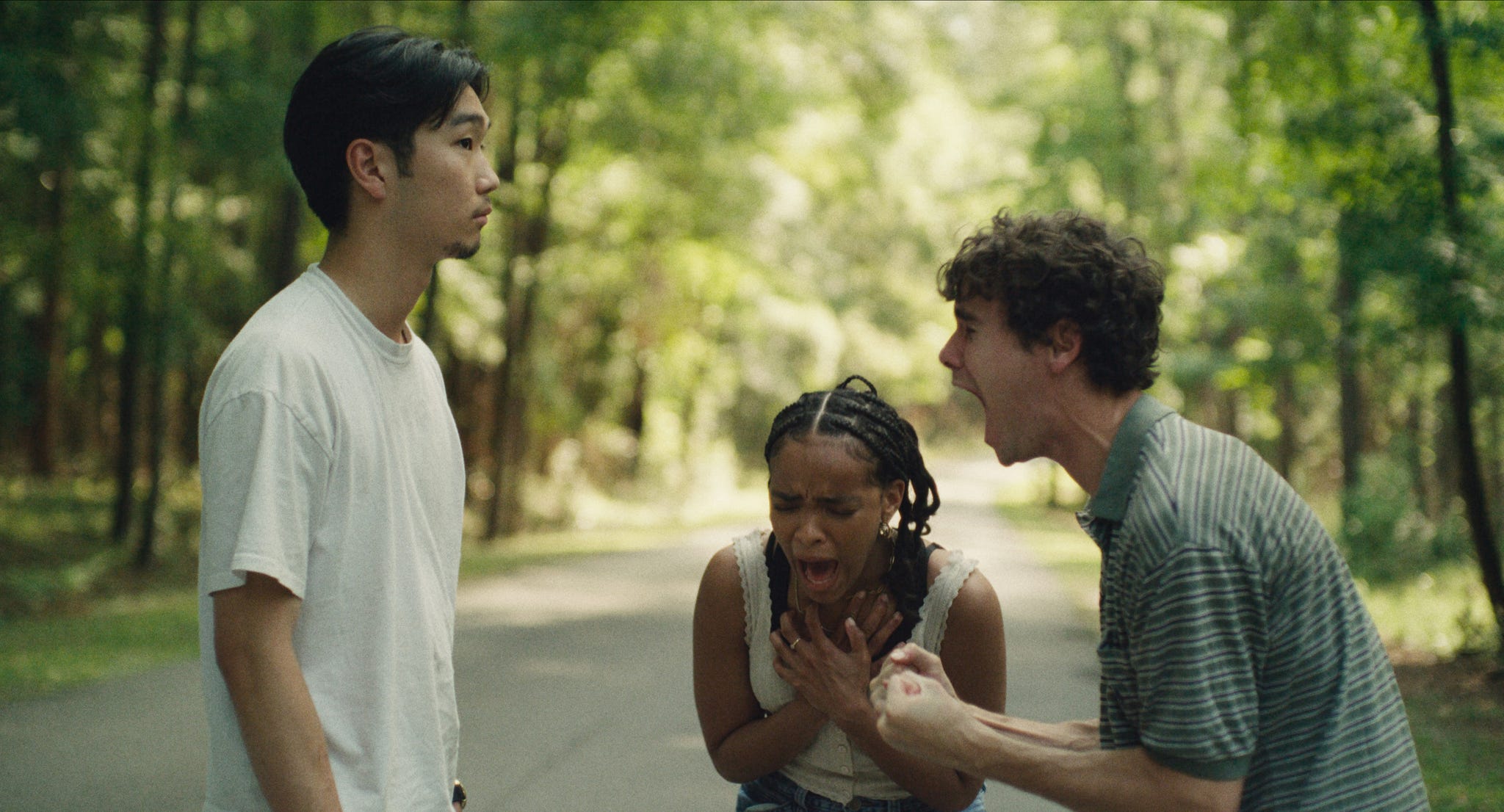
It Ends seeks to tap into that unrest. If the characters stop their Jeep Cherokee, a horde of other lost souls swarms out from the trees in a mindless rage. So they can only pause for a few minutes before rushing forward again. Are they in a time loop? Is it hell? A curse? Something surreal has definitely overtaken them, but all that the four friends know for sure is that they have each other—combative Tyler (played by Mitchell Cole), kindhearted Day (Akira Jackson), anxious Fisher (Noah Toth), and puzzle-solving James (Phinehas Yoon).
Ullom wrote It Ends when he was 20, just before he entered the liminal space of his own career. He edited videos for Nickelodeon and other companies while also working on commercials as he navigated toward the long-term goal of making big-screen features. Ullom finally reached his destination: It Ends became a sensation at SXSW, racked up a 100 percent fresh rating on Rotten Tomatoes that held for months, and was acquired for release on August 21 by Neon, the distributor behind Longlegs and Best Picture winners Parasite and Anora.
A first trailer for It Ends is coming in the days ahead, but for this exclusive first look at its imagery, Ullom spoke with Esquire about his generation’s angst about the future and how he turned it into an engine of fear.

The film’s central crew includes Tyler (played by Mitchell Cole), kindhearted Day (Akira Jackson), anxious Fisher (Noah Toth), and puzzle-solving James (Phinehas Yoon).
ESQUIRE: So many people are describing It Ends as a horror film. Do you think of it that way?
Alex Ullom: I don’t really see it as that. I don’t really see it as a horror film. I feel like if you just take any characters and put them into a life-or-death scenario, it becomes horror because of the inflated emotions. Is real life a horror film? I don’t know. They’re on an endless road.
It felt like a philosophical exercise to me, and I wondered if that’s what you intended.
Oh, for sure. I’m a huge Terrence Malick and Richard Linklater fan, and I always pitched it very early on as if Linklater made a horror movie. He’s one of my heroes.

Day (Akira Jackson) screams into the woods.
I’m further down the road than these characters, but I remember what that was like, starting out in life and wondering: What’s going to happen to me? The movie felt very metaphorical in that way.
No, it’s incredibly symbolic. I was pretty much just trying to articulate it. It’s weird because I got to grow up while making this movie, since we reshot it twice, essentially. All for absolutely no money, which was part of the reason we had to reshoot it. I fucked it up the first time.
How do you think you grew up during the production?
It’s almost like I started in a place that was very instinctual: Here’s what I wanted to try and say. And then as I got older, I was like, “Oh, this is what my younger self was actually trying to articulate about the world.” So, yeah, feel free to project as much as you like. It’s one of those movies that allow that.

If the characters stop their Jeep Cherokee, a horde of other lost souls swarms out from the trees in a mindless rage.
Have you heard a lot of different interpretations of It Ends from festival audiences?
Oh, yeah. I’ve heard crazy, crazy stuff. It’s one of my favorite parts of it, too. This is essentially the same thing James is doing in the whole movie. He’s like, “What does this mean?” It ends up being whatever you want.
What was the origin of the story for you?
I wish it was more poetic, but I just saw a picture of some headlights on a road at night when I was 19. The biggest thing that shaped it was, when I was 18, I had a pretty crazy depression. As I entered adulthood, there was this feeling of “Oh, this mundanity and flatlining is just what the rest of life is.” The driving thing for me was this decision to keep living and keep going and just eventually … that was it.
Without giving away spoilers, what do the four people stuck together on this infinite road represent to you?
All of these characters are different reactions to what happens when there is no answer to the horror that you get put through.

James (Phinehas Yoon) checks the rear.
This would’ve been a fascinating film for my existentialism philosophy class when I was in college. We were talking about Kierkegaard and Nietzsche and these explorations of why we are here. Do those ideas interest you?
Absolutely. Right when I was coming out of my depressive period, at age 18, I dove into every Western/European philosopher post-1940. All the absurdists. A lot of people do compare [the movie] to Sartre. There’s a lot of Nietzsche in there too, but when I was 20 and writing it, I was not pulling from those places. I was just pulling from my own void. It seems to be a pretty common human experience. All these guys have written about it.
There have been a lot of comparisons between your film and Backrooms, from Kane Parsons, another filmmaker from your generation. Do you see any connections between the appeal of a movie like that and something like It Ends?
Yeah, I do. Absolutely. Kane’s a good friend of mine. I love Backrooms. And I wrote it when I was a kid too. Kane still beats me out. Kane was 16 doing that stuff. He’s a beast.

Alex Ullom wrote It Ends when he was 20, just before he entered the liminal space of his own career. He edited videos for Nickelodeon and other companies while also working on commercials.
The distress you’re both tapping into—that sense of “I don’t want to get stuck in a rut; I don’t want to conform”—is something every generation confronts, isn’t it? The lost generation delved into that. Baby boomers pushed back with the ’60s counterculture, Gen X had Reality Bites and the fear of being a sellout.
I agree. I would maybe say that the difference now is that people actually would love to have that corporate structure. It’s funny, there are a lot of horror movies where they drive through a forest to get to where the horror happens—and this one doesn’t even get to that location. The idea of, like, “Oh, I don’t want to be a robot with my suburban house and a kid and my nine-to-five…” A lot of Gen Z kids would kill for the stability and structure of that.
Instead, they have…?
There is nothing. Now it’s just you’re just moving forward. That’s pretty much all the stability you have now.
‘ The preceding article may include information circulated by third parties ’
‘ Some details of this article were extracted from the following source www.esquire.com ’